原田英語の時事英語ジュニア|英語ニュース ワークシート(中学生レベル)
Class ____ No. ____ Name ____________________
地球の核(中心の金属)から水素がもれている?火山の溶岩に残る手がかり
Is Hydrogen Escaping From Earth's Core?
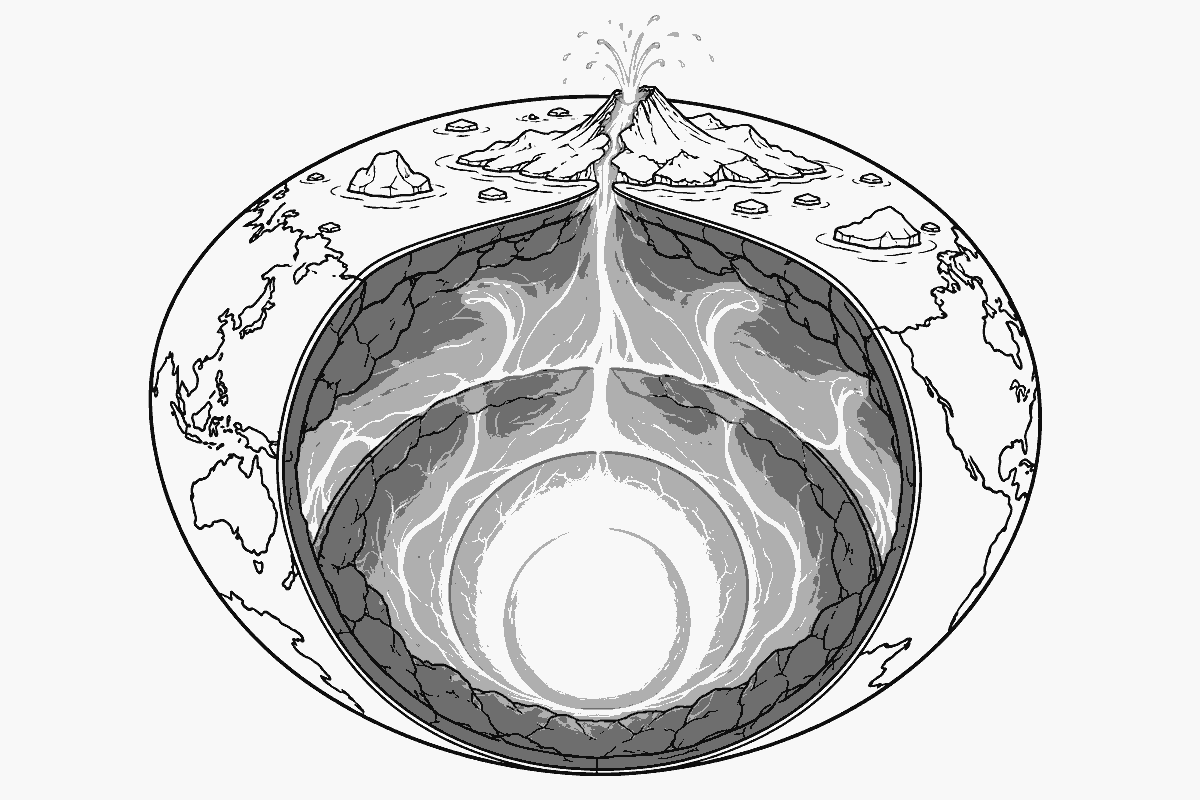
1Hydrogen from Earth's center may be reaching the surface in lava, a study says. Scientists in China studied clues about the core, the metal ball at Earth's center. They think hydrogen may have moved out of the core during most of Earth's history.
2The core starts about 2,900 kilometers below the surface. It is made mostly of iron and nickel. No one can go there or study it directly. Above the core is a thick layer of hot rock called the mantle.
3Some lava from Iceland and Baffin Island in Canada has very little heavy hydrogen. Heavy hydrogen weighs more than normal hydrogen. Scientists have argued about the reason for this.
4The team used computers to study early Earth and its ocean of melted rock. The results showed that this ocean could not make lava with so little heavy hydrogen. So the team says the hydrogen more likely came from the core. Some of this lava also has a higher share of rare helium-3 than most rocks.
Words 単語
| surfaceB1 | 名 | 表面、地面the top or outside part of something |
| metalA2 | 名 | 金属a hard material like iron or gold |
| directlyB1 | 副 | 直接にwith nothing or no one in between |
| layerB1 | 名 | 層one flat part lying on top of another |
| arguedA2 | 動 | 議論した、言い争ったtalked about something with different ideas |
| resultsA1 | 名 | 結果what you find out at the end |
| likelyA2 | 副 | たぶん、おそらくprobably, with a good chance |
| rareB1 | 形 | めずらしいnot seen or found very often |
単語のレベル:CEFR-J(『CEFR-J Wordlist Version 1.6』 東京外国語大学投野由紀夫研究室. (URL: https://www.cefr-j.org/download.html より 2026年8月ダウンロード))
1. Reading Quiz 本文の内容に合うものを選ぼう
What is the core mostly made of?
A. Water and iceB. Iron and nickelC. Sand and stoneD. Gold and silver
Where does some lava have very little heavy hydrogen?
A. Japan and HawaiiB. Iceland and Baffin IslandC. China and IndiaD. The moon
How did the team study early Earth?
A. By going to the coreB. By digging a deep holeC. By using computersD. By asking people
Where does the team think the hydrogen more likely came from?
A. From the coreB. From the seaC. From the sunD. From the air
2. True or False 正しければ T、違っていれば F
( ) People can go to the core and study it directly.
( ) The mantle is a thick layer of hot rock above the core.
( ) Heavy hydrogen weighs less than normal hydrogen.
( ) In some of the lava, the share of helium-3 is higher than in most rocks.
3. Fill in the Blanks 下の語から選んで空らんをうめよう(形を変えずに)
directlyarguedmetallayersurfaceresults
No one can go there or study it _____.
The _____ showed that this ocean could not make lava with so little heavy hydrogen.
Above the core is a thick _____ of hot rock called the mantle.
Scientists in China studied clues about the core, the _____ ball at Earth's center.
Scientists have _____ about the reason for this.
Hydrogen from Earth's center may be reaching the _____ in lava, a study says.
4. Word Order 語を並べかえて正しい文にしよう
( of / mostly / nickel / iron / is / It / and / made ) .
( No / it / study / can / one / directly / there / or / go ) .
( this / Scientists / about / for / the / have / reason / argued ) .
5. Think and Write 英語で答えてみよう
If you could travel to the center of Earth, what would you want to see?(もし地球の中心まで旅ができたら、何を見てみたいですか。)
Why do you think scientists use computers to study places they cannot visit?(科学者が、行けない場所を調べるのにコンピューターを使うのはなぜだと思いますか。)
Answers 解答
1. (1) B (2) B (3) C (4) A
2. (1) F (2) T (3) F (4) T
3. (1) directly (2) results (3) layer (4) metal (5) argued (6) surface
4.
- It is made mostly of iron and nickel.
- No one can go there or study it directly.
- Scientists have argued about the reason for this.
全文訳
1地球の中心の水素が、溶岩にまじって地上までとどいているかもしれないと、ある研究が発表しました。中国の科学者たちが、地球の中心にある金属のかたまり「核」の手がかりを調べました。地球の歴史のほとんどのあいだ、核から水素が外へ出てきたのかもしれないと、科学者たちは考えています。
2核は、地面から約2,900キロメートル下から始まります。核はおもに鉄とニッケルでできています。だれもそこへ行けず、直接調べることもできません。核の上には、マントルとよばれる、熱い岩の厚い層があります。
3アイスランドとカナダのバフィン島の溶岩の中には、重い水素がとても少ないものがあります。重い水素は、ふつうの水素より重さがあります。そのわけについて、科学者たちは議論してきました。
4研究チームはコンピューターを使って、大昔の地球と、そのころのとけた岩の海について調べました。その結果、この海では、重い水素がこんなに少ない溶岩はできないことがわかりました。そこでチームは、その水素は核から来たと考えるほうが合うと言っています。この溶岩の中には、めずらしい「ヘリウム3」の割合が、ほかの多くの岩より高いものもあります。
文法ポイント:受け身 be made of ~(~でできている)
be動詞 + made of ~で「~でできている」。本文の It is made mostly of iron and nickel. は「核はおもに鉄とニッケルでできている」。mostly(おもに)が間に入っている。
出典:Science Advances(Crossref の論文情報)、ScienceAlert、National Geographic Education、USGS(アメリカ地質調査所)、Quanta Magazine、Carleton University(The Conversation より)、Scientific American ほか(記事は原田英語の時事英語ジュニアのオリジナル)|https://www.haradaeigo.com/jijieigo-junior/news/2026-10-20-earth-core-leaking-gases/