原田英語の時事英語ジュニア|英語ニュース ワークシート(高校生レベル)
Class ____ No. ____ Name ____________________
オルガノイドとは?脳の細胞の小さなかたまりで点字を読み取る実験、最高83%正解
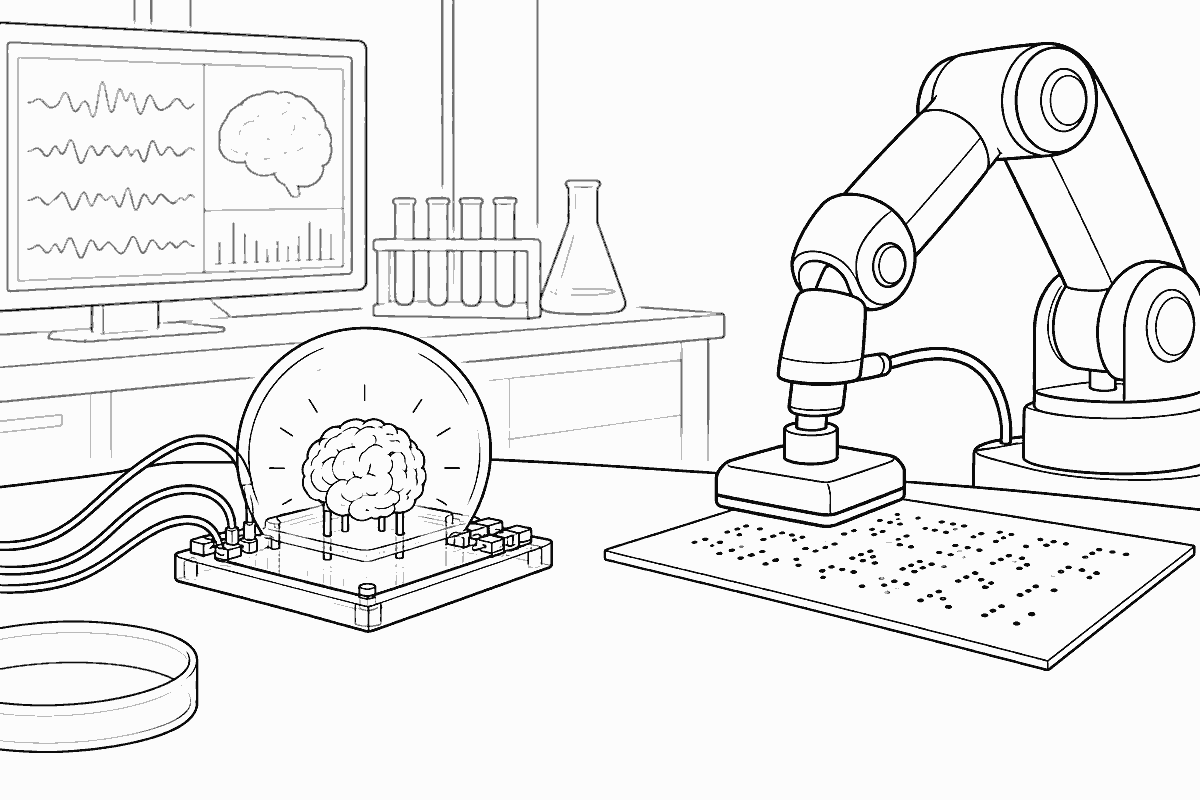
Lab-Grown Brain Cells Help a Computer Read Braille
1Researchers at the University of Bristol in Britain have used lab-grown clusters of human brain cells to help identify braille letters. Their best setup got the right letter about 83 percent of the time. The study was published on Oct. 16 in the journal Frontiers in Artificial Intelligence.
2The clusters, known as brain organoids, are smaller than a millimeter. Each one contains about 10,000 neurons, along with cells that support them. The organoids were provided by FinalSpark, a company that offers them for research.
3To create the signals, a robot arm slid a touch sensor across braille letters made with a 3D printer. The sensor recorded data for all 26 letters of the braille alphabet. The researchers turned the data into patterns of electrical pulses, which they delivered to each organoid through eight tiny electrodes. A basic program that learns from data then analyzed the electrical activity of the organoids and tried to tell which letter they had received.
4A single organoid gave a signal that the program decoded correctly about 61 percent of the time. When the responses of three organoids were combined, the accuracy rose to about 83 percent. The team also tested the system with added noise. In those tests, the three organoids held up better than a method that read the noisy signals directly, without organoids.
5Without noise, however, that direct method was about as accurate, at 82 percent. The researchers said they do not yet know why three organoids did better than one. They also said the study did not show that the organoids learned or changed over time.
6The human brain uses very little power for the amount of work it does. The researchers see biohybrid computing, which combines living cells with machines, as a possible way to build computers that use less power. Next, the researchers plan to test textures, edges and other kinds of touch.
Words 単語
| identifyB2 | 動 | 見分ける、特定するto find out what something is |
| clusters外 | 名 | かたまり、集まりsmall groups of things close together |
| containsB1 | 動 | ふくむhas something inside it |
| recordedA2 | 動 | 記録したkept information so it can be used later |
| deliveredB1 | 動 | 届けた、送ったtook something to a person or place |
| analyzedB1 | 動 | 分析したlooked at something carefully to understand it |
| accuracyB1 | 名 | 正確さ、正答率how often something is correct |
| noiseA1 | 名 | ノイズ、じゃまな雑音unwanted sound or signals that make things unclear |
| textures外 | 名 | 手ざわり、質感how the top of something feels when you touch it |
| combinesB1 | 動 | 組み合わせるputs two or more things together |
単語のレベル:CEFR-J(『CEFR-J Wordlist Version 1.6』 東京外国語大学投野由紀夫研究室. (URL: https://www.cefr-j.org/download.html より 2026年8月ダウンロード))
1. Reading Quiz 本文の内容に合うものを選ぼう
Where are the researchers from?
A. The University of BristolB. A hospital in the U.S.C. A company in JapanD. A school for the blind
How was the touch data collected?
A. People touched the letters with their fingers.B. A camera took photos of the letters.C. A robot arm slid a touch sensor across braille letters.D. The organoids touched the letters.
How many electrodes were used for each organoid?
A. ThreeB. EightC. 26D. 10,000
What happened when noise was added?
A. The organoids stopped working.B. The direct method did better than the organoids.C. The program could not read any letters.D. The three organoids held up better than the direct method.
What did the study NOT show?
A. That the organoids learned or changed over timeB. That three organoids did better than oneC. That a program could decode the signalsD. That the organoids reacted to electrical pulses
2. True or False 正しければ T、違っていれば F
( ) Without noise, the direct method was much less accurate than the three organoids.
( ) The researchers know why three organoids did better than one.
( ) The sensor recorded data for all 26 letters of the braille alphabet.
( ) The researchers plan to test other kinds of touch next.
3. Fill in the Blanks 下の語から選んで空らんをうめよう(形を変えずに)
clustersanalyzeddeliveredcontainsidentifyrecorded
Researchers at the University of Bristol in Britain have used lab-grown clusters of human brain cells to help _____ braille letters.
Each one _____ about 10,000 neurons, along with cells that support them.
The _____, known as brain organoids, are smaller than a millimeter.
The researchers turned the data into patterns of electrical pulses, which they _____ to each organoid through eight tiny electrodes.
The sensor _____ data for all 26 letters of the braille alphabet.
A basic program that learns from data then _____ the electrical activity of the organoids and tried to tell which letter they had received.
4. Word Order 語を並べかえて正しい文にしよう
( system / the / added / tested / also / noise / with / The / team ) .
( known / millimeter / than / clusters, / brain / a / organoids, / as / The / are / smaller ) .
( 26 / The / recorded / alphabet / data / letters / for / of / braille / the / sensor / all ) .
5. Think and Write 英語で答えてみよう
Do you think it is a good idea to build computers with living human cells? Why or why not?(生きた人の細胞を使ってコンピューターを作るのはよい考えだと思いますか。理由も答えましょう。)
Computers and AI use a lot of electricity. How could we make them use less energy?(コンピューターやAIはたくさんの電気を使います。どうすれば使うエネルギーを減らせると思いますか。)
Answers 解答
1. (1) A (2) C (3) B (4) D (5) A
2. (1) F (2) F (3) T (4) T
3. (1) identify (2) contains (3) clusters (4) delivered (5) recorded (6) analyzed
4.
- The team also tested the system with added noise.
- The clusters, known as brain organoids, are smaller than a millimeter.
- The sensor recorded data for all 26 letters of the braille alphabet.
全文訳
1イギリスのブリストル大学の研究者たちが、研究室で育てた人の脳の細胞のかたまりを使って、点字の文字を見分ける実験をしました。いちばんよいやり方では、約83%の確率で正しい文字がわかりました。この研究は10月16日、学術誌『フロンティアーズ・イン・アーティフィシャル・インテリジェンス』に発表されました。
2このかたまりは「脳オルガノイド」とよばれ、大きさは1ミリより小さいです。1つに約1万個のニューロン(神経細胞)と、それを支える細胞がふくまれています。オルガノイドは、研究用にそれを提供している会社「ファイナルスパーク」から提供されました。
3信号を作るために、ロボットのうでが、3Dプリンターで作った点字の文字の上で、さわった感じをはかるセンサーをすべらせました。センサーは、点字のアルファベット26文字すべてのデータを記録しました。研究者たちはそのデータを電気のパルス(短い電気の波)のパターンに変え、8本の小さな電極を通して、それぞれのオルガノイドに送りました。次に、データから学ぶかんたんなプログラムがオルガノイドの電気の活動を分析し、どの文字を受け取ったのかを当てようとしました。
4オルガノイド1つの場合、プログラムが信号を正しく読み解けたのは約61%でした。3つのオルガノイドの反応を合わせると、正答率は約83%に上がりました。チームは、信号にノイズ(じゃまな雑音)を加えたテストも行いました。そのテストでは、3つのオルガノイドを使ったほうが、オルガノイドなしでノイズ入りの信号をそのまま読む方法よりも、正答率が下がりにくくなりました。
5ただし、ノイズがないときは、その「そのまま読む」方法も82%と、ほぼ同じくらい正確でした。研究者たちは、なぜ3つのほうが1つよりよい結果になったのかは、まだわからないと話しています。また、この研究では、オルガノイドが学習したり、時間とともに変化したりすることは示されていないとも話しています。
6人の脳は、こなす仕事の量にくらべて、とても少ない電力しか使いません。研究者たちは、生きた細胞と機械を組み合わせる「バイオハイブリッド・コンピューティング」を、電力をあまり使わないコンピューターを作る方法の1つになりうると考えています。次に研究者たちは、表面の手ざわりやふち(かど)など、ほかの種類の「さわる感覚」を試す予定です。
文法ポイント:関係代名詞の非制限用法(, which ~)
コンマのあとの which が、前の名詞に説明を足す。本文の patterns of electrical pulses, which they delivered to each organoid は「電気のパルスのパターン、そしてそれをそれぞれのオルガノイドに送った」。biohybrid computing, which combines living cells with machines も同じ形。入試の長文で頻出。
出典:Frontiers in Artificial Intelligence、Frontiers(学術誌の出版社)、Tech Xplore ほか(記事は原田英語の時事英語ジュニアのオリジナル)|https://www.haradaeigo.com/jijieigo-junior/news/2026-10-18-mini-brains-read-braille/