原田英語の時事英語ジュニア|英語ニュース ワークシート(中学生レベル)
Class ____ No. ____ Name ____________________
オルガノイドとは?脳の細胞の小さなかたまりで点字を読み取る実験、最高83%正解
Brain Cells Help Read Braille
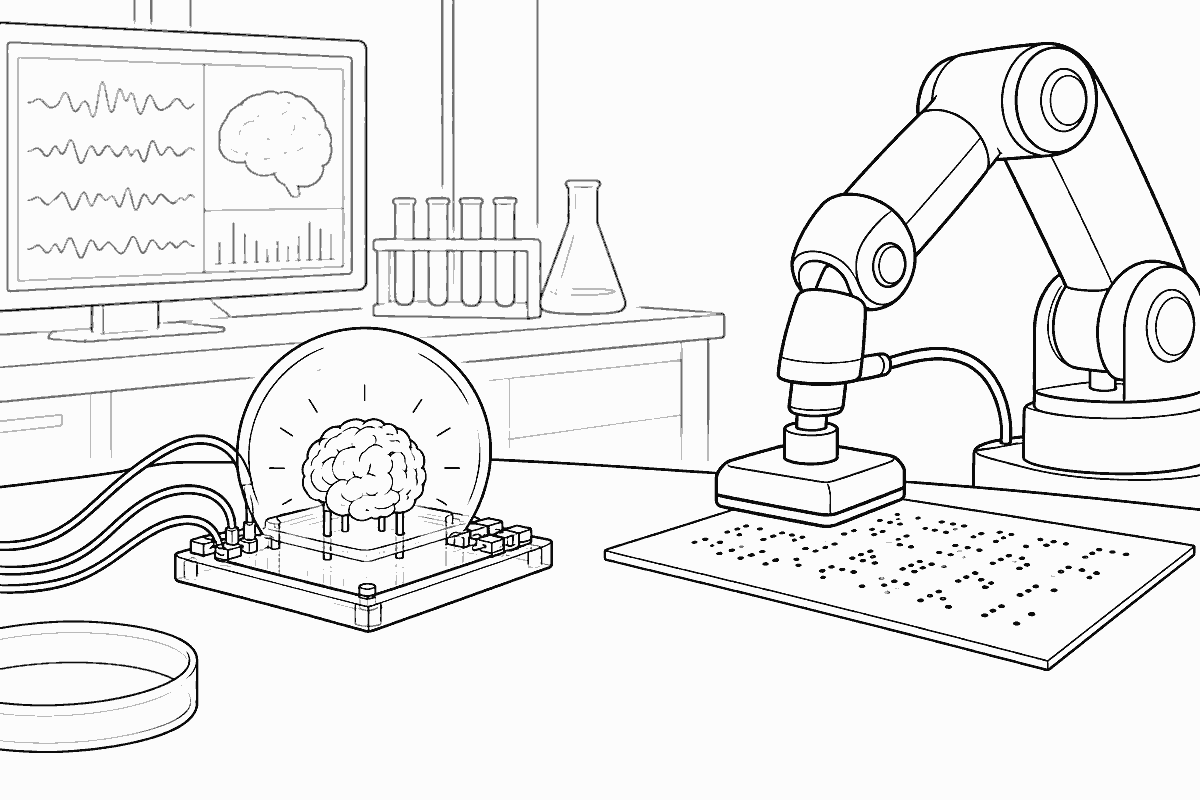
1Scientists in Britain have used tiny balls of human brain cells to help read braille. Braille is a writing system of raised dots that people read with their fingers. The study came out on Oct. 16.
2The tiny balls are called organoids. Each one is smaller than one millimeter. It has about 10,000 brain cells called neurons. The organoids were grown in a lab.
3First, a robot arm moved a touch sensor over all 26 braille letters. The team changed this touch data into electrical signals. They sent the signals to the organoids. Then a computer program studied how the organoids reacted and guessed each letter.
4With one organoid, the program was right about 61 percent of the time. With three organoids together, it was right about 83 percent of the time. The human brain uses very little energy for the work it does. The researchers see this kind of work as one way to build computers that use less energy.
Words 単語
| tinyB1 | 形 | とても小さいvery, very small |
| cellsB1 | 名 | 細胞the very small parts that make up living things |
| raisedA2 | 形 | もり上がったhigher than the flat part around it |
| sensor外 | 名 | センサーa device that notices touch, light or heat |
| electricalB1 | 形 | 電気のusing the power that runs lights and machines |
| reactedB1 | 動 | 反応したdid something because something else happened |
| percentB1 | 名 | パーセントa part of one hundred |
| energyB2 | 名 | エネルギーpower that makes machines work |
単語のレベル:CEFR-J(『CEFR-J Wordlist Version 1.6』 東京外国語大学投野由紀夫研究室. (URL: https://www.cefr-j.org/download.html より 2026年8月ダウンロード))
1. Reading Quiz 本文の内容に合うものを選ぼう
What are organoids?
A. Robot armsB. Tiny balls of brain cellsC. Braille lettersD. Computer programs
How big is each organoid?
A. Smaller than one millimeterB. About 10 centimetersC. As big as a handD. About one meter
What did the team send to the organoids?
A. FoodB. LightC. MusicD. Electrical signals
How often was the program right with three organoids?
A. About 26 percent of the timeB. About 61 percent of the timeC. About 83 percent of the timeD. Every time
2. True or False 正しければ T、違っていれば F
( ) Each organoid has about 10,000 neurons.
( ) The organoids were taken from a person's head.
( ) One organoid did better than three organoids together.
( ) A robot arm moved a touch sensor over braille letters.
3. Fill in the Blanks 下の語から選んで空らんをうめよう(形を変えずに)
raisedelectricalcellsreactedtinysensor
First, a robot arm moved a touch _____ over all 26 braille letters.
Then a computer program studied how the organoids _____ and guessed each letter.
It has about 10,000 brain _____ called neurons.
Scientists in Britain have used _____ balls of human brain cells to help read braille.
Braille is a writing system of _____ dots that people read with their fingers.
The team changed this touch data into _____ signals.
4. Word Order 語を並べかえて正しい文にしよう
( tiny / organoids / The / called / are / balls ) .
( organoids / signals / They / the / the / to / sent ) .
( this / changed / data / team / touch / The / signals / into / electrical ) .
5. Think and Write 英語で答えてみよう
What would you like a computer made with brain cells to do?(脳の細胞を使ったコンピューターに、何をしてほしいですか。)
How do you use your sense of touch every day?(あなたは毎日、さわる感覚をどんなふうに使っていますか。)
Answers 解答
1. (1) B (2) A (3) D (4) C
2. (1) T (2) F (3) F (4) T
3. (1) sensor (2) reacted (3) cells (4) tiny (5) raised (6) electrical
4.
- The tiny balls are called organoids.
- They sent the signals to the organoids.
- The team changed this touch data into electrical signals.
全文訳
1イギリスの科学者が、人の脳の細胞でできた小さなかたまりを使って、点字を読み取る実験をしました。点字は、もり上がった点でできた文字で、指でさわって読みます。この研究は10月16日に発表されました。
2この小さなかたまりは「オルガノイド」とよばれます。1つの大きさは1ミリより小さいです。その中に、ニューロンとよばれる脳の細胞が約1万個あります。オルガノイドは研究室で育てられました。
3まず、ロボットのうでが、さわったことを感じるセンサーを、点字の26文字すべての上で動かしました。チームは、この手ざわりのデータを電気の信号に変えました。そして、その信号をオルガノイドに送りました。次に、コンピューターのプログラムがオルガノイドの反応を調べて、どの文字かを当てました。
4オルガノイドが1つのとき、プログラムが正しく当てたのは約61%でした。オルガノイド3つをいっしょに使うと、約83%で正しく当てました。人の脳は、たくさんの仕事をするのに、とても少ないエネルギーしか使いません。研究者たちは、こうした研究を、エネルギーをあまり使わないコンピューターを作る方法の1つと考えています。
文法ポイント:受け身(be動詞 + 過去分詞)
「~される」を表す。本文の The organoids were grown in a lab.(オルガノイドは研究室で育てられた)や The tiny balls are called organoids.(その小さなかたまりはオルガノイドとよばれる)がその例。grow の過去分詞は grown。
出典:Frontiers in Artificial Intelligence、Frontiers(学術誌の出版社)、Tech Xplore ほか(記事は原田英語の時事英語ジュニアのオリジナル)|https://www.haradaeigo.com/jijieigo-junior/news/2026-10-18-mini-brains-read-braille/