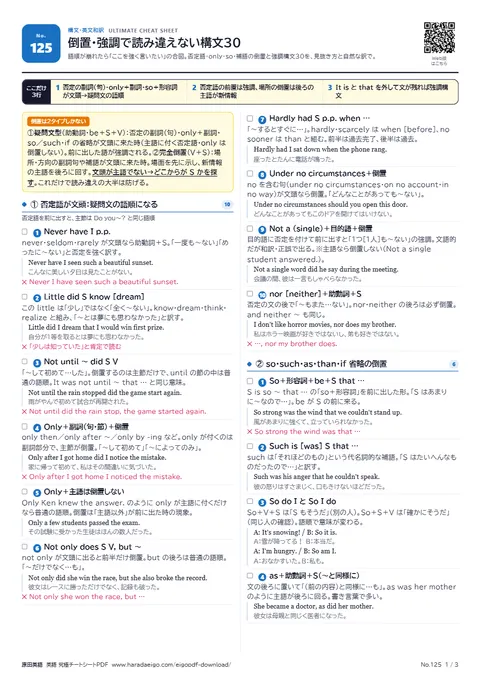
まずはこの3つ
- 否定の副詞(句)・only+副詞・so+形容詞が文頭→疑問文の語順
- 否定語の前置は強調、場所の倒置は後ろの主語が新情報
- It is と that を外して文が残れば強調構文
倒置は2タイプしかない
①疑問文型(助動詞・be+S+V):否定の副詞(句)・only+副詞・so/such・if の省略が文頭に来た時(主語に付く否定語・only は倒置しない)。前に出した語が強調される。②完全倒置(V+S):場所・方向の副詞句や補語が文頭に来た時。場面を先に示し、新情報の主語を後ろに回す。文頭が主語でない→どこからが S かを探す。これだけで読み違えの大半は防げる。
1否定語が文頭:疑問文の語順になる10
否定語を前に出すと、主節は Do you〜? と同じ語順
- 1Never have I p.p.never・seldom・rarely が文頭なら助動詞+S。「一度も〜ない」「めったに〜ない」と否定を強く訳す。Never have I seen such a beautiful sunset.こんなに美しい夕日は見たことがない。✕Never I have seen such a beautiful sunset.
- 2Little did S know [dream]この little は「少し」ではなく「全く〜ない」。know・dream・think・realize と組み、「〜とは夢にも思わなかった」と訳す。Little did I dream that I would win first prize.自分が1等を取るとは夢にも思わなかった。✕「少しは知っていた」と肯定で読む
- 3Not until 〜 did S V「〜して初めて…した」。倒置するのは主節だけで、until の節の中は普通の語順。It was not until 〜 that … と同じ意味。Not until the rain stopped did the game start again.雨がやんで初めて試合が再開された。✕Not until did the rain stop, the game started again.
- 4Only+副詞(句・節)+倒置only then/only after 〜/only by -ing など。only が付くのは副詞部分で、主節が倒置。「〜して初めて」「〜によってのみ」。Only after I got home did I notice the mistake.家に帰って初めて、私はその間違いに気づいた。✕Only after I got home I noticed the mistake.
- 5Only+主語は倒置しないOnly Ken knew the answer. のように only が主語に付くだけなら普通の語順。倒置は「主語以外」が前に出た時の現象。Only a few students passed the exam.その試験に受かった生徒はほんの数人だった。
- 6Not only does S V, but 〜not only が文頭に出ると前半だけ倒置。but の後ろは普通の語順。「〜だけでなく…も」。Not only did she win the race, but she also broke the record.彼女はレースに勝っただけでなく、記録も破った。✕Not only she won the race, but …
- 7Hardly had S p.p. when …「〜するとすぐに…」。hardly・scarcely は when [before]、no sooner は than と組む。前半は過去完了、後半は過去。Hardly had I sat down when the phone rang.座ったとたんに電話が鳴った。
- 8Under no circumstances+倒置no を含む句(under no circumstances・on no account・in no way)が文頭なら倒置。「どんなことがあっても〜ない」。Under no circumstances should you open this door.どんなことがあってもこのドアを開けてはいけない。
- 9Not a (single)+目的語+倒置目的語に否定を付けて前に出すと「1つ[1人]も〜ない」の強調。文語的だが和訳・正誤で出る。※主語なら倒置しない(Not a single student answered.)。Not a single word did he say during the meeting.会議の間、彼は一言もしゃべらなかった。
- 10nor [neither]+助動詞+S否定の文の後で「〜もまた…ない」。nor・neither の後ろは必ず倒置。and neither 〜 も同じ。I don't like horror movies, nor does my brother.私はホラー映画が好きではないし、弟も好きではない。✕…, nor my brother does.
2so・such・as・than・if 省略の倒置6
- 1So+形容詞+be+S that …S is so 〜 that … の「so+形容詞」を前に出した形。「S はあまりに〜なので…」。be が S の前に来る。So strong was the wind that we couldn't stand up.風があまりに強くて、立っていられなかった。✕So strong the wind was that …
- 2Such is [was] S that …such は「それほどのもの」という代名詞的な補語。「S はたいへんなものだったので…」と訳す。Such was his anger that he couldn't speak.彼の怒りはすさまじく、口もきけないほどだった。
- 3So do I と So I doSo+V+S は「S もそうだ」(別の人)。So+S+V は「確かにそうだ」(同じ人の確認)。語順で意味が変わる。A: It's snowing! / B: So it is.A:雪が降ってる! B:本当だ。A: I'm hungry. / B: So am I.A:おなかすいた。B:私も。
- 4as+助動詞+S(〜と同様に)文の後ろに置いて「(前の内容)と同様に…も」。as was her mother のように主語が後ろに回る。書き言葉で多い。She became a doctor, as did her mother.彼女は母親と同じく医者になった。
- 5than+助動詞+S比較の than の後ろで、主語が長いと倒置することがある(任意)。than do people 〜 の do は代動詞。City dwellers walk more than do people in rural areas.都会に住む人は、地方に住む人よりよく歩く。
- 6Had [Were/Should] S 〜仮定法の if を省くと助動詞・be が前に出る。文頭の Had・Were・Should を見たら「もし〜」。Had I known the truth, I would have told you.真実を知っていたら、君に話していただろう。✕Had I known を疑問文と読む(後ろに ? がない)
3完全倒置:V+S の語順6
長い主語を文末に回し、新しい情報を最後に置く
- 1場所の副詞句+V+SOn the hill stands 〜 のように場所が先、主語が後ろ。動詞は stand・lie・sit・live・come など存在・移動の自動詞。On top of the hill stands an old castle.丘の上には古い城が建っている。✕the hill を主語と読む(前置詞の後ろの名詞は主語になれない)
- 2Here comes 〜/There goes 〜here・there+V+名詞。主語が代名詞なら倒置しない(Here it comes.)。新情報の名詞だけが後ろに回る。Here comes the bus.ほら、バスが来た。Here it comes.ほら、来たよ。✕Here comes it.
- 3方向の副詞+V+SOut came 〜/Down came 〜 のように方向の副詞が先。物語文で場面を生き生きと描く。訳は普通の語順でよい。The clouds cleared, and out came the sun.雲が晴れて、太陽が顔を出した。
- 4補語の倒置 C+V+SGone are the days when 〜(〜の時代は過ぎ去った)が定番。形容詞・分詞が文頭で be が続けば、主語は後ろ。Gone are the days when we had to write letters by hand.手紙を手で書かなければならなかった時代は過ぎ去った。
- 5分詞句の前置Included in the price is 〜(料金に含まれているのは〜)など。be の後ろが本当の主語。動詞の単複は後ろの主語に合わせる。Included in the price are breakfast and dinner.料金には朝食と夕食が含まれている。✕Included in the price is breakfast and dinner.
- 6目的語の前置は倒置しないThat I can't promise. のように目的語を前に出しても S+V の順は変わらない(話題化)。前の名詞を主語と取らない。That I can't promise.それは約束できない。What he said I don't remember.彼が何と言ったかは覚えていない。
4強調構文 It is A that 〜6
「〜なのは A だ」と、A を後ろに回して訳す
- 1基本と見分け方It is と that を外し、A を元の位置に戻して文が完全なら強調構文。そうならなければ形式主語の It(It is true that 〜)。人なら that の代わりに who も可。It was Ken that [who] broke the window.窓を割ったのはケンだった。✕It is important that 〜 を強調構文と読む(It is+形容詞+that は形式主語が基本)
- 2It is not A but B that 〜「〜なのは A ではなく B だ」。It is B, not A, that 〜 の形もある。主張は B。It is not talent but effort that matters most.いちばん大切なのは才能ではなく努力だ。
- 3副詞(句・節)の強調時・場所・理由も強調できる。理由の節は because のみで、since・as は強調構文に入れない。It was because of the heavy rain that the game was canceled.試合が中止になったのは大雨のせいだった。
- 4疑問詞+is it that 〜?疑問詞を強調構文で前に出した形。「いったい何が[誰が]〜なのか」。間接疑問なら what it is that 〜 の語順。What is it that you really want?君が本当に欲しいのはいったい何なの?I wonder what it was that made her so angry.彼女をあんなに怒らせたのはいったい何だったのだろう。
- 5It is only when 〜 that …「〜して初めて…」。only の付いた副詞節を強調した形。Only when 〜 do S V の倒置と同じ意味。It is only when we lose our health that we realize its value.健康を失って初めて、私たちはそのありがたさに気づく。
- 6It was not until 〜 that …「〜して初めて…した」。not until 〜 を強調した形で、和訳の定番。詳しくは「難解構文がストンと落ちる解説20」。It was not until I lived abroad that I understood my own culture.海外に住んで初めて、自分の国の文化がわかった。
5語順を変えない強調2
- 1do [does/did]+原形動詞の前に do を置いて「本当に〜する」。相手の疑いを打ち消す場面で使う。訳は「確かに」「本当に」。I did lock the door. I'm sure of it.ドアには確かに鍵をかけた。間違いない。
- 2on earth/the very/at all疑問詞+on earth [in the world]=いったい、the very+名詞=まさにその、not 〜 at all [in the least]=全く〜ない。What on earth are you doing?いったい何をしているの?This is the very book I was looking for.これこそ私が探していた本だ。
倒置の型 早見表
| 文頭に来るもの | 後ろの語順 | 例 |
|---|---|---|
| 否定語・only+副詞 | 助動詞+S+V | Never have I 〜/Only then did I 〜 |
| so+形容詞/such | be [助動詞]+S | So hot was it that 〜 |
| if 省略 | Had/Were/Should+S | Had I known, 〜 |
| 場所・方向の副詞句 | V+S | Here comes the bus. |
| 補語・分詞 | be+S | Gone are the days 〜 |
| 目的語 | S+V(倒置しない) | That I can't promise. |
正誤・和訳で狙われる所6
- ✕Only then I understood what she meant.○Only then did I understand what she meant.only+副詞が文頭→主節は疑問文の語順
- ✕Not until he came home he noticed it.○Not until he came home did he notice it.倒置は主節。until 節の中はそのまま
- ✕Here comes he.○Here he comes.主語が代名詞なら倒置しない
- ✕Little did he know=彼は少し知っていた○彼は全く知らなかった文頭の little は強い否定
- ✕Among the guests was two famous actors.○Among the guests were two famous actors.動詞は後ろの本当の主語 actors に一致
- ✕It was since he was ill that he was absent.○It was because he was ill that he was absent.理由の強調構文は because のみ
和訳のコツ:強調は「語順」で出す
倒置・強調構文は、強調された語を日本語でも目立つ位置に置くと点になる。Never have I 〜 は「一度も〜したことがない」、It is A that 〜 は「〜なのは A だ」。完全倒置(On the hill stands 〜)は強調よりも「新情報を後ろに」が目的なので、「丘の上には〜が建っている」と普通の語順で訳してよい。
確認テスト
- 1Never such a delicious meal.正解は have I eaten。否定語が文頭→have+S+p.p.
- 2Only by working hard succeed.正解は can you。only+副詞句→主節を倒置
- 3So difficult that nobody could solve it.正解は was the problem。So+形容詞が文頭→be+S
- 4A: I don't eat meat. / B: I.正解は Neither do。否定の同意は Neither+V+S
- 5It was in this room the treaty was signed.正解は that。It was と that を消すと文が完全→強調構文
- 6Gone the days when we had no smartphones.正解は are。主語は後ろの the days(複数)
- 7I known about the party, I would have come.正解は Had。If I had known の if を省略して倒置
- 8Little that he was being watched.正解は did he know。文頭の little=全く〜ない→倒置
倒置・強調の構文を一覧にまとめ、A4 3枚で印刷できる無料PDFにしました。Web版は赤シート・覚えたチェック・カード・4択テストつき。