


 宇宙・NASAホント
宇宙の年齢「138億歳」はどうやって測った?出生届のない宇宙の年齢当て
 2026.10.02
 English Corner(A2〜B2・4択クイズ)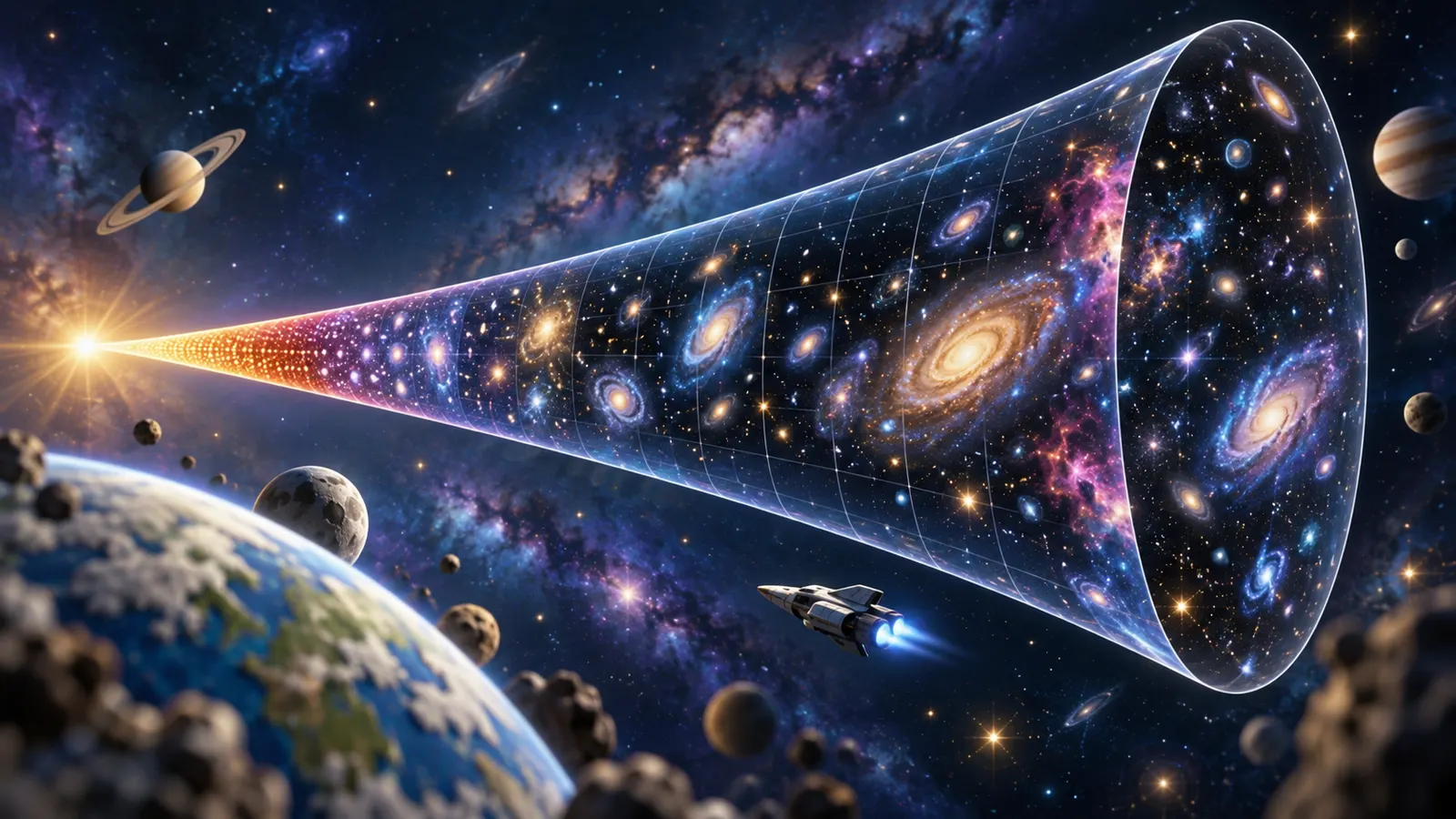
 読む前に予想してみよう!
宇宙の年齢は、いちばん古い星の年齢より若いと計算されている
最も古い星は約120〜130億歳と推定され、宇宙の年齢約138億年と矛盾しない。
 研究カード(どんな研究?)
- 対象
- 宇宙全体
- 規模
- 全天の宇宙背景放射の観測
- 研究の種類
- 観測と宇宙論モデルの組み合わせ
- 確かさ
- ★★★★★
宇宙の年齢約138億年は、宇宙の膨張の速さと中身を、ビッグバンの「残り光」から精密に測って計算した値。古い星の年齢とも矛盾しない。
ひとことで言うと宇宙のふくらむ速さを逆回しして、年齢を計算した!
人の年齢は、出生届を見れば分かります。木の年齢は、年輪を数えれば分かります。では、宇宙の年齢は?
教科書には「約138億年」と書いてあります。でも、宇宙には出生届も年輪もありません。いったいどうやって、こんな数字を出したのでしょう。
01宇宙は「ふくらんでいる」
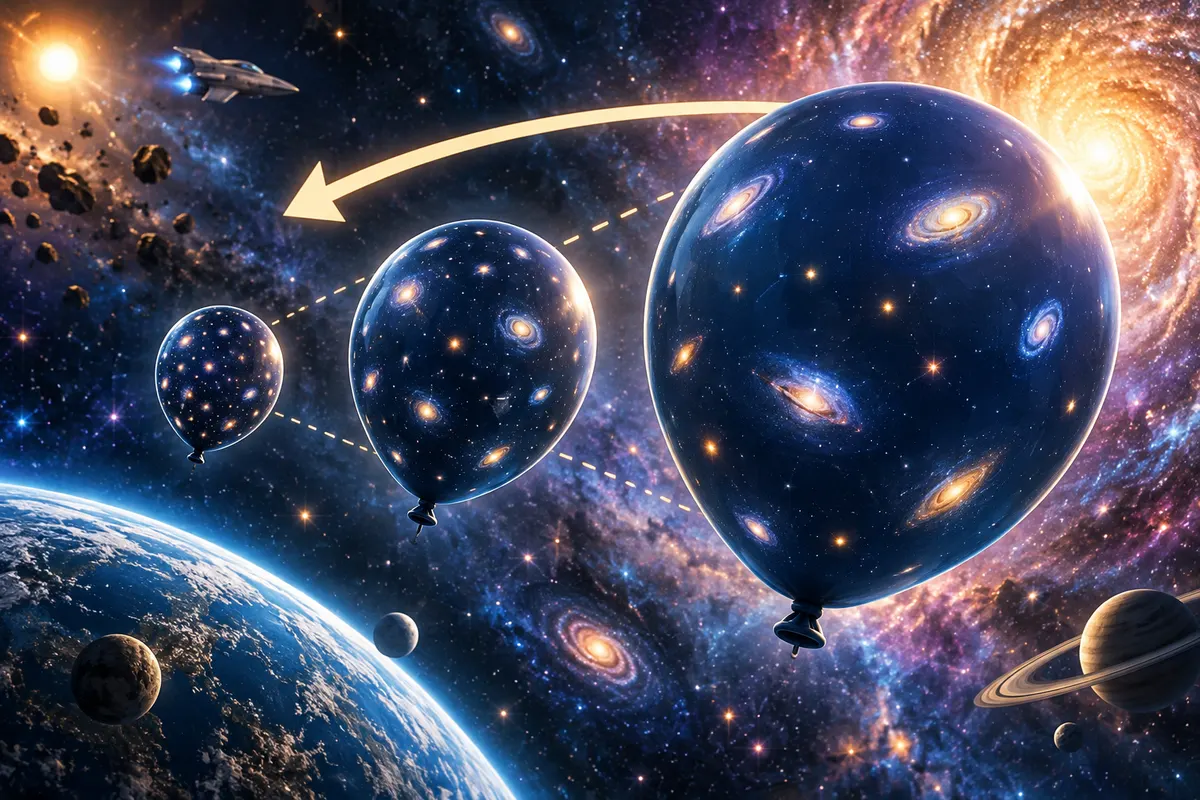
1929年、アメリカの天文学者エドウィン・ハッブルさんは、遠くの銀河ほど速いスピードで私たちから遠ざかっていることを報告しました。これが、宇宙そのものが膨張していることの証拠になりました。
膨張しているなら、時間を逆回しすれば、昔の宇宙はもっと小さかったはず。どんどんさかのぼると、宇宙全体がとても熱く、ぎゅっと詰まっていた時期にたどり着きます。それがビッグバンです。
02年齢を決める2つの材料
逆回しで年齢を計算するには、2つのことを知る必要があります。
- 今、宇宙がどれくらいの速さで膨張しているか(ハッブル定数)
- 宇宙が何でできているか(ふつうの物質、暗黒物質、暗黒エネルギーの割合)
中身が分かると、膨張がこれまでにどう速くなったり遅くなったりしてきたかが計算できます。車で言えば、出発地点からの距離と今のスピード、途中のアクセルやブレーキの踏み方が分かれば、出発した時刻を逆算できるのと似ています。
03カギは「ビッグバンの残り光」
04古い星との「年齢チェック」
もう一つの確かめ方が、いちばん古い星の年齢です。銀河のまわりにある球状星団の星などは、約120〜130億歳と推定されています。
宇宙より年上の星があったら困りますが、計算は矛盾していません。まったく別の方法で出した数字がかみ合うことが、138億年という答えの信頼性を高めています。
05でも、まだ謎が残っている
実は、膨張の速さ(ハッブル定数)には大きな謎があります。
- ビッグバンの残り光から計算すると:1メガパーセクあたり毎秒約67〜68km
- 近くの銀河の星(明るさが規則的に変わる星)や超新星で直接測ると:毎秒約70〜76km
数字は、約326万光年(1メガパーセク)遠くなるごとに、銀河が遠ざかる速さが毎秒何km増えるかを表します。
このズレは「ハッブル・テンション(ハッブル定数の食い違い)」と呼ばれています。原因はまだ決着しておらず、測定の誤差なのか、宇宙の理解に足りない部分があるのかを、多くの研究者が調べています。
06宇宙の「年齢」と「大きさ」は別もの
宇宙の年齢が138億年だからといって、見える宇宙の果てが138億光年先というわけではありません。光が旅している間にも宇宙は膨張し続けているため、いちばん遠い場所は今、約460億光年先にあると計算されています。
07まとめ
宇宙の年齢は、膨張を逆回しする計算と、ビッグバンの残り光の精密観測、そして古い星の年齢チェックで決められていました。
それでも「膨張の速さ」の謎は解けていません。138億年という答えの先に、まだ新しい物理が隠れているかもしれないのです。
この研究を英語で読もう原田英語の English CornerScientists say the universe is about 13.8 billion years old, but there is no birth certificate for the… 音声
音声 4択クイズ9問A2・B1・B2タップして開く
原田英語の English Corner
この研究を英語で読もう
How old is the universe? Scientists say it is about 13.8 billion years old.
But how do they know? The universe is getting bigger. If we run time backward, everything was once packed close together. That was the Big Bang.
Scientists study the old light left from the Big Bang. It tells them how fast the universe grows and what is in it. The oldest stars are a little younger, so the answer makes sense.
75 words ・ CEFR A2
和訳を見る
宇宙は何歳でしょうか。科学者たちは、約138億歳だと言います。
でも、どうやってわかるのでしょうか。宇宙はだんだん大きくなっています。時間を逆に戻すと、すべてがかつてぎゅっと詰まっていたことになります。それがビッグバンでした。
科学者たちは、ビッグバンから残った古い光を調べます。その光は、宇宙がどれくらいの速さで大きくなっているか、宇宙に何があるかを教えてくれます。最も古い星は少しだけ若いので、この答えはつじつまが合います。
4択リーディングクイズ
Q1. What is the passage mainly about?
宇宙の年齢をどうやって知ったかが主題なので A。
Q2. How old is the universe, according to scientists?
it is about 13.8 billion years old とあるので C。
Q3. In the passage, "makes sense" means the answer ...
make sense は「意味が通る、つじつまが合う」。星が宇宙より少し若いので矛盾がない、という文脈なので D。
Scientists say the universe is about 13.8 billion years old, but there is no birth certificate for the universe. So how did they find out? In 1929, Edwin Hubble reported that distant galaxies are moving away from us, which showed that the universe is expanding. If we run this expansion backward, everything was once packed together, at the Big Bang.
To calculate the age, scientists need to know how fast the universe is expanding now and what it is made of. The Planck satellite measured tiny patterns in the afterglow of the Big Bang very precisely. Its final results gave an age of about 13.787 billion years. The oldest stars, which are about 12 to 13 billion years old, agree with this.
122 words ・ CEFR B1
和訳を見る
科学者たちは宇宙が約138億歳だと言いますが、宇宙に出生届はありません。では、どうやってわかったのでしょうか。1929年、エドウィン・ハッブルは、遠くの銀河が私たちから遠ざかっていることを報告し、これは宇宙が膨張していることを示しました。この膨張を逆回しすると、すべてはかつてビッグバンの時点で一か所に詰めこまれていたことになります。
年齢を計算するには、宇宙が今どれくらいの速さで膨張しているか、そして何でできているかを知る必要があります。プランク衛星は、ビッグバンの残り光にあるわずかな模様をとても精密に測りました。その最終結果では、年齢は約137億8,700万年となりました。約120〜130億歳である最も古い星も、これと矛盾しません。
4択リーディングクイズ
Q1. What did Edwin Hubble's discovery show?
distant galaxies are moving away from us, which showed that the universe is expanding とあるので B。
Q2. What two things do scientists need to know to calculate the age?
how fast the universe is expanding now and what it is made of とあるので C。
Q3. Why does the writer mention the oldest stars?
最古の星(約120〜130億歳)が宇宙の年齢と agree with this(一致する)と述べ、計算の妥当性を確かめるために挙げているので A。
The universe has no birth certificate, yet astronomers state that it is about 13.8 billion years old. The reasoning begins with Edwin Hubble's 1929 observation that more distant galaxies recede from us faster, evidence that space itself is expanding. Running this expansion backward leads back to the Big Bang, when everything was packed together.
Estimating the elapsed time, however, requires two ingredients, the current expansion rate, known as the Hubble constant, and the composition of the universe, which determines how the expansion has sped up or slowed down. The key data come from the cosmic microwave background, light released about 380,000 years after the Big Bang. By mapping its tiny fluctuations across the whole sky, the European Space Agency's Planck mission derived an age of about 13.787 billion years, with an uncertainty of roughly 20 million years.
Independent estimates of the oldest stars, at around 12 to 13 billion years, are consistent with this figure. A puzzle remains. The expansion rate inferred from the afterglow is about 67 to 68 kilometers per second per megaparsec, while direct measurements of nearby galaxies give about 70 to 76. This discrepancy, the Hubble tension, may reveal gaps in our knowledge.
197 words ・ CEFR B2
和訳を見る
宇宙には出生届がありませんが、天文学者たちは宇宙が約138億歳だと述べています。その推論は、遠い銀河ほど速く私たちから遠ざかっているという、エドウィン・ハッブルの1929年の観測から始まります。これは空間そのものが膨張している証拠です。この膨張を逆回しすると、すべてがぎゅっと詰まっていたビッグバンの時点にさかのぼります。
しかし、経過した時間を見積もるには2つの材料が必要です。ハッブル定数として知られる現在の膨張率と、膨張がどう加速したり減速したりしてきたかを決める宇宙の組成です。重要なデータは、ビッグバンの約38万年後に放たれた光である宇宙マイクロ波背景放射から得られます。
全天でそのわずかなゆらぎを地図にすることで、欧州宇宙機関のプランク計画は、約2,000万年の誤差で約137億8,700万年という年齢を導き出しました。最も古い星について独立に推定された約120〜130億年という年齢は、この数字と矛盾しません。なぞは残っています。残り光から推定される膨張率は1メガパーセクあたり毎秒約67〜68kmですが、近くの銀河を直接測ると約70〜76kmになります。ハッブル・テンションと呼ばれるこの食い違いは、私たちの知識に欠けている部分を明らかにするのかもしれません。
4択リーディングクイズ
Q1. Why is the composition of the universe needed to estimate its age?
the composition of the universe, which determines how the expansion has sped up or slowed down とあるので B。
Q2. What is the "Hubble tension"?
残り光からの値(67〜68)と近くの銀河の直接測定(70〜76)の discrepancy(食い違い)を Hubble tension と呼んでいるので C。
Q3. What does the author suggest at the end of the passage?
may reveal gaps in our knowledge(知識に欠けている部分を明らかにするかもしれない)と結んでいるので D。
重要単語
- expansionB2名詞膨張The expansion of the universe was discovered in the 1920s.
 動詞 expand(ex-「外へ」+pand「広げる」)。economic expansion(経済拡大)でも頻出。
 - afterglowC1名詞残光、なごりの光The cosmic microwave background is the afterglow of the Big Bang. after+glow(光る)。比喩で「余韻」の意味にも使う。
- estimateB2動詞・名詞推定する/推定値Scientists estimate the age of the universe at 13.8 billion years. 動詞は /ˈestɪmeɪt/、名詞は /ˈestɪmət/ と語尾の発音が変わる。estimate A at B「A を B と見積もる」。
- galaxyB1名詞銀河Distant galaxies are moving away from us. ギリシャ語 gala(乳)から。天の川 the Milky Way も「乳の道」で発想が同じ。
- tensionB2名詞食い違い、緊張The Hubble tension is still a mystery. tense(張りつめた)の名詞形。日本語の「テンションが高い」とは意味が違うので注意。
- discrepancyC1名詞食い違い、不一致There is a discrepancy between the two measurements. a discrepancy between A and B の形で使う。データ・統計の長文で頻出。
- recedeC1動詞遠ざかる、後退するDistant galaxies recede from us faster. re-(後ろへ)+cede(行く)。名詞 recession は「景気後退」で入試頻出。
 入試に出る順の単語帳を印刷する →
 全5903語の「科学英単語カード」で復習する →
 動画でもっと知る
動画は各チャンネルの公式埋め込みで表示しています(YouTube)。
この話題を TED で聞く
同じテーマの TED・TED-Ed を、 TED HACK で。英語の見どころ・使える表現・学習ミッションつきの日本語ガイドです。(運営:原田英語)

 公式・一次情報をチェック
このネタ、誰かに教えたくなった?
宇宙の年齢「138億歳」って、出生届もないのにどうやって分かったの?答えは、宇宙のふくらむ速さを逆回しする方法と、ビッグバンの「残り光」の精密な観測。ただ、膨張の速さが測り方によってズレる謎も残っているらしい。
押すと「マジかリスト」に保存されます
 出典・参考文献(4件)タップで表示
- Hubble (1929) A relation between distance and radial velocity among extra-galactic nebulae, PNASdoi.org
- Planck Collaboration (2020) Planck 2018 results. VI. Cosmological parameters, Astronomy & Astrophysicsdoi.org
- Riess et al. (2022) A Comprehensive Measurement of the Local Value of the Hubble Constant with 1 km/s/Mpc Uncertainty from the Hubble Space Telescope and the SH0ES Team, The Astrophysical Journal Lettersdoi.org
- NASA Science: Hubble Constant and Tensionscience.nasa.gov

※本記事は上記の研究・公開資料をもとに、原田英語が独自の言葉で解説したものです。引用は著作権法第32条の範囲で行い、出典を明記しています。画像はすべてオリジナルのイメージです。研究結果には限界や個人差があります。誤りのご指摘は原田英語のお問い合わせフォームから。
 これも「マジか!?」
 宇宙
宇宙
宇宙の始まりの前には何があった?「ビッグバン以前」に挑む物理学者たちの答えは"まだ誰も知らない"
 宇宙
宇宙
ブラックホールに落ちると“スパゲッティ”になる。でも巨大なほど、境界を越えるまでは無事という逆説
 宇宙
宇宙
宇宙の95%は“正体不明”。私たちが知っている物質は、たった5%しかなかった
 宇宙
宇宙
いま見ている太陽は8分20秒前の姿。夜空の星も全部、過去の姿
 宇宙
宇宙
「金星の雲に生命のサイン」は本当だったのか? 謎のガス「ホスフィン」をめぐる5年越しの論争
 宇宙
宇宙