

 動物・植物ビミョー
渡り鳥は目で地球の磁場を感じているかもしれない。カギは「量子」のふしぎな現象
 2026.10.02
 English Corner(A2〜B2・4択クイズ)
 読む前に予想してみよう!
ヨーロッパコマドリの磁気コンパスは、身の回りの電子機器が出す弱い電磁ノイズで狂うことがある
2014年のNature論文で、都市の電磁ノイズを遮ると方角がわかり、遮らないとわからなくなった。
 研究カード(どんな研究?)
- 対象
- ヨーロッパコマドリ(行動実験)+精製タンパク質
- 規模
- 実験室・野外の複数研究
- 研究の種類
- 行動実験・分光実験
- 確かさ
- ★★★☆☆
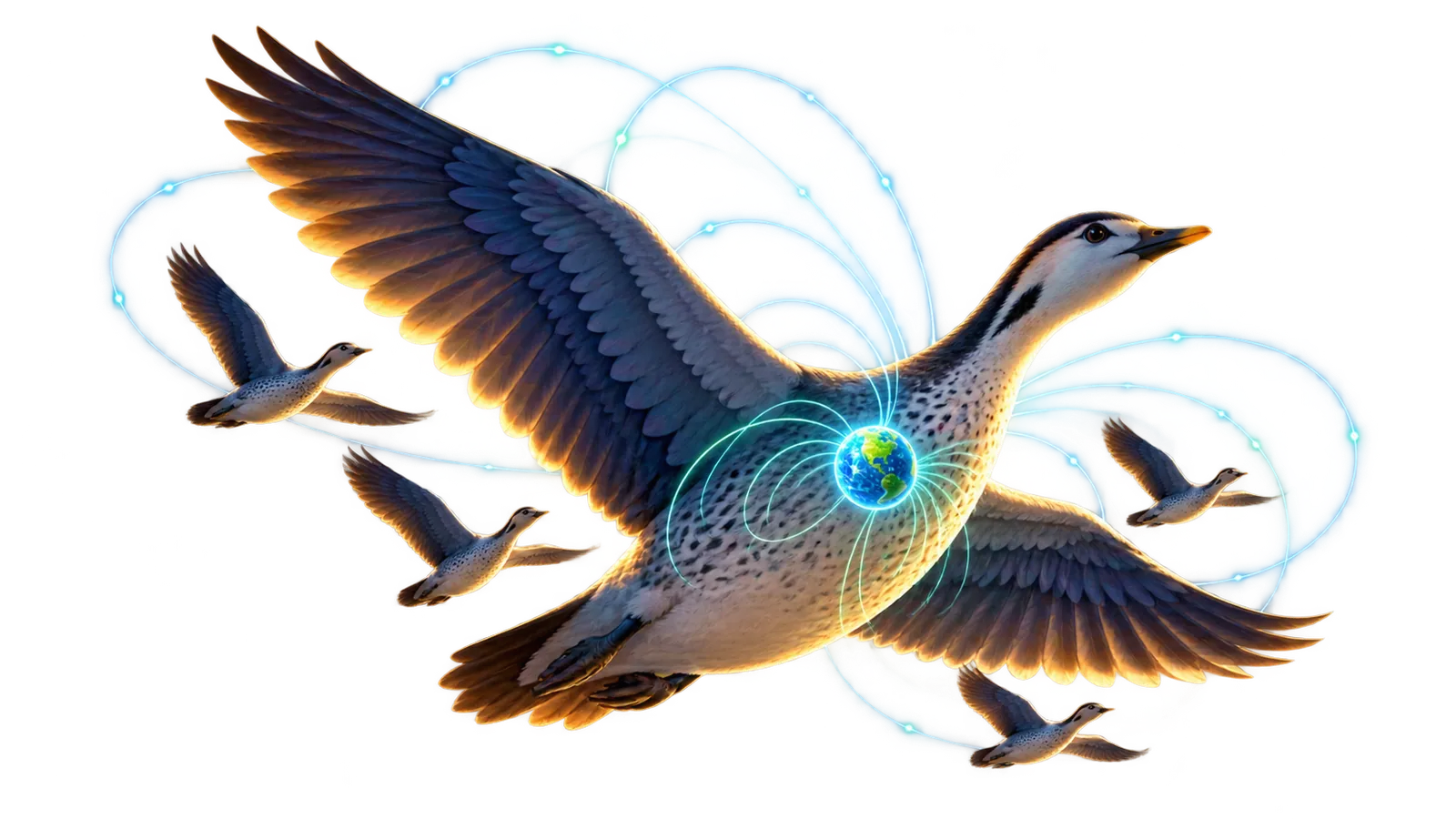
渡り鳥は地球の磁場で方角を知る。その仕組みとして、目のタンパク質の中で起きる量子の現象が最有力候補になっている。
ひとことで言うと鳥は目で地球の「磁石の向き」を感じているかも。カギは量子のふしぎ!
秋になると、小さな渡り鳥たちが、何千kmも離れた冬の住みかへ旅立ちます。地図もスマホもなしで。
鳥たちは太陽や星、景色など、いろいろな手がかりを使っています。その中でも特に不思議なのが、地球の磁場(地磁気)を感じとる力です。
そして、その仕組みのカギを握っているかもしれないのが、なんと量子力学なのです。
01鳥の体には「方位磁石」が入っている
地球は、巨大な磁石のようなものです。北極と南極の間を、目に見えない磁力線がぐるりと結んでいます。
つまり鳥は、「北はどっち?」ではなく、「磁力線が地面に突っこむ角度」から「極の方向」と「赤道の方向」を見分けているらしいのです。
では、その磁場をどこで、どうやって感じているのでしょうか。
02目の中の「電子のペア」が磁場を感じとる?
有力なのが、ラジカル対(たい)メカニズムという仮説です。
難しい名前ですが、イメージはこうです。
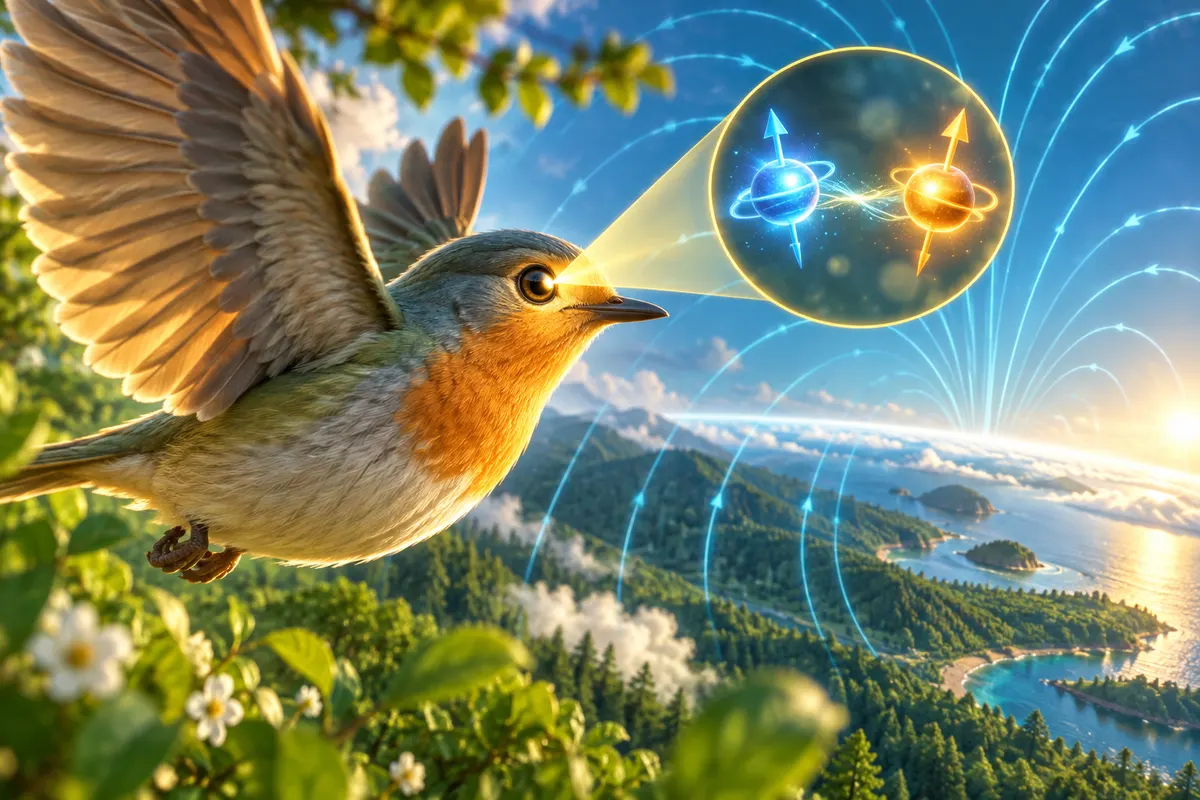
鳥の目の網膜には、クリプトクロムという光に反応するタンパク質があります。ここに光が当たると、タンパク質の中で電子がひとつポンと移動します。すると、少し離れた2か所に、相手のいない電子が1つずつ残ります。この2つの電子が「ペア」です。
電子には「スピン」という、こまのような性質があります。2つのこまの回り方の組み合わせは、ごく弱い磁場の向きによって、わずかに変わると考えられています。
その変化が化学反応の結果を変え、最終的に「目に見える景色に、磁場の向きを表す模様が重なって見える」のでは——という説です。地磁気はとても弱いので、ふつうの化学反応では感じとれません。量子の世界の、ちょっと不思議なふるまいが必要になるわけです。
032021年、渡り鳥の目のタンパク質が実験室で磁場に反応した
この仮説を大きく後押ししたのが、2021年に『Nature』に載った研究です。
ドイツ・オルデンブルク大学とイギリス・オックスフォード大学などのチーム(Xu ら)が調べたのは、ヨーロッパコマドリのクリプトクロム4というタンパク質です。遺伝子をもとにこのタンパク質を作り、取り出して、実験室で調べました。すると、このタンパク質の中で起きる反応が、磁場によって実際に変化することが確かめられたのです。しかも、渡りをしないニワトリやハトのクリプトクロム4より、コマドリのもののほうが磁場に敏感な傾向がありました。
04街の「電磁ノイズ」でコンパスが狂う
これほど弱いノイズで狂うのは、鳥のコンパスがとても繊細な仕組みで動いているからかもしれません。ラジカル対の仕組みなら、こうした弱い電波の影響を受けうると考えられています。
05まだ「証明」ではない
ただし、注意も必要です。
タンパク質が実験室で磁場に反応することはわかりました。しかも実験の磁場は、地球の磁場より数百倍強いものでした。生きた鳥の目の中で、本当にそれがコンパスとして使われているかは、まだ確かめられていません。かつては「くちばしの中の鉄の粒(磁鉄鉱)がセンサー」という説もありました。しかし2012年の研究で、ハトのくちばしで見つかった鉄の多い細胞は免疫細胞の一種だったと報告され、この説は見直されています。ただ、鉄を使った別の磁気センサーが「地図」の役割を担っている可能性は、今も研究が続いています。
06まとめ
渡り鳥は地磁気を感じて方角を決めています。その仕組みとして、目のタンパク質の中で起きる量子の現象が最有力候補になっています。
ただ、まだ「ほぼ決まり」ではなく「かなり有力」の段階。空を渡る小さな鳥たちは、物理学のいちばん不思議な部分を、毎年の旅で使いこなしているのかもしれません。
この研究を英語で読もう原田英語の English CornerMigratory birds travel thousands of kilometers using many clues, including the sun, the stars and the… 音声
音声 4択クイズ9問A2・B1・B2タップして開く
原田英語の English Corner
この研究を英語で読もう
Some birds fly thousands of kilometers every year without a map. One way they find their direction is by sensing the Earth's magnetic field.
Scientists think a special protein in birds' eyes may work like a compass. When light hits it, tiny particles inside react to the magnetic field. This idea uses quantum physics. It has not been fully proven yet, but many scientists find it very exciting.
68 words ・ CEFR A2
和訳を見る
毎年、地図なしで何千キロも飛ぶ鳥がいます。鳥が方角を知る方法の1つは、地球の磁場を感じとることです。
科学者たちは、鳥の目の中にある特別なタンパク質が方位磁石のように働いているのかもしれないと考えています。光が当たると、その中の小さな粒子が磁場に反応するのです。この考えには量子物理学が使われています。まだ完全には証明されていませんが、多くの科学者がとてもわくわくしています。
4択リーディングクイズ
Q1. What is the passage mainly about?
鳥が目の中のタンパク質を方位磁石のように使っているかもしれない、という話なので A。
Q2. Where is the special protein found?
a special protein in birds' eyes とあるので C。
Q3. In this passage, "proven" means ...
prove は「証明する」。proven は「証明された」なので D。
Migratory birds travel thousands of kilometers using many clues, including the sun, the stars and the Earth's magnetic field. In 1972, German scientists showed that when they changed the direction of a magnetic field, European robins tried to fly in a different direction. What the birds sensed was the angle of the magnetic field lines rather than north and south.
A leading explanation involves a light-sensitive protein called cryptochrome in the retina. When light hits it, a pair of electrons forms, and the pair's behavior may change slightly depending on the magnetic field. In 2021, researchers confirmed in the lab that a robin's cryptochrome reacts to magnetic fields. However, it has not been proven that birds actually use it as a compass.
122 words ・ CEFR B1
和訳を見る
渡り鳥は、太陽、星、地球の磁場など、多くの手がかりを使って何千キロも移動します。1972年、ドイツの科学者たちは、磁場の向きを変えると、ヨーロッパコマドリが別の方向へ飛ぼうとすることを示しました。鳥が感じとっていたのは、北と南ではなく、磁力線の角度でした。
有力な説明は、網膜にあるクリプトクロムという光に反応するタンパク質に関わるものです。光が当たると電子のペアができ、そのペアのふるまいが磁場によってわずかに変わるのかもしれません。2021年、研究者たちは実験室で、コマドリのクリプトクロムが磁場に反応することを確かめました。しかし、鳥が実際にそれを方位磁石として使っていることは証明されていません。
4択リーディングクイズ
Q1. What happened when scientists changed the direction of the magnetic field in 1972?
European robins tried to fly in a different direction とあるので D。
Q2. What did the birds sense, according to the passage?
What the birds sensed was the angle of the magnetic field lines rather than north and south とあるので B。
Q3. What is the author's view of the cryptochrome explanation?
実験室で反応を確認したが it has not been proven that birds actually use it as a compass とあるので C。
When German researchers artificially rotated the magnetic field around migratory songbirds, the birds changed their intended direction. It was an early detailed account of how birds such as the European robin use Earth's magnetic field. The robin's compass responds not to magnetic polarity but to the angle of the field lines relative to the ground. The leading explanation is the radical pair mechanism.
According to this hypothesis, when light hits cryptochrome, a protein in the retina, an electron moves and creates a pair of molecules with unpaired electrons. Their quantum spin states are subtly influenced by the direction of a weak magnetic field. That could alter chemical reactions and perhaps let the bird see the field as a pattern laid over its vision.
In 2021, a team including Oldenburg and Oxford researchers showed in the laboratory that the robin's cryptochrome 4 is magnetically sensitive, more so than the versions from non-migratory chickens and pigeons. Those tests used magnetic fields much stronger than Earth's, however, and the mechanism has not been shown inside living birds' eyes. In a 2014 study, weak electromagnetic noise from electronic devices disrupted robins' orientation, and the birds recovered once their huts were shielded.
197 words ・ CEFR B2
和訳を見る
ドイツの研究者たちが渡り鳥のまわりの磁場を人工的に回転させると、鳥は向かおうとする方向を変えました。これは、ヨーロッパコマドリのような鳥が地球の磁場をどう利用しているかを、早い時期に詳しく示した研究でした。コマドリのコンパスは、磁極ではなく、地面に対する磁力線の角度に反応します。有力な説明は、ラジカル対メカニズムです。
この仮説によると、網膜にあるタンパク質クリプトクロムに光が当たると電子が移動し、対になっていない電子をもつ分子のペアができます。その量子的なスピンの状態は、弱い磁場の向きによってわずかに影響を受けます。それが化学反応を変え、もしかすると鳥が磁場を視界に重なった模様として見られるようにしているのかもしれません。
2021年、オルデンブルクとオックスフォードの研究者を含むチームは、実験室で、コマドリのクリプトクロム4が磁場に敏感であり、渡りをしないニワトリやハトのものより敏感であることを示しました。ただし、これらの実験では地球の磁場よりはるかに強い磁場が使われており、この仕組みは生きた鳥の目の中ではまだ示されていません。2014年の研究では、電子機器が出す弱い電磁ノイズがコマドリの方角定めを乱し、小屋を遮へいすると鳥たちは元に戻りました。
4択リーディングクイズ
Q1. According to the radical pair hypothesis, what happens when light hits cryptochrome?
when light hits cryptochrome ... an electron moves and creates a pair of molecules with unpaired electrons とあるので A。
Q2. What did the 2014 study show?
weak electromagnetic noise ... disrupted robins' orientation, and the birds recovered once their huts were shielded とあるので B。
Q3. Which limitation does the author point out?
Those tests used magnetic fields much stronger than Earth's ... and the mechanism has not been shown inside living birds' eyes とあるので D。
重要単語
- magnetic fieldB2名詞(句)磁場Birds may be able to see the Earth's magnetic field.
 magnet(磁石)の形容詞 magnetic。field は物理では「場」。
 - migratoryC1形容詞渡りをするThe European robin is a migratory songbird. migrate(移住する・渡る)の形容詞。migratory birds「渡り鳥」。
- retinaC1名詞網膜Cryptochrome is found in the retina of birds. 目の奥で光を受け取る膜。lens(水晶体)、cornea(角膜)もセットで。
- radical pairC1名詞(句)ラジカル対(電子のペア)A radical pair can be affected by weak magnetic fields. 化学の radical は「遊離基」。日常語の「過激な」とは別の意味。
- disruptB2動詞乱す、妨げるElectronic noise can disrupt the bird's compass. dis-(ばらばらに)+rupt(壊す)。名詞 disruption。
- orientationB2名詞方向定め、方角の把握Noise disrupted the robins' orientation. orient(東)が語源で「方角を合わせる」。新入生の「オリエンテーション」も同じ語。
 入試に出る順の単語帳を印刷する →
 全5903語の「科学英単語カード」で復習する →
 動画でもっと知る
動画は各チャンネルの公式埋め込みで表示しています(YouTube)。
 4コマでわかる
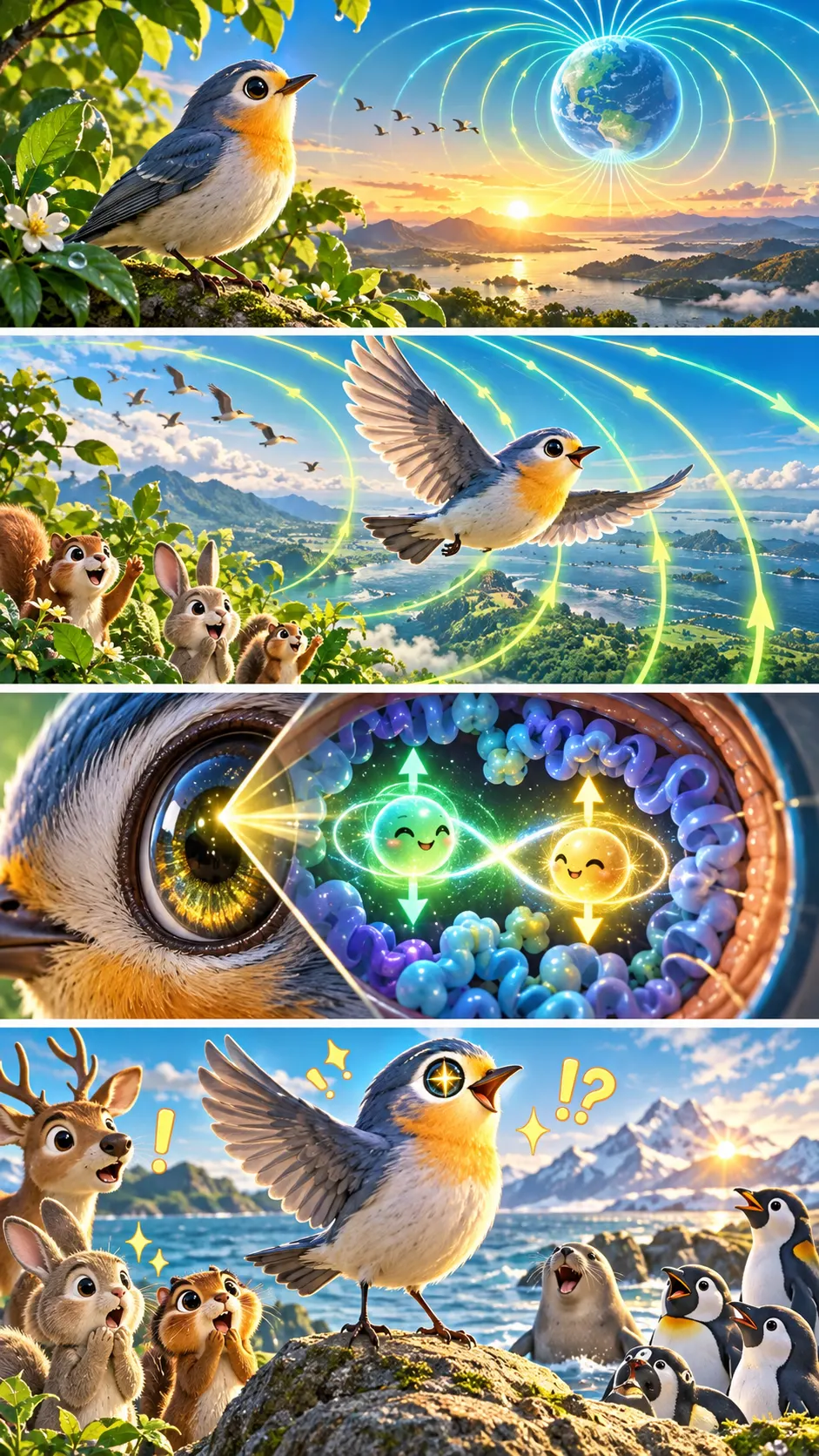
このネタ、誰かに教えたくなった?
渡り鳥が何千kmも迷わず飛べる理由、目の中のタンパク質で「量子力学」の現象が起きているからかもしれない。しかも、街の電子機器の電磁ノイズでコンパスが狂うという実験まである。
押すと「マジかリスト」に保存されます
 出典・参考文献(5件)タップで表示
- Xu et al. (2021) Magnetic sensitivity of cryptochrome 4 from a migratory songbird, Naturedoi.org
- Engels et al. (2014) Anthropogenic electromagnetic noise disrupts magnetic compass orientation in a migratory bird, Naturedoi.org
- Wiltschko & Wiltschko (1972) Magnetic compass of European robins, Sciencedoi.org
- Ritz, Adem & Schulten (2000) A model for photoreceptor-based magnetoreception in birds, Biophysical Journaldoi.org
- Hore & Mouritsen (2016) The radical-pair mechanism of magnetoreception, Annual Review of Biophysicsdoi.org

※本記事は上記の研究・公開資料をもとに、原田英語が独自の言葉で解説したものです。引用は著作権法第32条の範囲で行い、出典を明記しています。画像はすべてオリジナルのイメージです。研究結果には限界や個人差があります。誤りのご指摘は原田英語のお問い合わせフォームから。
 これも「マジか!?」

 動物・植物
動物・植物
「観葉植物で空気がキレイに」は幻想? 換気と同じ効果には床1㎡に10〜1000鉢が必要という計算
 動物・植物
動物・植物
【立命館の入試に出た】口と口を合わせて交尾するタコがいた。30年以上うわさだけだったパナマのタコ
 動物・植物
動物・植物
「鳥がラーテルをハチの巣へ案内する」話は証拠が薄かった。本当に鳥と組んでいたのは人間だった
 動物・植物
動物・植物
タコの神経細胞の約3分の2は「腕」にある。8本の腕は脳の細かい指示なしでも動ける

 動物・植物
動物・植物
天才犬は「盗み聞き」で言葉を覚える。1歳半の子どもと同じ学び方だった
 動物・植物
動物・植物