原田英語の時事英語ジュニア|英語ニュース ワークシート(高校生レベル)
Class ____ No. ____ Name ____________________
ロボットが宇宙でアンテナの骨組みを組み立て 宇宙飛行士なしでは初めてとアメリカの大学
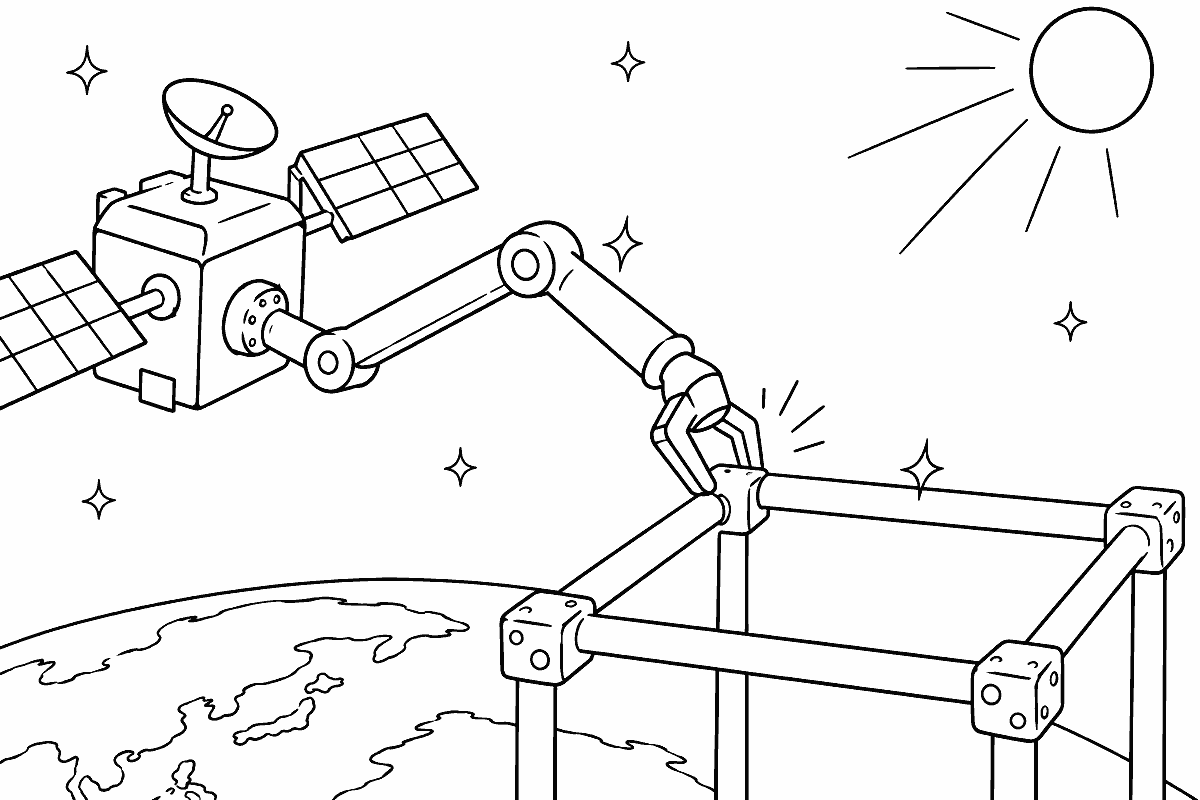
Robot Assembles Part of an Antenna in Orbit Without Astronauts
1A robot built by engineers at Caltech has assembled part of a structure in orbit without astronauts. The team says no robot had ever built a structure in space on its own before. The California Institute of Technology announced the result in November.
2The robot, called ASTRA, was launched on March 30, 2026, on a SpaceX rocket from California. A spacecraft made by the company Momentus then carried it into low Earth orbit. The machine and its building materials took up only about one cubic meter.
3ASTRA's task was to build the frame of a reflector antenna 1.4 meters across. The full design has 11 connected sections, known as truss bays. Two bays were assembled on the ground before launch. In orbit, the robot used an arm and motorized dispensers to build a third bay from composite tubes and aluminum connectors.
4The robot did the assembly automatically, but engineers on the ground sent instructions and checked its progress using photos from orbit. They could reach it only about seven or eight times a day, for roughly 15 minutes each time. When problems came up, the team recreated them on a spare robot in the team's lab at Caltech and then sent fixes. Because of technical problems and a tight schedule, the team says ASTRA will probably not complete the full 11-bay frame by the time the mission wraps up in December.
5Anything sent into space has to fit inside a rocket, which limits the size of telescopes and antennas. Building in orbit could get around that limit. DARPA, the U.S. agency that paid for the project, hopes to one day see structures that measure several hundred meters, or even several kilometers.
Words 単語
| assembledB2 | 動 | 組み立てたput the parts of something together |
| orbitB1 | 名 | 軌道(星などのまわりを回る道)the path of something going around a planet |
| recreated外 | 動 | 再現した、もう一度起こしたmade something happen again in the same way |
| launchedB1 | 動 | 打ち上げられたsent up into the sky or space |
| taskA2 | 名 | 任務、仕事a piece of work that you have to do |
| connectedB1 | 形 | つながったjoined to each other |
| progressB1 | 名 | 進み具合、進歩how far something has moved toward its goal |
| spareB2 | 形 | 予備のkept as an extra one in case you need it |
| scheduleA2 | 名 | 予定、スケジュールa plan of when things will happen |
| limitsB1 | 動 | 限る、制限するkeeps something from going over a certain amount |
単語のレベル:CEFR-J(『CEFR-J Wordlist Version 1.6』 東京外国語大学投野由紀夫研究室. (URL: https://www.cefr-j.org/download.html より 2026年8月ダウンロード))
1. Reading Quiz 本文の内容に合うものを選ぼう
How does the Caltech team describe what ASTRA did?
A. As the first time a robot built a structure in space on its ownB. As the first robot ever sent into spaceC. As the largest antenna ever builtD. As the first rocket launched from California
What carried ASTRA into low Earth orbit after the launch?
A. An astronautB. The International Space StationC. A spacecraft made by MomentusD. A balloon
How many bays were assembled on the ground before launch?
A. NoneB. TwoC. ThreeD. Eleven
What did the team do when problems came up?
A. They sent astronauts to fix the robot.B. They stopped the mission.C. They built a new rocket.D. They recreated the problems on a spare robot and sent fixes.
Why could building in orbit be useful?
A. It is cheaper than building on the ground.B. Rockets can carry only things that fit inside them, which limits size.C. Astronauts do not like building things.D. Telescopes work better when they are small.
2. True or False 正しければ T、違っていれば F
( ) ASTRA was launched on a SpaceX rocket from California.
( ) The antenna ASTRA is building is 14 meters across.
( ) Engineers could talk to the robot at any time of the day.
( ) DARPA paid for the project.
3. Fill in the Blanks 下の語から選んで空らんをうめよう(形を変えずに)
recreatedlaunchedorbitassembledtaskconnected
When problems came up, the team _____ them on a spare robot in the team's lab at Caltech and then sent fixes.
A spacecraft made by the company Momentus then carried it into low Earth _____.
The robot, called ASTRA, was _____ on March 30, 2026, on a SpaceX rocket from California.
The full design has 11 _____ sections, known as truss bays.
A robot built by engineers at Caltech has _____ part of a structure in orbit without astronauts.
ASTRA's _____ was to build the frame of a reflector antenna 1.4 meters across.
4. Word Order 語を並べかえて正しい文にしよう
( launch / on / ground / Two / bays / assembled / before / the / were ) .
( limit / that / get / could / Building / orbit / around / in ) .
( of / announced / The / Technology / November / California / in / result / Institute / the ) .
5. Think and Write 英語で答えてみよう
Robots are taking on more jobs that people used to do. Do you think this is a good thing? Give your reasons.(これまで人がしてきた仕事を、ロボットがするようになってきています。これはよいことだと思いますか?理由を挙げよう。)
If people could build a huge telescope in space, what would you want it to look for?(宇宙にとても大きな望遠鏡を作れたら、それで何をさがしてほしいですか?)
Answers 解答
1. (1) A (2) C (3) B (4) D (5) B
2. (1) T (2) F (3) F (4) T
3. (1) recreated (2) orbit (3) launched (4) connected (5) assembled (6) task
4.
- Two bays were assembled on the ground before launch.
- Building in orbit could get around that limit.
- The California Institute of Technology announced the result in November.
全文訳
1カリフォルニア工科大学の技術者たちが作ったロボットが、宇宙飛行士なしで、地球を回る軌道上で建造物の一部を組み立てました。チームは、ロボットが自分だけで宇宙で建造物を組み立てたことは、これまで一度もなかったとしています。カリフォルニア工科大学は、11月にこの結果を発表しました。
2ASTRA という名前のロボットは、2026年3月30日にカリフォルニアからスペースXのロケットで打ち上げられました。その後、モメンタスという会社の宇宙船が、ロボットを地球の低い軌道まで運びました。機械と組み立ての材料は、合わせて約1立方メートルしか場所をとりませんでした。
3ASTRA の任務は、直径1.4メートルの反射鏡のアンテナの骨組みを作ることでした。全体の設計は、「トラスベイ」と呼ばれる11の区画がつながった形です。2つの区画は、打ち上げの前に地上で組み立てられていました。軌道上で、ロボットはうでとモーターつきの部品送り出し装置を使い、複合素材の管とアルミのつなぎ具から3つ目の区画を作りました。
4ロボットは自動で組み立てましたが、地上の技術者たちが指示を送り、軌道から届く写真で進み具合を確かめました。ロボットと連絡できたのは1日に約7〜8回だけで、1回あたり15分ほどでした。問題が起きると、チームはカリフォルニア工科大学の研究室にある予備のロボットで同じことを起こして確かめ、それから直し方を送りました。技術的な問題と時間の足りなさから、チームは、12月に計画が終わるまでに ASTRA が11区画の骨組み全体を作り終えることはおそらくないとしています。
5宇宙へ送るものはどれもロケットの中に入らなければならず、そのため望遠鏡やアンテナの大きさに限りがあります。軌道上で組み立てれば、その限りを乗りこえられるかもしれません。この計画にお金を出したアメリカの機関 DARPA(ダーパ)は、いつか数百メートル、さらには数キロメートルの大きさの建造物ができることをめざしています。
文法ポイント:過去分詞の後置修飾(名詞+過去分詞〜)
名詞のすぐあとに過去分詞を置いて「〜された(名詞)」と説明する。本文の A robot built by engineers at Caltech は「カリフォルニア工科大学の技術者たちによって作られたロボット」。Anything sent into space(宇宙へ送られるもの)も同じ形。
出典:ScienceDaily(California Institute of Technology)、New Atlas ほか(記事は原田英語の時事英語ジュニアのオリジナル)|https://www.haradaeigo.com/jijieigo-junior/news/2026-11-18-astra-robot-builds-in-orbit/