shogi
Japanese chess
将棋(しょうぎ)
In one line
The shortest answer that works
Shogi is Japanese chess, and its key difference is that captured pieces can be returned to the board.
将棋は日本のチェスで、最大の違いは取った駒を自分の駒として盤に打てることです。
In 30 seconds
The standard explanation
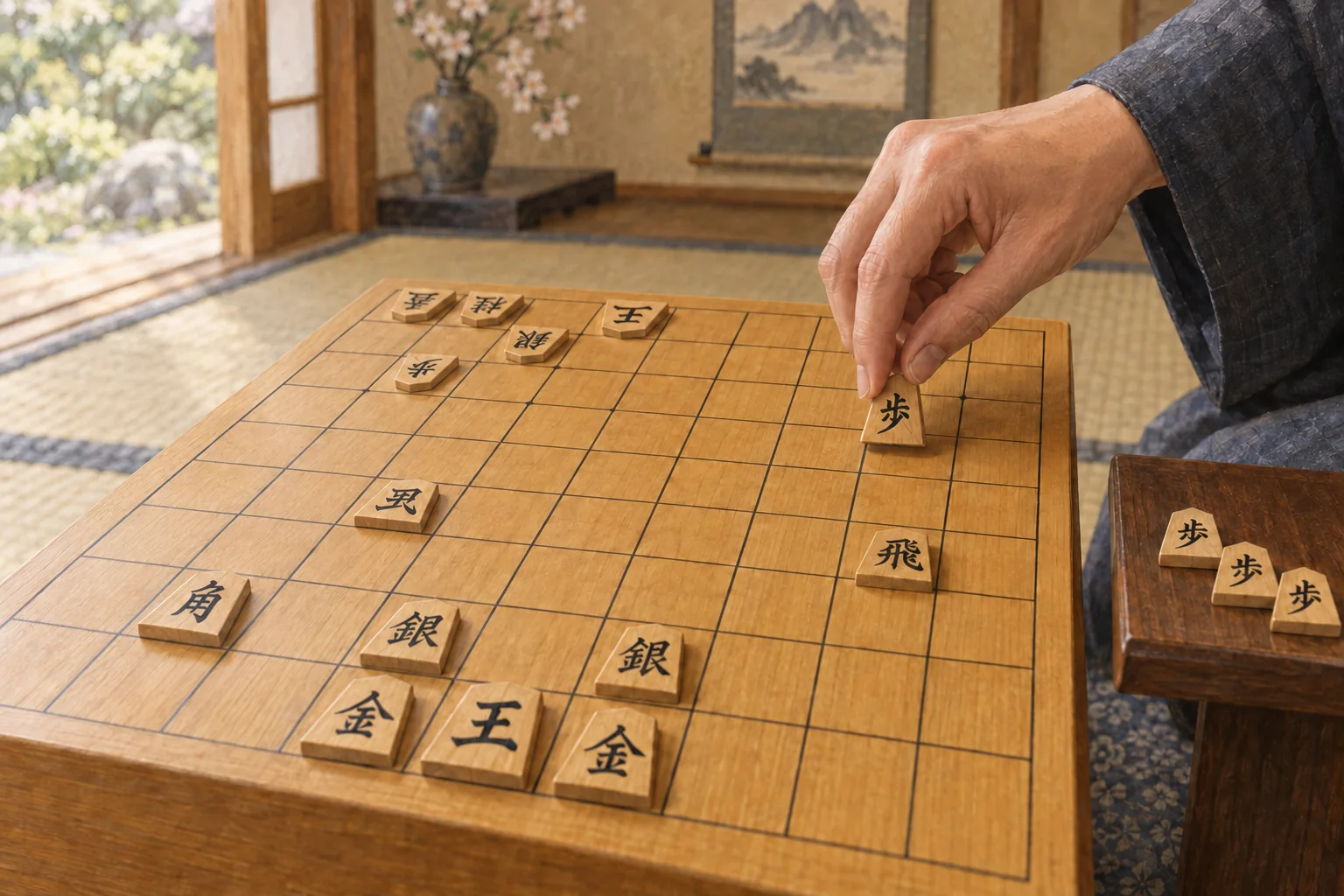
Shogi is played on a nine by nine board with flat five-sided pieces, all the same color, pointing toward the opponent. The defining rule is the drop: a piece you capture becomes yours and can be placed back on the board on a later turn. Because material never leaves the game, draws are rare and endgames stay sharp.
将棋は九かける九の盤で、同じ色の五角形の平らな駒を使い、駒の向きで持ち主を示します。決定的な規則は「打つ」ことです。取った駒は自分のものになり、後の手番で盤に戻せます。駒が盤上から消えないため、引き分けはまれで、終盤まで鋭さが保たれます。
As a short speech
A full paragraph you can read aloud
Shogi is Japanese chess, played on a nine by nine board. The pieces are flat five-sided tablets, all the same color, and you tell whose is whose by which way they point. The rule that changes everything is the drop.
When you capture a piece it becomes yours, and on any later turn you may place it anywhere on the board as your own. Because material never leaves play, the board does not simplify toward a draw the way chess does, draws are very rare, and a game can turn completely in one move late on.
Professional shogi is a real career in Japan, with a ranked league, major title matches sponsored by newspapers, and games broadcast with commentary. The path to turning pro is famously harsh: trainees who have not qualified by their mid-twenties must leave. Engines now beat the strongest humans, as in chess, and professionals openly use them to study.
将棋は日本のチェスで、九かける九の盤で指します。駒は同じ色の五角形の平らな板で、どちらの向きを指しているかで持ち主が分かります。すべてを変える規則が「打つ」ことです。取った駒は自分のものになり、以後どの手番でも、自分の駒として盤上のどこにでも置けます。
駒が盤から消えないので、チェスのように単純化して引き分けへ向かうことがなく、引き分けは非常にまれで、終盤の一手で局面が丸ごとひっくり返ります。日本ではプロ棋士は実際の職業で、順位戦があり、新聞社が主催する大きな棋戦があり、対局は解説つきで中継されます。
プロになるまでの道は厳しさで知られ、養成機関の奨励会では、原則として26歳までにプロになれなければ退会となります。チェスと同じくソフトが最強の人間を上回るようになり、棋士は公然とそれを研究に使っています。
Questions people actually ask
And how to answer them.
Why are all the pieces the same color?
Because ownership is shown by direction, not color, and that is what makes drops possible. A piece you capture is turned around and becomes yours, which would be awkward if pieces were colored by side.
持ち主を色ではなく向きで示すからで、それがあるからこそ駒を打てます。取った駒は向きを変えて自分のものになります。色で陣営を分けていたら、それは成り立ちません。
Is it harder than chess?
Different rather than simply harder. Drops make the number of legal moves much larger and make attacks very hard to extinguish, so the game rewards calculation and sharp play. Both games are deep enough to occupy a lifetime.
難しいというより違います。打つ手があるため合法手の数がずっと多く、攻めを消し止めるのが非常に難しいので、読みと鋭さが物を言います。どちらも一生かけて向き合える深さがあります。
Phrases you can use
- Captured pieces come back into play.取った駒は盤に戻せます。
- The direction shows whose piece it is.向きで持ち主が分かります。
- Draws are very rare.引き分けは非常にまれです。
- Professional shogi is a full career here.日本ではプロ棋士は職業です。
Words you need
- board game盤上遊戯
- to capture取る
- to promote (a piece)成る
- title matchタイトル戦
Watch
From YouTubeBackground (Japanese)
将棋は、インドのチャトランガを起源とする盤上遊戯が伝わり、日本で独自に変化したものとされます。取った駒を打てる規則がいつ定まったかについては諸説あり、室町時代までには成立していたと考えられています。駒の裏に朱で書かれた文字は成った状態を表します。プロの制度には奨励会という養成機関があり、年齢の制限が設けられています。藤井聡太の活躍によって、近年は若い世代にも関心が広がりました。