nihon teien
the traditional garden
日本庭園(にほんていえん)
In one line
The shortest answer that works
Nihon teien, the Japanese garden, is designed to look like natural scenery, with every stone and tree placed deliberately.
日本庭園とは、自然の風景に見えるように作られながら、石も木も一つずつ位置が決められた庭です。
In 30 seconds
The standard explanation
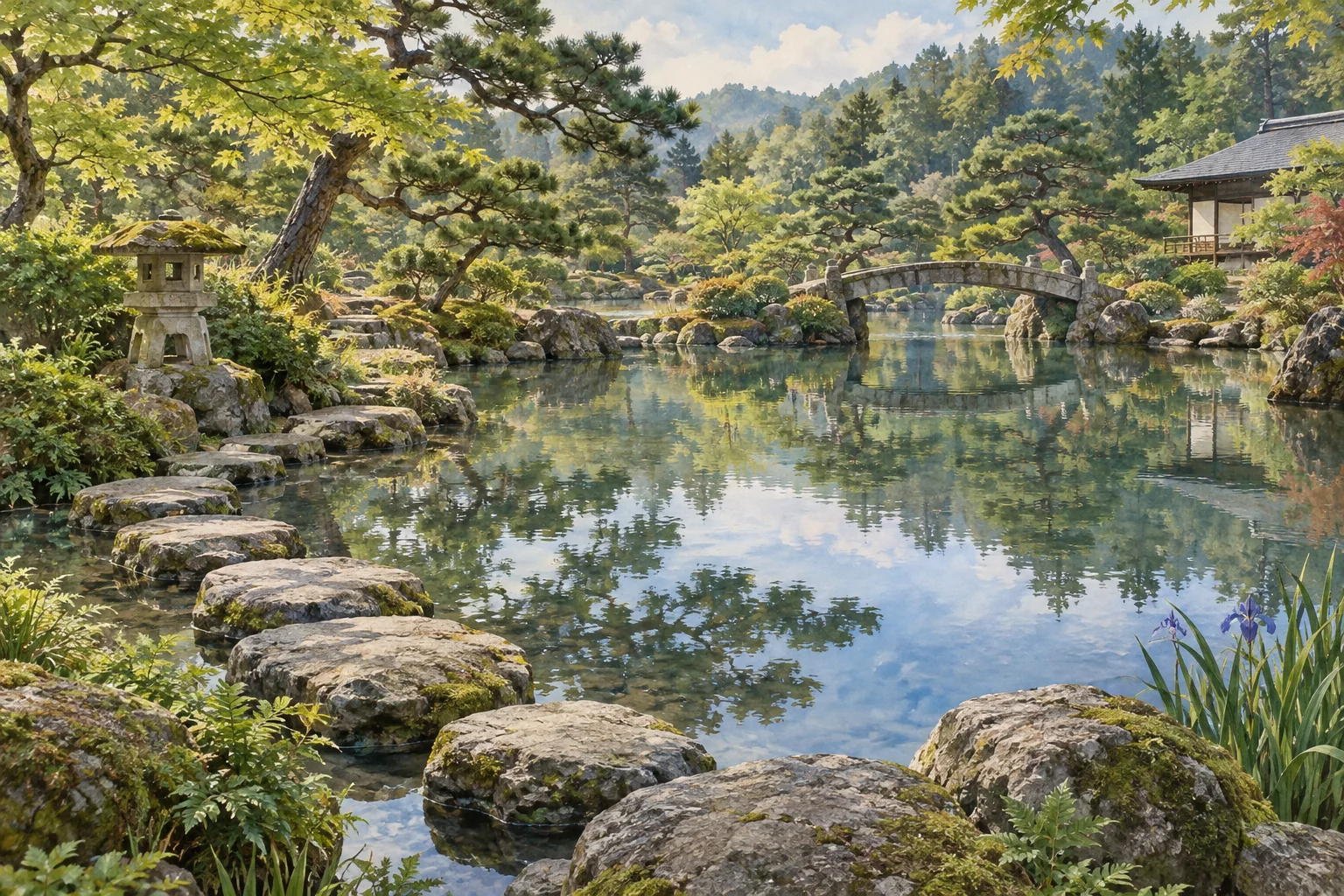
A Japanese garden aims to compose a scene rather than display flowers. Ponds stand for the sea, stones for mountains and islands, raked gravel for water, and clipped shrubs for distant hills. Many are designed to be walked around, revealing a new view at each turn, and some borrow a real mountain beyond the wall as part of the composition.
日本庭園は、花を見せることより、景色を組み立てることを目指します。池は海を、石は山や島を、掻いた砂利は水を、刈り込んだ低木は遠い丘を表します。多くは歩いて回るように作られ、曲がるたびに新しい眺めが現れます。塀の外の実際の山を構図に取り込むものもあります。
As a short speech
A full paragraph you can read aloud
A Japanese garden is built to compose a view rather than to display plants. A pond can stand for the sea, a group of stones for a mountain range or an island, raked gravel for flowing water, and a clipped shrub for a hill in the distance. Nothing is where it is by accident, and the apparent naturalness is the result of very exact placement.
Several types exist: the stroll garden built around a pond, where the path deliberately hides and reveals the view as you walk; the dry landscape garden of stone and gravel attached to a Zen temple; and the small tea garden, which is really a passage designed to slow you down before you enter the tea room. One device worth knowing is borrowed scenery, where a real hill or forest outside the garden is framed by the planting and treated as part of the design, so the garden appears to extend for kilometers.
日本庭園は、植物を並べて見せるためではなく、眺めを組み立てるために作られます。池は海を、石の一組は山並みや島を、掻いた砂利は流れる水を、刈り込んだ低木は遠くの丘を表しえます。
何ひとつ偶然そこにあるものはなく、自然に見えるのは、きわめて正確な配置の結果です。いくつかの型があります。池を中心に巡る回遊式庭園は、歩くにつれて眺めを隠したり現したりするように道を作ります。禅寺に付属する枯山水は石と砂利でできています。
小さな露地は、茶室に入る前に人の歩みを遅くするための通路です。知っておく値打ちのある工夫に借景があります。庭の外にある実際の丘や森を植栽で切り取り、設計の一部として扱うもので、庭が何キロも先まで続いているように見えます。
Questions people actually ask
And how to answer them.
Why are there so few flowers?
Because the garden is composed of form, texture and the changes of the season rather than color. Moss, stone, water and evergreen give a picture that works all year, and flowering trees are used as a brief event rather than the main subject.
庭が色ではなく、形と質感と季節の移り変わりで組み立てられているからです。苔、石、水、常緑の木は一年を通して絵になります。花の咲く木は主題ではなく、短い出来事として使われます。
What is borrowed scenery?
It is the technique of framing a mountain, forest or distant temple outside the garden so it reads as part of the composition. Trees and walls are placed to hide everything between, so the borrowed view seems to sit just beyond the garden.
庭の外の山や森、遠くの堂を切り取って、構図の一部として読ませる技法です。その間にあるものを隠すように木や塀を置くので、借りた眺めが庭のすぐ向こうにあるように見えます。
Phrases you can use
- Every stone is placed deliberately.石はすべて意図して置かれています。
- The pond stands for the sea.池は海を表しています。
- The path hides the view, then reveals it.道が眺めを隠し、また現します。
- The mountain outside is part of the design.外の山も設計の一部です。
Words you need
- borrowed scenery借景
- stroll garden回遊式庭園
- moss苔
- to rake (gravel)砂利を掻く
Watch
From YouTubeBackground (Japanese)
平安時代の庭づくりの書『作庭記』には、石の据え方についての細かい心得が記されています。回遊式庭園は大名庭園として各地に作られ、金沢の兼六園、岡山の後楽園、水戸の偕楽園がよく知られています。借景の例としては京都の円通寺から見る比叡山が挙げられます。庭を維持するには継続的な手入れが要り、松の芽を手で摘む「みどり摘み」など、季節ごとの作業が決まっています。