gojunoto
the five-storied pagoda
五重塔(ごじゅうのとう)
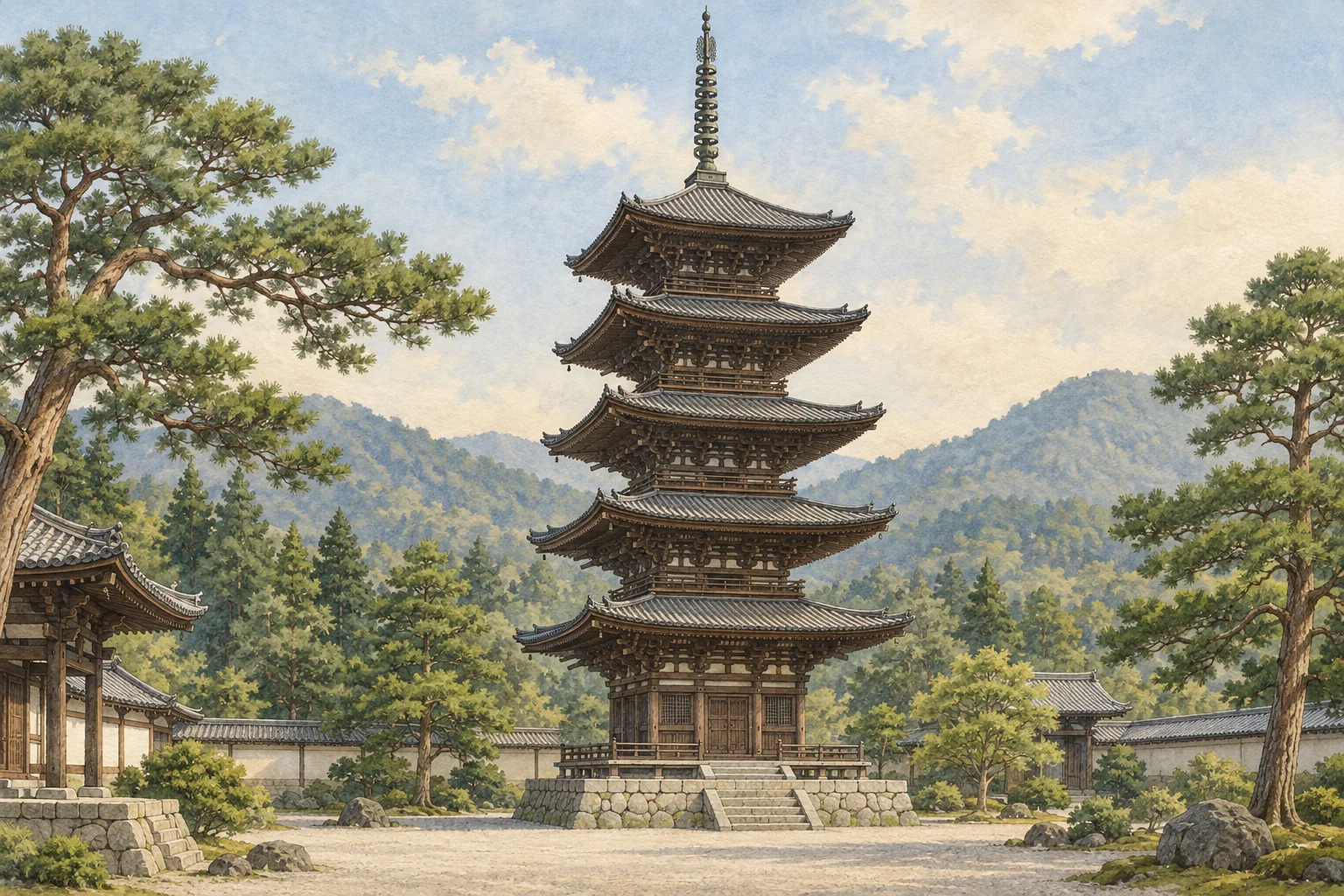
In one line
The shortest answer that works
Gojunoto, or a five-storied pagoda, is a reliquary tower, not a building people go inside and climb.
五重塔とは、遺骨を納めるための塔で、人が中に入って登る建物ではありません。
In 30 seconds
The standard explanation
A pagoda is the Japanese descendant of the Indian stupa, a mound built over relics of the Buddha. It has no usable floors and no stairs for visitors; the stories are roofs stacked around a frame. Almost all have an odd number of levels, usually three or five, and a long central pillar runs up the middle; it does not hold up the roofs, and in some pagodas it even hangs free of the ground.
塔は、釈迦の遺骨を納めるために築かれたインドのストゥーパが、日本まで伝わった姿です。人が使える床も、参拝者が登る階段もありません。各層は骨組みのまわりに重ねられた屋根です。層の数はほとんどが奇数で、たいていは三重か五重。中心には心柱と呼ばれる長い柱が通っていますが、屋根の重さは支えておらず、地面から浮いて吊られている塔さえあります。
As a short speech
A full paragraph you can read aloud
The first thing to know about a pagoda is that it is not a building in the ordinary sense. It descends from the Indian stupa, a mound raised over the Buddha's relics, and its purpose is to hold something sacred at its base, not to give people a place to stand.
There are no stairs for visitors and the upper stories are hollow. What makes them remarkable is that they survive. Japan has earthquakes, and wooden pagodas well over a thousand years old are still standing, including the one at Horyuji, which is among the oldest wooden buildings in the world.
Engineers argue about why. The stories are loosely stacked rather than rigidly joined, so they shift against each other and lose energy, and the heavy central pillar moves out of phase with them. When the Tokyo Skytree was designed, its engineers drew on that pillar and built a modern version of the idea into the tower.
塔についてまず知っておきたいのは、ふつうの意味の建物ではないということです。釈迦の遺骨の上に築かれたインドのストゥーパの子孫で、目的は聖なるものを基部に納めることであり、人が立つ場所を作ることではありません。参拝者用の階段はなく、上の層は空洞です。
驚かされるのは、それが残っていることです。日本は地震の国ですが、千年を大きく超える木造の塔が今も立っています。法隆寺の塔は、現存する世界最古級の木造建築に数えられます。なぜ倒れないのか、専門家の説明は一つではありません。
各層はかたく組まれておらず、ゆるく積まれているために互いにずれて力を逃がし、重い心柱はそれとは違う揺れ方をします。東京スカイツリーを設計した技術者はこの心柱を参考にし、その考えを現代の形にして塔に組み込みました。
Questions people actually ask
And how to answer them.
Can I go inside?
Almost never. A few pagodas open the ground floor for a limited period, but there is no staircase for visitors and nothing to see above. The building is meant to be looked at, not entered.
ほとんど入れません。期間を限って初層を公開する塔はありますが、参拝者用の階段はなく、上に見るものもありません。塔は眺めるためのものです。
Why five stories?
Odd numbers are preferred, and the five are commonly explained as earth, water, fire, wind and sky. Three-storied pagodas are just as traditional and more numerous; five stories simply took more money and labor to build.
奇数が好まれ、五は地水火風空を表すと説明されるのが一般的です。三重塔も同じく伝統的で、数はこちらのほうが多くあります。五重にするには、それだけ費用と手間がかかりました。
Is there really a relic inside?
Something is enshrined beneath the central pillar, usually in a stone chamber, but what it is varies. Actual relics of the Buddha are rare; crystal, scriptures or a substitute stand in for them at most temples.
心柱の下に、たいていは石の室を設けて何かが納められています。ただし中身はさまざまです。釈迦の遺骨そのものは稀で、多くの寺では水晶や経典などが代わりに納められています。
A common misunderstanding
MYTHA pagoda is a tower you climb for the view.
FACTIt is a reliquary. The upper stories are hollow, there are no stairs for visitors, and what matters is enshrined at the base beneath the central pillar.
Phrases you can use
- There are no stairs inside.中に階段はありません。
- It holds a relic at the base.基部に遺骨を納めています。
- The central pillar doesn't hold up the roofs.心柱は屋根を支えていません。
- It has survived many earthquakes.何度も地震に耐えてきました。
- Three-storied pagodas are more common.三重塔のほうが数は多いです。
Words you need
- pagoda塔
- central pillar心柱
- relic of the Buddha仏舎利
- eaves軒
- temple grounds境内
Watch
From YouTubeBackground (Japanese)
五重塔は、釈迦の遺骨を納めるインドのストゥーパが中国を経て日本に伝わったもので、各層は人が使う階ではなく、重ねられた屋根です。層の数は奇数が原則で、三重塔のほうが数は多くあります。中心を貫く心柱は、基部の礎石に載る形や、上から吊る形など寺によって異なります。地震で倒壊した例が極めて少ないことが知られ、層どうしがずれて揺れを逃がす仕組みが働くと説明されます。東京スカイツリーの心柱制振は、この構造を参考にしたとされます。