kentoshi
the missions Japan sent to Tang dynasty China
遣唐使(けんとうし)
In one line
The shortest answer that works
Kentoshi were official missions Japan sent to Tang China for over two centuries to bring back learning and technology.
遣唐使とは、二百年以上にわたり日本が唐に送った公式の使節で、学問や技術を持ち帰る役目を担いました。
In 30 seconds
The standard explanation
Starting in 630, Japan sent official missions across the sea to the Tang court, carrying students and monks along with envoys. They brought back Buddhist teachings, legal and administrative models, and the layout Japan copied for its own capital cities. The crossing was dangerous, and multiple ships were lost at sea. The practice wound down through the 800s and was never formally resumed after a planned mission was called off in 894.
630年に始まり、日本は使節とともに留学生や僧を乗せた船を唐の朝廷へ送りました。持ち帰ったのは仏教の教え、法律や行政の仕組み、そして自国の都を築く際にまねた都市の設計です。航海は危険で、海で失われた船も複数ありました。この使節は800年代を通じて減っていき、894年に予定されていた派遣が中止されて以降、正式に再開されることはありませんでした。
As a short speech
A full paragraph you can read aloud
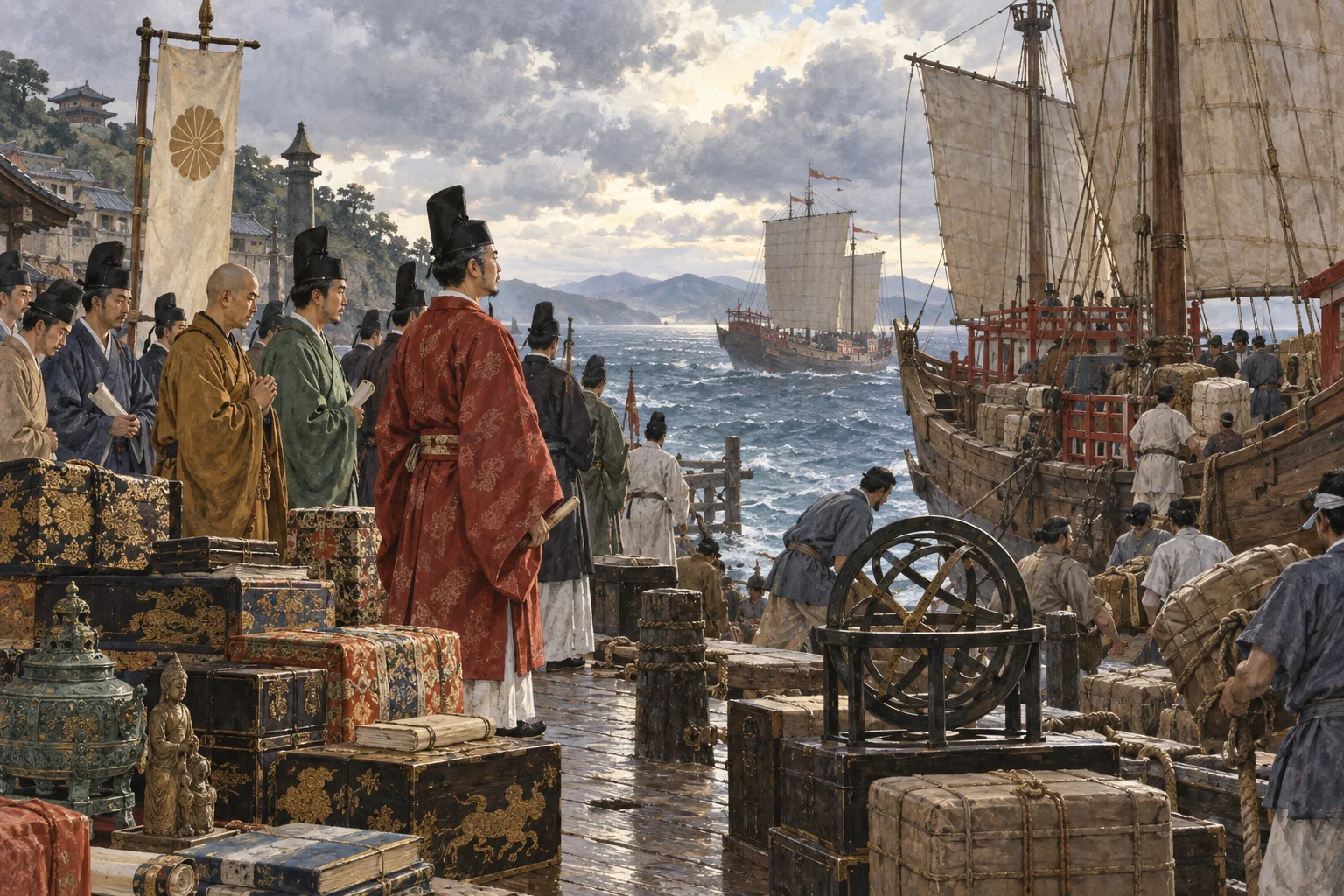
Kentoshi is how Japan describes the official missions it sent to Tang China, starting in 630 and continuing on and off for more than two centuries. A mission carried diplomats, but also students and Buddhist monks who stayed on to study and came home years later with texts, techniques and firsthand knowledge of a much larger civilization.
Much of what Japan built in this period leaned on what they brought back: Buddhist teachings, the legal codes the court used to organize the country, and a capital city, first Heijokyo and later Heiankyo, laid out on a grid modeled on the Tang capital.
The crossing itself was genuinely dangerous, and ships were lost with everyone aboard often enough that being appointed to a mission was no guaranteed honor. By the mid-800s missions had become rare, and in 894 the scholar Sugawara no Michizane argued against sending another one, pointing out that Tang China was in decline and the risk no longer made sense. None was sent again.
遣唐使とは、630年に始まり、二百年以上にわたって断続的に続いた、日本が唐へ送った公式の使節を指す言葉です。使節団には外交の役目を持つ人だけでなく、留学生や留学僧も加わり、彼らは唐にとどまって学び、何年も経ってから書物や技術、そしてはるかに大きな文明を直接見た知識を持って帰国しました。
この時期に日本が築いたものの多くは、彼らが持ち帰ったものに支えられています。仏教の教え、朝廷が国を治めるために使った法律の仕組み、そして唐の都を手本に方格状に築かれた平城京や平安京といった都です。
航海そのものは実際に危険で、乗員もろとも船が失われることも珍しくなく、使節に選ばれることが確実な栄誉とは限りませんでした。800年代半ばには派遣は少なくなり、894年、学者の菅原道真が、唐がすでに衰えており危険を冒すだけの意味がないと訴えて次の派遣に反対しました。その後、遣唐使が送られることは二度とありませんでした。
Questions people actually ask
And how to answer them.
How dangerous was the crossing really?
Genuinely dangerous. Ships relied on seasonal winds and imprecise navigation, and a meaningful share of the missions sent across never arrived or were badly damaged, sometimes with heavy loss of life.
本当に危険でした。船は季節風と不確かな航法に頼るしかなく、送られた使節のうちかなりの割合が目的地にたどり着けなかったり、大きな被害を受けたりし、命を落とす者も出ました。
Did any famous figures travel with a mission?
Yes. The Buddhist monks Kukai and Saicho, who each founded major schools of Japanese Buddhism, both crossed on the same 804 mission, on separate ships, and studied in China before returning to establish their teachings at home.
います。のちに日本の仏教の大きな宗派をそれぞれ開いた空海と最澄は、804年の同じ使節団に、別々の船で乗り込み、唐で学んだのちに帰国して教えを広めました。
Why did it end in 894?
Sugawara no Michizane, appointed to lead a new mission, petitioned the court to reconsider, arguing Tang China was politically unstable and in decline, so the risk no longer matched the benefit. The mission was called off, and none replaced it.
新たな使節の長に任じられた菅原道真が、唐が政治的に不安定で衰えており、危険に見合う利益がないとして再考を求める意見書を朝廷に出しました。その派遣は中止され、代わりが送られることはありませんでした。
Phrases you can use
- They sailed across to study in Tang China.唐で学ぶために海を渡りました。
- The crossing itself could be fatal.航海そのものが命がけでした。
- He brought Buddhist teachings back with him.彼は仏教の教えを持ち帰りました。
- The capital was modeled on a Tang city.都は唐の都市を手本にしました。
- The missions stopped after 894.この使節は894年以降、送られなくなりました。
Words you need
- mission to Tang China遣唐使
- envoy使節
- overseas student留学生
- capital city都
- legal code律令
Watch
From YouTubeBackground (Japanese)
遣唐使は630年(舒明天皇2年)の第一回から894年の中止まで、十数回にわたり実際に海を渡ったとされる。任命はおよそ十九回とされるが、暴風や計画中止で実現しなかった回もあり、実際の渡海はそれより少ない。894年、任命されていた菅原道真が唐の衰退と危険を理由に派遣の再検討を求める意見書を提出し、これが遣唐使が再開されなかった直接のきっかけとされる。804年の使節団には空海と最澄がそれぞれ別の船で同行し、のちに真言宗と天台宗を開いた。