onsengai
a hot spring town
温泉街(おんせんがい)
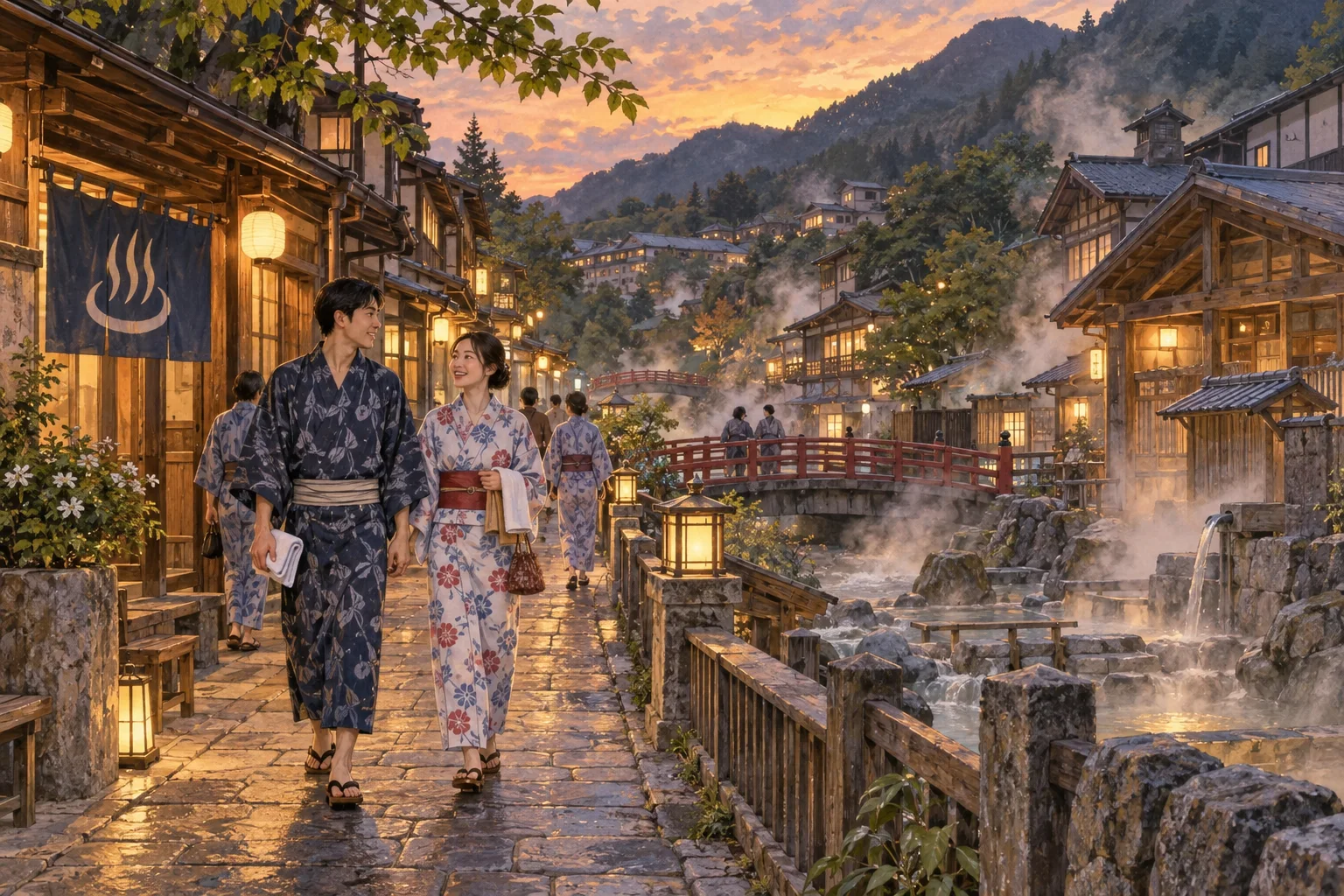
In one line
The shortest answer that works
An onsengai is a hot spring town where guests walk the streets in cotton robes and wooden sandals.
温泉街とは、客が浴衣に下駄で通りを歩く温泉の町のことです。
In 30 seconds
The standard explanation
An onsengai is the town that grows around hot springs: inns along a narrow street, public bathhouses, souvenir shops, foot baths, arcade games and places selling steamed eggs and rice crackers. The distinctive custom is that guests wear the inn's cotton yukata and wooden sandals outside, which is normal there and nowhere else.
温泉街とは、温泉のまわりに育った町のことです。狭い通りに沿って宿が並び、共同浴場、土産物屋、足湯、遊技場、温泉卵や煎餅を売る店があります。特徴的な習慣は、客が宿の浴衣と下駄のまま外を歩くことで、それはその町ではふつうのことですが、ほかでは違います。
As a short speech
A full paragraph you can read aloud
An onsengai is a hot spring town, and it has its own atmosphere that exists nowhere else in Japan. The inns line a narrow street, and in the evening the street fills with guests wearing the cotton yukata provided by their inn, with a jacket over it in winter, clopping along in wooden sandals.
Walking around town in what is essentially indoor clothing is completely normal there and would be strange anywhere else. The shops are geared to this: bathhouses you can enter for a few hundred yen, foot baths, shooting galleries and old arcade games, shops selling steamed eggs cooked in the spring water, pickles and rice crackers.
Many towns have a circuit of several public baths with a stamp card. A practical note: the street can be steep and wooden sandals are slippery on wet stone, so take small steps and do not be embarrassed to wear your own shoes.
温泉街は温泉の町で、日本のほかのどこにもない空気を持っています。狭い通りに宿が並び、夕方になるとその通りは、宿の浴衣を着て、冬ならその上に羽織をはおり、下駄を鳴らして歩く客でいっぱいになります。
要するに部屋着のまま町を歩くわけですが、そこではまったくふつうのことで、ほかの場所なら奇異に映ります。店もそれに合わせています。数百円で入れる共同浴場、足湯、射的や古い遊技機、温泉の湯で蒸した卵や漬物や煎餅を売る店。
いくつかの外湯をめぐるスタンプの札を用意している町も多くあります。実際的な注意をひとつ。通りは急なことがあり、濡れた石畳の上で下駄はよく滑ります。歩幅を小さくし、自分の靴を履くことをためらわないでください。
Questions people actually ask
And how to answer them.
Can I really walk around town in a yukata?
In a hot spring town, yes, and most guests do. Wear the left side over the right, tie the sash comfortably, and take the inn's jacket if it is cold. This is specific to hot spring towns, not something to do in a city.
温泉街ならそうですし、多くの客がそうしています。左側を上に重ね、帯は楽に締め、寒ければ宿の羽織を持って出てください。これは温泉街だけの習慣で、街なかでするものではありません。
What are the public baths along the street?
They are separate bathhouses, often older than the inns, run by the town or a local association. Entry is usually a few hundred yen, and many inns give guests a pass or a stamp card for a set of them.
外湯と呼ばれる別の共同浴場で、宿より古いことも多く、町や地元の組合が運営しています。入浴料はたいてい数百円で、複数の外湯をめぐる手形やスタンプの札を宿が渡してくれることもあります。
Phrases you can use
- You can walk around in the inn's yukata.宿の浴衣で外を歩けます。
- Left side over right when you put it on.左側を上に重ねて着てください。
- The wooden sandals are slippery when wet.下駄は濡れると滑ります。
- The inn gives you a pass for the public baths.宿が外湯の手形をくれます。
Words you need
- hot spring town温泉街
- public bath (outside the inn)外湯
- cotton robe浴衣
- wooden sandals下駄
Watch
From YouTubeBackground (Japanese)
外湯めぐりの文化で知られる温泉地には、兵庫県の城崎温泉や長野県の渋温泉などがあります。城崎では宿の客が七つの外湯をめぐる習わしがあり、浴衣で歩く姿がそのまま町の景色になっています。温泉街に射的や卓球が残っているのは、娯楽の少なかった時代の名残です。近年は空き旅館の増加や後継者不足に悩む温泉地も多く、町並みの保存と再生が課題になっています。