otokoyu and onnayu
the separate men's and women's baths
男湯と女湯(おとこゆとおんなゆ)
In one line
The shortest answer that works
Most Japanese baths are split into a men's side and a women's side, marked by a curtain.
日本の風呂屋や温泉の多くは男湯と女湯に分かれ、のれんで区別されています。
In 30 seconds
The standard explanation
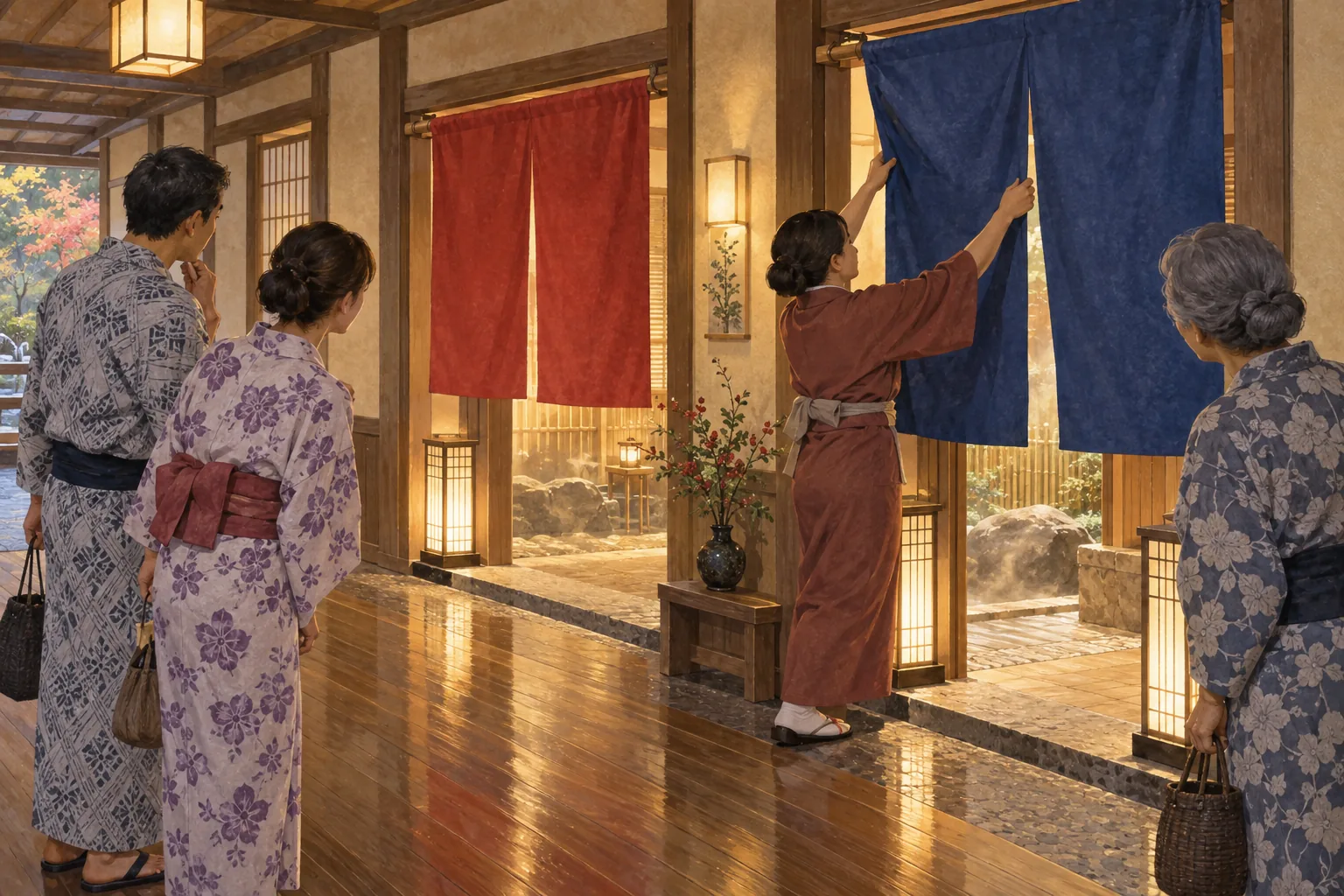
At most onsen and sento, men and women bathe separately. The entrances are usually marked with a noren, or cloth curtain, showing the character for man or woman, and often blue for men and red for women, though colors vary. At many ryokan, the two baths swap at a set time each day, so guests can try both. Always read the sign before walking in.
多くの温泉や銭湯では、男女は別々に入浴します。入口にはたいてい「男」「女」の字が書かれたのれんが掛かっていて、男湯は青、女湯は赤のことが多いですが、色はさまざまです。多くの旅館では決まった時間に2つの浴場が入れ替わり、泊まり客は両方を楽しめます。入る前には必ず表示を確かめてください。
As a short speech
A full paragraph you can read aloud
In Japan, public baths are almost always divided into a men's side, otokoyu, and a women's side, onnayu. The easiest way to tell them apart is the noren, the cloth curtain at the entrance.
It usually shows the kanji for "man" or "woman," and very often the men's is blue and the women's is red, but that's a habit, not a rule. What catches many visitors off guard is that at a lot of ryokan the baths switch sides at a certain hour, often late at night or early in the morning.
Since the two baths may have different views or outdoor pools, swapping lets every guest enjoy both. The catch is that the door you used last night may now lead to the other gender's bath. I always recommend checking the curtain, every single time.
日本の公衆浴場は、ほぼ必ず男湯と女湯に分かれています。いちばん簡単な見分け方は、入口に掛かっている布ののれんです。たいてい男性用には「男」、女性用には「女」の字があり、男湯は青、女湯は赤であることがとても多いのですが、それは慣習であって決まりではありません。
多くの訪日客が戸惑うのは、旅館の多くで、決まった時刻、よくあるのは深夜か早朝に、浴場の男女が入れ替わることです。2つの浴場は眺めや露天風呂が違うことがあるので、入れ替えればどの客も両方を楽しめます。
困るのは、昨夜使った入口が、今は異性の浴場につながっているかもしれないことです。私はいつも、毎回のれんを確かめるよう勧めています。
Questions people actually ask
And how to answer them.
Why do the men's and women's baths switch?
The two baths are often different in size, view, or style, so swapping them is a way to be fair to everyone. It also gives overnight guests a reason to bathe twice.
2つの浴場は広さや眺め、造りが違うことが多いので、入れ替えるのが全員に公平なやり方だからです。泊まり客が2回入浴する楽しみにもなります。
Can young children go into the other parent's bath?
Yes, up to a certain age set by each prefecture. Following a 2020 change in national guidelines, many local governments, including Tokyo, now set the limit at under seven.
はい、都道府県ごとに決められた年齢までは入れます。2020年に国の指針が改められたのを受けて、東京都をはじめ多くの自治体が7歳未満としています。
What if I can't read the kanji on the curtain?
It helps to learn the two kanji for man and woman, which are simple shapes. Many places also add English or pictures, and staff are happy to point you the right way.
「男」と「女」の2つの漢字を覚えておくと便利です。形は簡単です。英語や絵で示している施設も多く、スタッフも喜んで案内してくれます。
A common misunderstanding
MYTHA blue curtain always means the men's bath and a red one the women's.
FACTThat's common but not guaranteed, and at many ryokan the sides switch during the day. The characters on the curtain are what count.
Phrases you can use
- This character means men, and this one means women.この字は男性、こちらの字は女性という意味です。
- The baths switch at 10 p.m. tonight.今夜10時に男湯と女湯が入れ替わります。
- Please check the curtain before you go in.入る前にのれんを確かめてください。
- In the morning, the other bath will be the men's.朝はもう一方の浴場が男湯になります。
- The outdoor bath is on the women's side tonight.今夜は露天風呂が女湯側です。
Words you need
- men's bath男湯
- women's bath女湯
- cloth curtain at the entranceのれん
- to switch sides入れ替わる
- changing room脱衣所
Watch
From YouTubeBackground (Japanese)
公衆浴場で何歳まで異性の浴場に入れるかは、国の指針をもとに都道府県などの条例で決まる。厚生労働省は2020年12月に指針を改め、目安を「おおむね10歳以上は混浴させない」から「おおむね7歳以上」に引き下げた。これを受けて各地で条例が改正され、東京都では2022年から7歳以上の混浴ができなくなった。旅館の入れ替え制は、造りや眺めの違う浴場を男女で公平に使うための工夫で、時刻は施設によって違う。のれんの青と赤も慣習にすぎず、色で判断するのは危うい。