kimono no kaku
the ranking that decides which kimono may be worn where
着物の格(きもののかく)
In one line
The shortest answer that works
Kimono no kaku, or kimono rank, is a formality ranking set by pattern placement and number of crests, not price.
着物の格とは、値段ではなく、柄の位置と紋の数で決まる格式の順位です。
In 30 seconds
The standard explanation
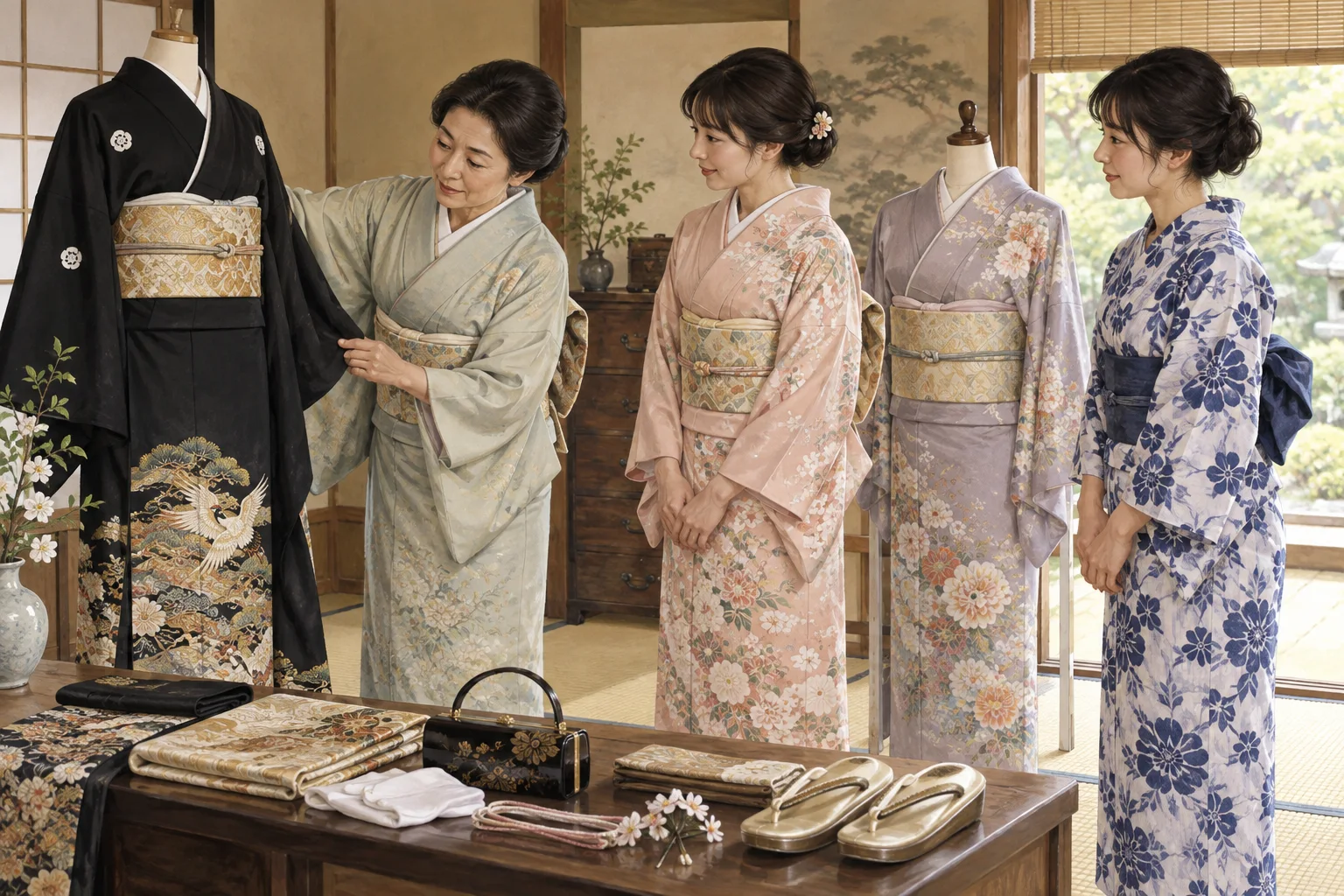
Japanese formal dress works like a ranking. At the top are kurotomesode and irotomesode for married women at weddings, and furisode for unmarried women. Below them come homongi, tsukesage, iromuji and komon, in descending formality. What decides the rank is where the pattern is placed, whether it runs across the seams, and how many family crests are dyed on. A cheap kimono can outrank an expensive one.
日本の正装には序列があります。上には、結婚式で既婚の女性が着る黒留袖と色留袖、未婚の女性の振袖。その下に、訪問着、付け下げ、色無地、小紋と続きます。格を決めるのは、柄がどこに置かれ、縫い目をまたいで続いているか、そして紋がいくつ付いているかです。安い着物が高い着物より格上になることもあります。
As a short speech
A full paragraph you can read aloud
The hard thing about kimono is not wearing one, it is knowing which one. Japanese formal dress is ranked, and the rank is readable if you know what to look at. The highest for a married woman is the kurotomesode, black, with the pattern only below the waist and five crests, worn by the couple's mothers at a wedding; the colored version is a step less formal.
For an unmarried woman the top is the furisode, with long swinging sleeves, which is why it appears at coming-of-age ceremonies. Below those, a homongi has a pattern flowing across the seams as one picture, a tsukesage a similar pattern that stops at the seams, an iromuji a single color with no pattern, and a komon a small repeating design for everyday wear.
The two things that raise or lower the rank are the placement of the pattern and the number of crests: five is the most formal, then three, then one, then none. This is why price is a poor guide: an expensive komon is still casual, and a cheap crested iromuji can go to a formal occasion.
着物で難しいのは、着ることではなく、どれを着るかです。日本の礼装には格があり、どこを見ればよいか分かれば読み取れます。既婚の女性の最上位は黒留袖。黒地で、柄は腰から下だけ、紋は五つ。結婚式で新郎新婦の母親などが着るものです。色留袖はそれより一段下がります。
未婚の女性の最上位は振袖。袖が長く垂れるので、成人式で見かけるのはこれです。その下に、縫い目をまたいで一枚の絵のように柄が続く訪問着、似た柄が縫い目で切れる付け下げ、柄のない一色の色無地、小さな柄が全体に繰り返す普段着の小紋が並びます。
格を上げ下げするのは、柄の位置と紋の数です。五つ紋が最も改まり、次が三つ紋、一つ紋、そして紋なし。だから値段は当てになりません。高価な小紋でも普段着ですし、紋の入った安い色無地は改まった席に着ていけます。
Questions people actually ask
And how to answer them.
How do I tell a homongi from a tsukesage?
Look at the seams. On a homongi the pattern continues across them as one design; on a tsukesage the motifs are placed separately and do not join up.
縫い目を見ます。訪問着は柄が縫い目をまたいで一つの絵として続き、付け下げは柄が別々に置かれてつながりません。
Can an unmarried woman wear a tomesode?
An irotomesode, yes, and it is sometimes worn by an unmarried relative at a wedding. The black kurotomesode is understood as married women's dress.
色留袖なら着られますし、結婚式で未婚の親族が着ることもあります。黒留袖は既婚の女性の装いとされています。
Does this apply to men too?
Yes, in a simpler form. Montsuki haori hakama in black with five crests is the formal top; plain kimono with haori is less so; and everyday men's kimono has no crest at all.
あります。もっと簡単です。黒の五つ紋付羽織袴が最も改まった装い、紋のない着物に羽織はそれより軽く、普段着には紋を付けません。
A common misunderstanding
MYTHThe more expensive the kimono, the more formal it is.
FACTFormality is set by pattern placement and the number of crests. A costly everyday komon still cannot be worn to a wedding.
Phrases you can use
- Kimono are ranked by how formal they are.着物には格があります。
- The number of crests shows the rank — five is highest.紋の数が格を示し、五つ紋が最上です。
- On a homongi the pattern crosses the seams.訪問着は柄が縫い目をまたいで続きます。
- Komon is everyday wear, however expensive.小紋は、どんなに高価でも普段着です。
- Furisode is for unmarried women.振袖は未婚の女性の装いです。
Words you need
- black formal kimono黒留袖
- visiting wear訪問着
- single-color kimono色無地
- small repeating pattern小紋
- family crest紋
Watch
From YouTubeBackground (Japanese)
留袖の「留袖」は、袖を短く留めたことに由来するとされ、振袖の長い袖を婚礼後に詰めた習わしに結びつけて説明される。紋は五つ紋・三つ紋・一つ紋の順に格が下がり、染め抜き日向紋が最も正式とされる。色無地は紋を一つ入れると訪問着に近い扱いができるが、紋がなければ略装になる。帯にも格があり、袋帯と名古屋帯では着られる場が変わる。