haori
the short jacket worn open over a kimono
羽織(はおり)
In one line
The shortest answer that works
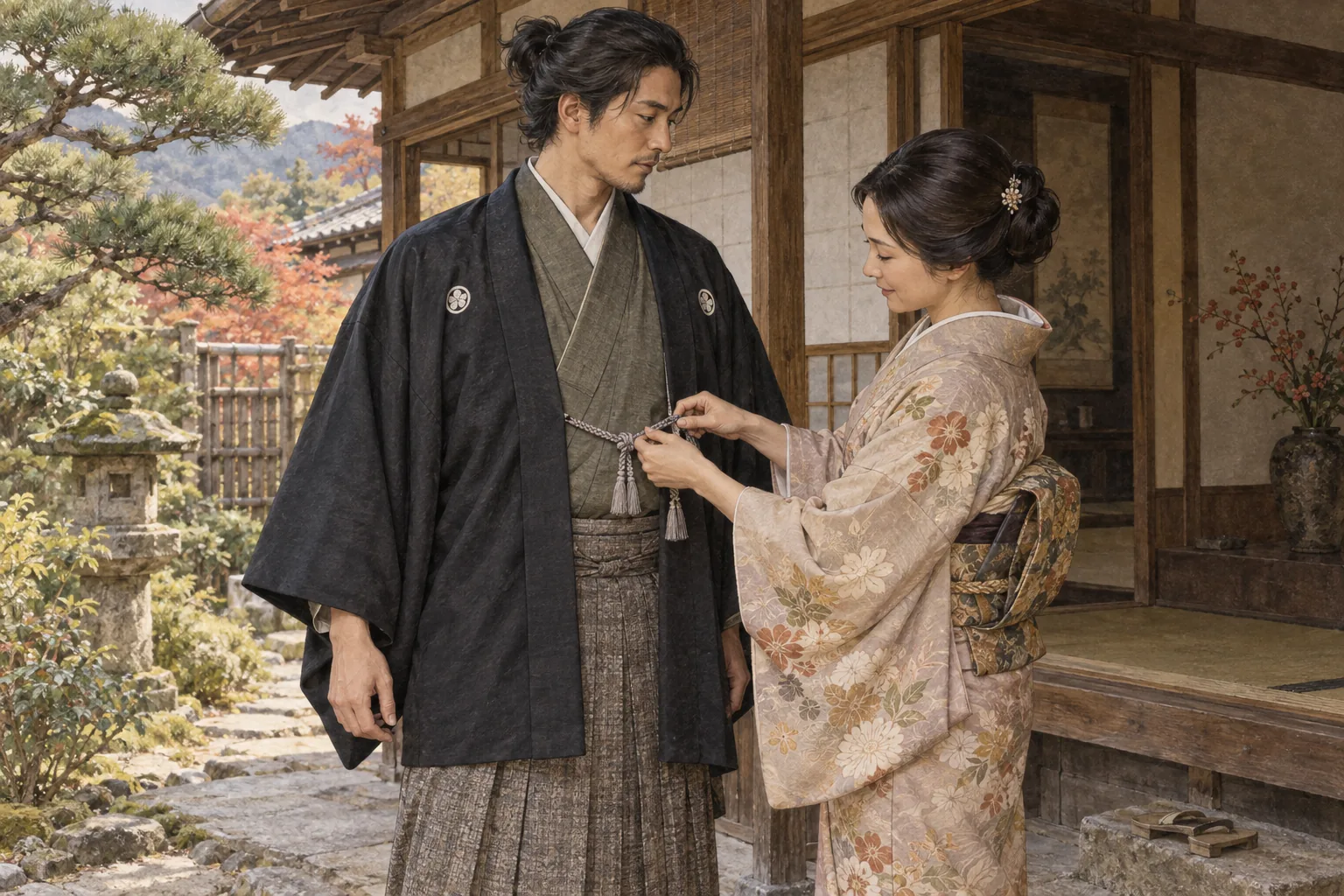
A haori is a short, open-front jacket worn over a kimono, once restricted to men but now worn by anyone.
羽織は着物の上に着る短い前開きの上着で、かつては男性のものでしたが今は誰でも着ます。
In 30 seconds
The standard explanation
A haori is a hip-to-thigh-length jacket worn open over a kimono, closed only loosely by a cord called haori-himo rather than wrapped and tied like the kimono underneath. It adds a layer of formality and warmth without the fuss of a full formal kimono, and its lining is often the most decorated part, hidden unless the wearer lifts the front. For much of the Edo period, women were generally not supposed to wear one at all, and women's haori only became common from the Meiji era (1868-1912) onward.
羽織は腰からももあたりまでの丈の上着で、着物のように体に巻いて帯で結ぶのではなく、羽織紐という紐で軽く前を留めるだけで着ます。格式と暖かさを一枚で加えられ、正式な着物ほどの手間はかかりません。裏地がいちばん凝っていることも多く、前を開けたり動いたりしたときだけ見えます。江戸時代の大半、女性は基本的に羽織を着ないものとされ、女性の羽織が広まったのは明治時代以降とされます。
As a short speech
A full paragraph you can read aloud
A haori looks almost like an afterthought next to a kimono, a short open jacket thrown over the top and held closed by a single cord, but the rules around it used to be strict. Through most of the Edo period, haori were considered men's outerwear, and women who wore one, mainly geisha in certain districts, were doing something close to transgressive; it wasn't until the late nineteenth and early twentieth centuries that haori for women became fully accepted, ordinary wear.
Part of its appeal is the contrast between outside and in: the visible fabric is often understated, dark or plain, while the lining can be wildly patterned, a private flourish that only shows when the wearer moves or lifts the front open. Paired with hakama trousers, a men's haori becomes one of the most formal combinations in Japanese dress, seen at weddings and graduations even now. For everyday wear it does something more practical: a haori adds warmth and a layer of politeness over an ordinary kimono without requiring the more elaborate tying a formal outer robe would need.
羽織は着物の隣に置くと、ほとんど付け足しのように見えます。上から羽織って一本の紐で留めるだけの短い上着だからです。しかし、その扱いにはかつて厳しい決まりがありました。江戸時代の大半、羽織は男性の外衣とされ、女性がそれを着ること、主に一部の花街の芸者に限られていましたが、それはほとんど規範を踏み外す行為でした。
女性の羽織が広く受け入れられ、ふつうの装いになったのは、19世紀の終わりから20世紀初めにかけてのことです。羽織の魅力の一つは、表と裏の対比にあります。表地は控えめで地味な色が多い一方、裏地は思い切り派手な柄になることがあり、これは着ている人が動いたり前を開けたりしたときにだけ見える、いわば秘密の遊び心です。
男性の羽織を袴と合わせると、日本の装いの中でも最も正式な組み合わせの一つになり、今でも結婚式や卒業式で目にします。日常では、より実用的な役割を果たし、正式な外衣ほど複雑に結ばなくても、ふだんの着物の上に暖かさと礼儀正しさの一枚を加えてくれます。
Questions people actually ask
And how to answer them.
Is a haori the same as a kimono?
No, it's a separate short jacket worn over a kimono, closed loosely with a cord rather than a full sash, and it can be added or removed without changing the kimono underneath.
いいえ、着物の上に着る別の短い上着で、帯ではなく紐で軽く留めるだけです。下の着物を着替えずに、羽織だけを足したり脱いだりできます。
Why is the inside lining sometimes so much more decorated than the outside?
It became a way to express personal taste discreetly, especially for men whose outer kimono and haori were expected to look restrained; a wild lining was a private flourish only glimpsed when the coat moved.
特に男性は、表に出る着物や羽織を控えめに見せることが求められたため、裏地は個人の好みをひそかに表現する場になりました。派手な裏地は、上着が動いたときにだけちらりと見える、秘密の楽しみだったのです。
Do women wear haori too?
Yes, commonly today, though for much of the Edo period it was considered men's clothing and women wearing one, mostly certain geisha, stood out as unusual.
はい、今では一般的です。ただし江戸時代の大半は男性の衣服とされ、それを着る女性、主に一部の芸者は、珍しい存在として目立っていました。
A common misunderstanding
MYTHHaori have always been worn by both men and women equally.
FACTFor most of the Edo period they were treated as men's outerwear, and haori for women only became broadly accepted from the Meiji era onward.
Phrases you can use
- This haori has a beautiful lining.この羽織は裏地がきれいです。
- He wore a haori and hakama to the ceremony.式には羽織袴で出席しました。
- Just tie the cord loosely.紐は緩く結んでください。
- A haori adds a layer of formality.羽織を羽織ると格が上がります。
- You can wear a haori over most everyday kimono.ふだんの着物なら、たいてい羽織を合わせられます。
Words you need
- short outer jacket羽織
- jacket cord羽織紐
- lining裏地
- trousers worn with kimono袴
- formal outfit正装
Watch
From YouTubeBackground (Japanese)
羽織は江戸時代、基本的に男性の上着とされ、女性が着ることは一部の芸者などを除いて認められていなかった。女性の羽織が広く受け入れられるようになったのは明治から大正、昭和初期にかけてとされる。表地は無地や落ち着いた柄が多い一方、裏地には派手な絵柄を仕立てる「裏勝り」という洒落があり、羽織を脱いだときや動いたときにだけ見える。紐を結ぶだけで着られる手軽さから、防寒と格式を兼ねた実用着として今も使われている。