montsuki hakama
formal Japanese dress for men
紋付袴(もんつきはかま)
In one line
The shortest answer that works
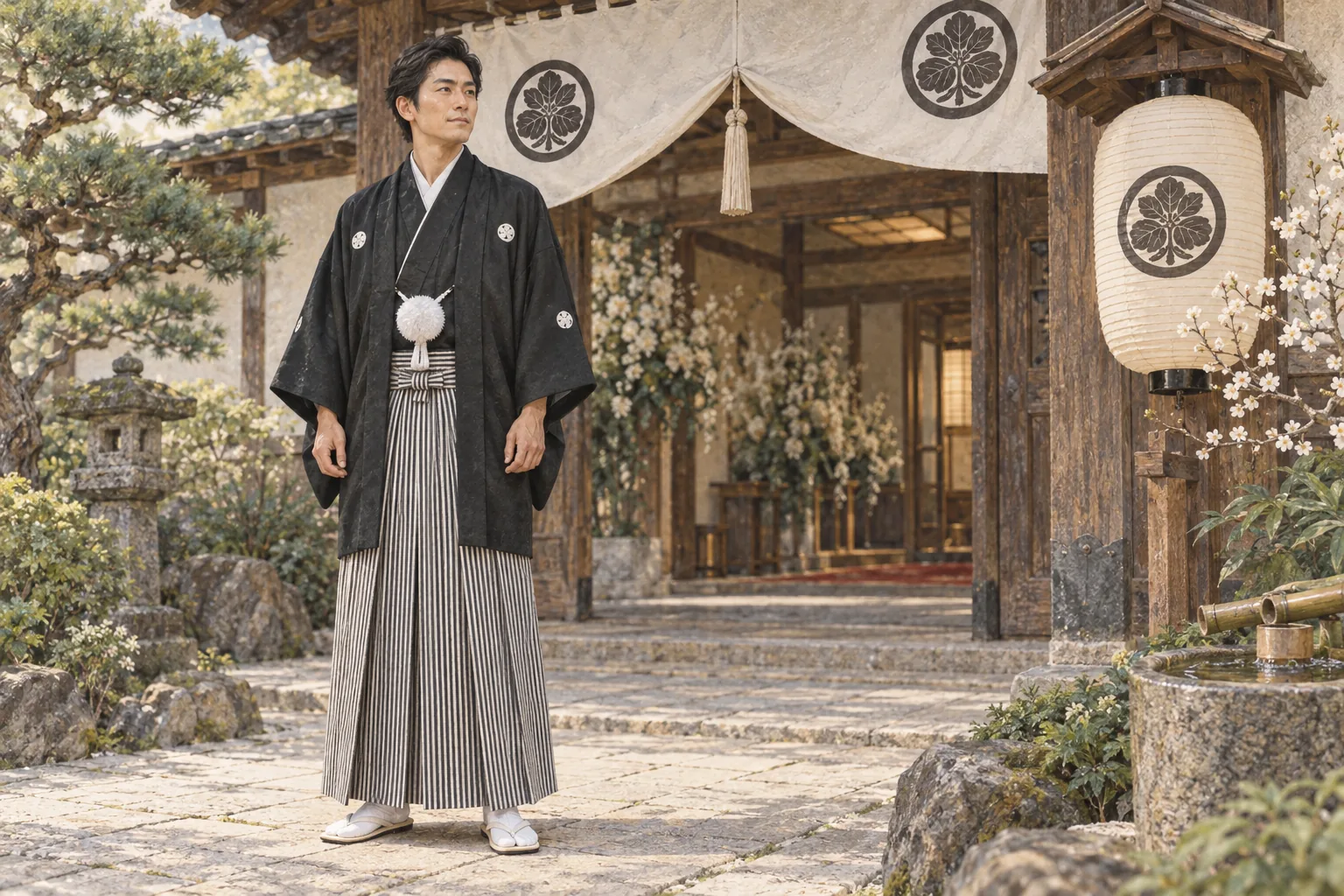
Montsuki hakama is the most formal traditional outfit for Japanese men, marked by the family crests on it.
紋付袴は日本の男性の第一礼装で、家紋が入っていることがその印です。
In 30 seconds
The standard explanation
The full formal outfit for a man is a black kimono bearing five family crests, worn with a pleated divided skirt called hakama and a short jacket called haori. It appears at weddings, at the coming-of-age ceremony and in traditional arts. The number of crests indicates the level of formality: five is the highest, then three, then one.
男性の完全な礼装は、家紋を五つ入れた黒い着物に、袴とよばれるひだのある下衣、そして羽織を合わせたものです。結婚式、成人式、伝統芸能の場で着られます。紋の数が格式を示し、五つ紋が最も高く、次いで三つ紋、一つ紋となります。
As a short speech
A full paragraph you can read aloud
The most formal traditional dress for a Japanese man is called montsuki hakama. It has three parts: a black kimono carrying the family crest, a pleated divided garment worn over it called hakama, and a short jacket called haori. What makes it formal is the crest.
Each family has its own emblem, a simplified design in a circle, and the number placed on the garment sets the level: five crests is the highest formality, then three, then one. You see it at weddings, where the groom often wears it, at the coming-of-age ceremony, and in kendo, kyudo and traditional performing arts, where hakama is standard practice wear.
There is a good story attached to the hakama's seven pleats: they are often explained as representing seven virtues of the samurai. Whether or not that was the original reason, it is what people are taught when they first learn to fold one.
日本の男性の最も格式の高い伝統的な装いを紋付袴といいます。三つの部分からなります。家紋の入った黒い着物、その上に着けるひだのある袴、そして羽織です。格式を決めるのは紋です。
家ごとに丸の中に収めた簡略な意匠の家紋があり、衣服に入れる数で格が決まります。五つ紋が最も高く、次に三つ紋、一つ紋。結婚式で新郎が着ることが多く、成人式でも、剣道・弓道や伝統芸能でも見られます。
袴は稽古着として標準です。袴のひだが七本あることにはよい言い伝えがあります。武士の七つの徳を表す、という説明です。もとの理由がそうだったかはともかく、袴のたたみ方を最初に習うとき、人はそう教わります。
Questions people actually ask
And how to answer them.
What exactly is a family crest?
A kamon, a simplified emblem in a circle identifying a family line. There are thousands of designs, often based on plants, birds or geometric shapes, and most Japanese families still have one even if they never use it.
家紋です。丸の中に収めた簡略な意匠で、家の系統を示します。植物・鳥・幾何学模様を基にした意匠が何千とあり、使う機会がなくても、多くの家が今も持っています。
Do women wear hakama?
Yes. Women wear hakama at university graduation ceremonies, a style dating from the Meiji era when it was worn by female students and teachers, and also in kyudo and other arts.
着ます。大学の卒業式で女性が袴を着る装いは、明治期に女学生や女性教員が着ていた形に由来します。弓道などの武道でも着ます。
Is it common at weddings?
For the groom in a Shinto-style wedding, yes. Many couples now have a Western-style ceremony instead, so the outfit appears less often than it used to.
神前式の新郎なら一般的です。今は洋式の挙式を選ぶ人も多いので、以前より見る機会は減りました。
Phrases you can use
- Five crests is the highest level of formality.五つ紋がいちばん格式の高い形です。
- Each family has its own crest.家ごとに家紋があります。
- The hakama is worn over the kimono.袴は着物の上に着けます。
- Women wear hakama at graduation ceremonies.女性は卒業式に袴を着ます。
- The seven pleats are said to stand for seven virtues.七本のひだは七つの徳を表すと言われます。
Words you need
- family crest家紋
- pleatひだ
- formality (level of)格式
- groom新郎
- emblem紋章、意匠
Watch
From YouTubeBackground (Japanese)
家紋は平安時代の公家が牛車や調度に付けた印に始まり、武家が戦場での識別に用いたことで広まった。意匠は数千種あり、桐・藤・鷹の羽・橘などの図案が知られる。日本政府が用いる五七桐は、豊臣秀吉が用いたことでも知られる桐紋の一つである。袴の腰板や紐の結び方にも決まりがあり、男袴の「馬乗袴」と「行灯袴」は、脚が分かれているかどうかで区別される。女性が卒業式に袴を着る習慣は、明治期の女学校で女性教員や学生が動きやすさのために袴を用いたことに由来し、大正期の「はいからさん」の装いとして定着した。