tenugui
a thin cotton cloth
手ぬぐい(てぬぐい)
In one line
The shortest answer that works
A tenugui is a thin cotton cloth used as a towel, a headband, a wrapper and a decoration.
手ぬぐいとは、手拭きにも鉢巻にも包みにも飾りにもなる薄い木綿の布です。
In 30 seconds
The standard explanation
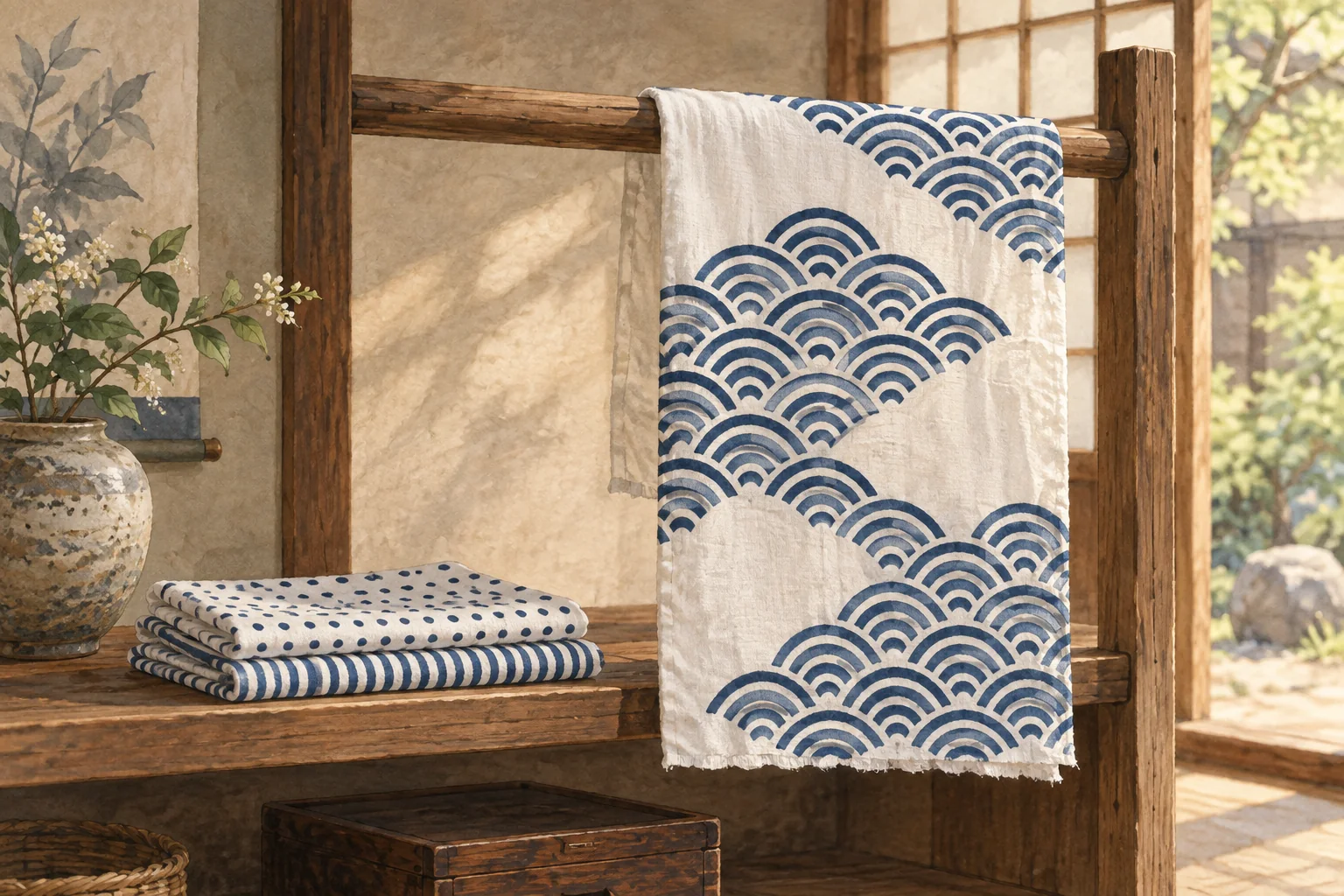
A tenugui is a thin rectangular cotton cloth, roughly ninety by thirty-five centimeters. The short ends are left unhemmed, so it dries quickly and does not hold water in a seam. People use it as a hand towel, a headband, a face cloth in the bath, a wrapper for a bottle, and increasingly as something to frame and hang on a wall.
手ぬぐいは薄い長方形の木綿の布で、おおよそ90センチかける35センチです。短い辺は縫わずに切りっぱなしにしてあるため、早く乾き、縫い目に水が残りません。手拭き、鉢巻、風呂で体を洗う布、瓶の包み、そして近ごろは額に入れて壁に掛けるものとしても使われます。
As a short speech
A full paragraph you can read aloud
A tenugui is a plain rectangle of thin cotton, and it is one of those objects that does far more than it looks capable of. It is a hand towel, a face cloth in the bath, a headband for a festival, a cover for a lunch box, a wrapper for a bottle, a cloth to wipe a table, and, since the designs are often beautiful, something people hang on the wall and change with the season.
The short ends are deliberately not hemmed. A hem holds water and breeds smell, and an unhemmed edge dries fast and can be torn to size or torn into a bandage. The threads fray for the first few washes and then stop.
The traditional dyeing method soaks the color right through, so the pattern looks the same on both sides, which is how you tell a traditionally dyed one from a printed souvenir.
手ぬぐいは薄い木綿の、ただの長方形です。そして見た目よりはるかに多くのことができる道具のひとつです。手拭きであり、風呂で体を洗う布であり、祭りの鉢巻であり、弁当の覆いであり、瓶の包みであり、卓を拭く布であり、柄が美しいので季節ごとに掛け替える壁の飾りにもなります。
短い辺はわざと縫っていません。縫い目は水を含んで匂いのもとになりますが、切りっぱなしの端は早く乾き、必要なら裂いて大きさを変えたり、包帯にしたりできます。
糸は最初の何度かの洗濯でほつれ、そこで止まります。伝統的な染めは色が生地を通るので、柄は裏表とも同じに見えます。伝統的な染めのものと、印刷された土産物とを見分ける目印がそこです。
Questions people actually ask
And how to answer them.
The edges are fraying. Is it faulty?
No, that is normal. The ends are cut, not hemmed, so loose threads come away for the first several washes and then the edge settles. Trim the long threads with scissors rather than pulling them.
いいえ、それでふつうです。端は縫わずに裁ってあるので、最初の何度かの洗濯で糸が抜け、やがて落ち着きます。長い糸は引っ張らずに鋏で切ってください。
How do I tell a good one from a cheap printed one?
Look at the back. In the traditional dyeing method the dye goes through the cloth, so the pattern is nearly as clear on the reverse. A screen-printed souvenir is white on the back and often feels stiffer.
裏を見てください。伝統的な染めでは染料が生地を通るので、裏側でも柄がほぼ同じように見えます。印刷した土産物は裏が白く、生地も硬めなことが多いです。
Phrases you can use
- The ends aren't hemmed so it dries fast.早く乾くように端を縫っていません。
- You can use it as a headband.鉢巻にもできます。
- The pattern shows on both sides.柄は裏表とも出ています。
- People hang them on the wall too.壁に飾る人もいます。
Words you need
- cotton cloth木綿の布
- hem縫い目
- to frayほつれる
- headband鉢巻
Watch
From YouTubeBackground (Japanese)
手ぬぐいの伝統的な染め方に「注染」があり、型紙を使って染料を注ぎ込むため、生地の裏まで色が通ります。江戸時代には手ぬぐいの柄そのものが流行になり、歌舞伎役者が用いた文様が広まりました。落語家が高座で使う小道具も手ぬぐいで、財布にも本にも見立てられます。銭湯や温泉では体を洗う布として使われ、湯船には入れないのが決まりです。店や催しの記念品として配られることも多く、安価な宣伝の品でもあります。