seifuku
the school uniform
制服(せいふく)
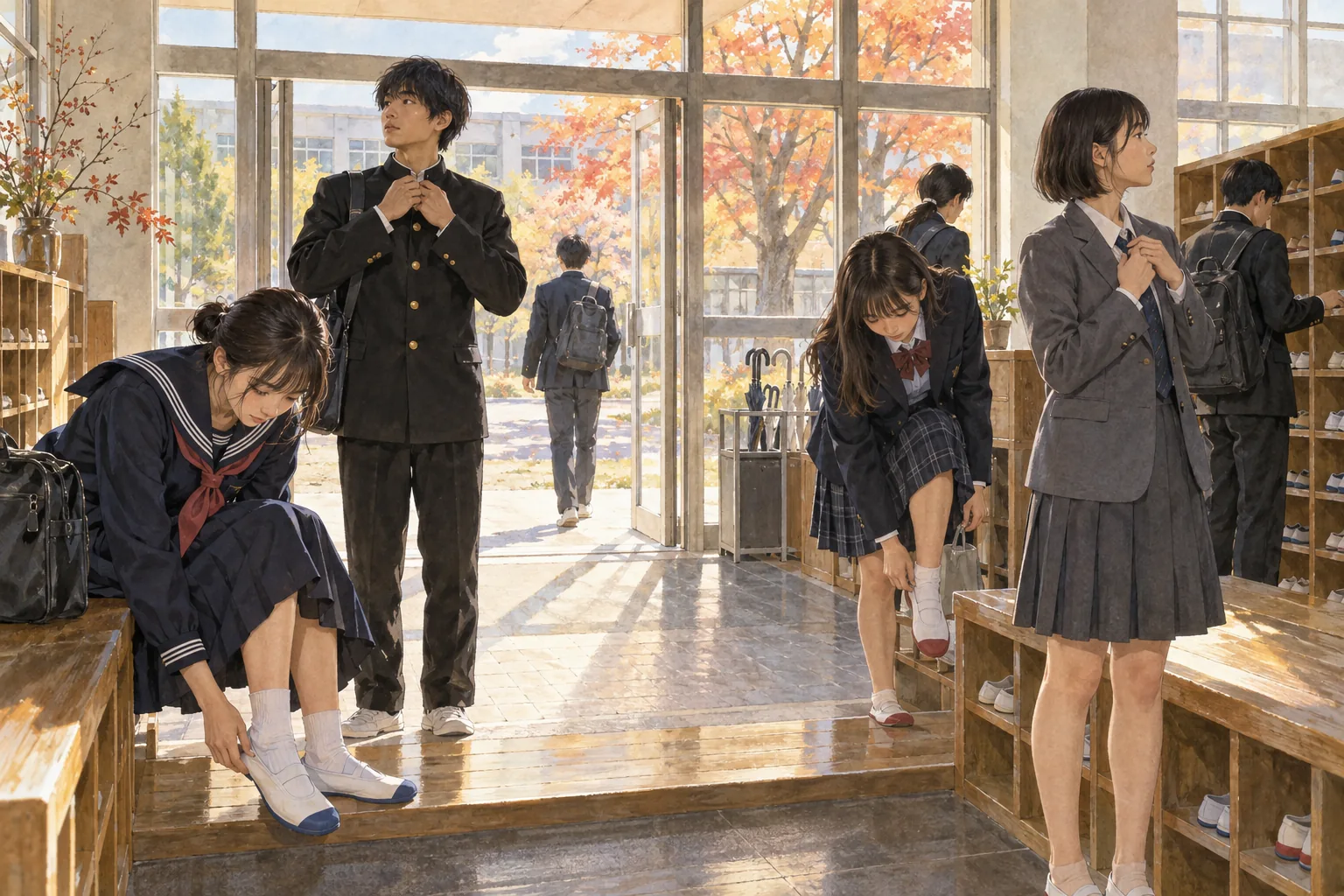
In one line
The shortest answer that works
Almost all Japanese secondary school students wear a uniform, and many schools set detailed rules for it.
日本の中学生・高校生のほとんどが制服を着ており、それに関する細かな校則を持つ学校も多くあります。
In 30 seconds
The standard explanation
Uniforms are standard from junior high school onward. The classic styles are the sailor top for girls and the stand-collar jacket for boys, though blazers are now more common. Rules often extend well beyond the clothes, covering hair length, sock color and whether you may wear a coat, and those rules have become a subject of national debate.
制服は中学校からが標準です。伝統的な型は女子のセーラー服と男子の学ランですが、今はブレザーのほうが多くなっています。校則は服そのものを超えて、髪の長さ、靴下の色、コートを着てよいかまで及ぶことが多く、その細かさが全国的な議論になっています。
As a short speech
A full paragraph you can read aloud
School uniforms are near-universal in Japanese junior and senior high schools. The two traditional styles are the sailor top for girls, and for boys a black jacket with a stand-up collar. Both have military origins: the sailor style came from European naval uniforms, and the boys' jacket is usually said to be modeled on nineteenth-century European army uniforms.
Today many schools have moved to blazers. What surprises people is how far the rules go beyond the uniform itself. Some schools specify the color of your socks, the length of your hair, whether you may wear a coat on the way to school, and even the color of your underwear.
In recent years these have been called black rules in Japanese, and there has been serious pushback. Several boards of education have ordered schools to review them, and some schools now let students choose between a skirt and trousers.
日本の中学・高校では制服がほぼ全員に共通です。伝統的な二つの型は、女子のセーラー服と、男子の詰襟の黒い上着です。どちらも軍服が起源で、セーラー服はヨーロッパの海軍の制服から、男子の学ランは19世紀のヨーロッパの軍服を手本にしたとされます。
今は多くの学校がブレザーに移行しました。驚かれるのは、規則が制服そのものを超えて広がっている点です。靴下の色、髪の長さ、登下校でコートを着てよいか、さらには下着の色まで定める学校もあります。
近年これらは「ブラック校則」と呼ばれ、本格的な反発が起きました。複数の教育委員会が校則の見直しを指示し、スカートとスラックスを選べるようにした学校も出ています。
Questions people actually ask
And how to answer them.
Why does everyone look the same?
The usual explanations are that it removes visible differences in family income, makes students identifiable in public, and marks a boundary between school and home. Whether it achieves those is argued about.
よく挙げられる理由は、家庭の経済差が服に出ないこと、外で生徒だと分かること、学校と家の区切りになることです。それが実現できているかは議論があります。
Are uniforms expensive?
Yes, and this is a real complaint. A full set including summer and winter versions and sports kit can cost a significant amount at the start of junior high, and second-hand schemes have grown because of it.
高く、これは実際の不満です。夏服・冬服・体操着まで一式そろえると中学入学時にかなりの額になり、そのため制服のリユースの取り組みが広がっています。
Can students choose skirts or trousers now?
An increasing number of schools allow it, often introduced as an option for all students rather than for particular students, so that choosing does not single anyone out.
選べる学校が増えています。特定の生徒向けではなく全員の選択肢として導入することが多く、選んだこと自体が目立たないよう配慮されています。
A common misunderstanding
MYTHJapanese students love their uniforms because of anime.
FACTAttitudes are mixed. Many students like the convenience and the look, and many resent the rules attached to them. The fondness in anime is a stylized version, not a survey result.
Phrases you can use
- Uniforms start from junior high school.制服は中学校からです。
- There's a summer version and a winter version.夏服と冬服があります。
- The rules cover hair and socks too.校則は髪や靴下にも及びます。
- The boys' jacket was based on a European army uniform.学ランはヨーロッパの軍服がもとになっています。
- More schools now let students choose trousers or a skirt.スラックスとスカートを選べる学校が増えています。
Words you need
- uniform制服
- school rules校則
- blazerブレザー
- second-hand中古の、お下がりの
- conform従う、合わせる
Watch
From YouTubeBackground (Japanese)
男子の詰襟(学ラン)は1886年に帝国大学が採用したのが始まりとされ、当時のヨーロッパの軍服に範をとった。女子のセーラー服は1920年代に平安女学院や福岡女学院などで採用された記録があり、西洋の子ども服・海軍の制服が源流とされる。「ブラック校則」という言葉は2017年ごろから広まり、大阪府の高校で生まれつき茶色い髪を黒く染めるよう指導されたことが訴訟になった件が大きく報じられた。その後、東京都は2022年に都立高校で「地毛証明書」や下着の色の指定など5項目の校則を全廃した。制服のリユース事業やジェンダーレス制服の導入も広がっている。