gakuseifuku
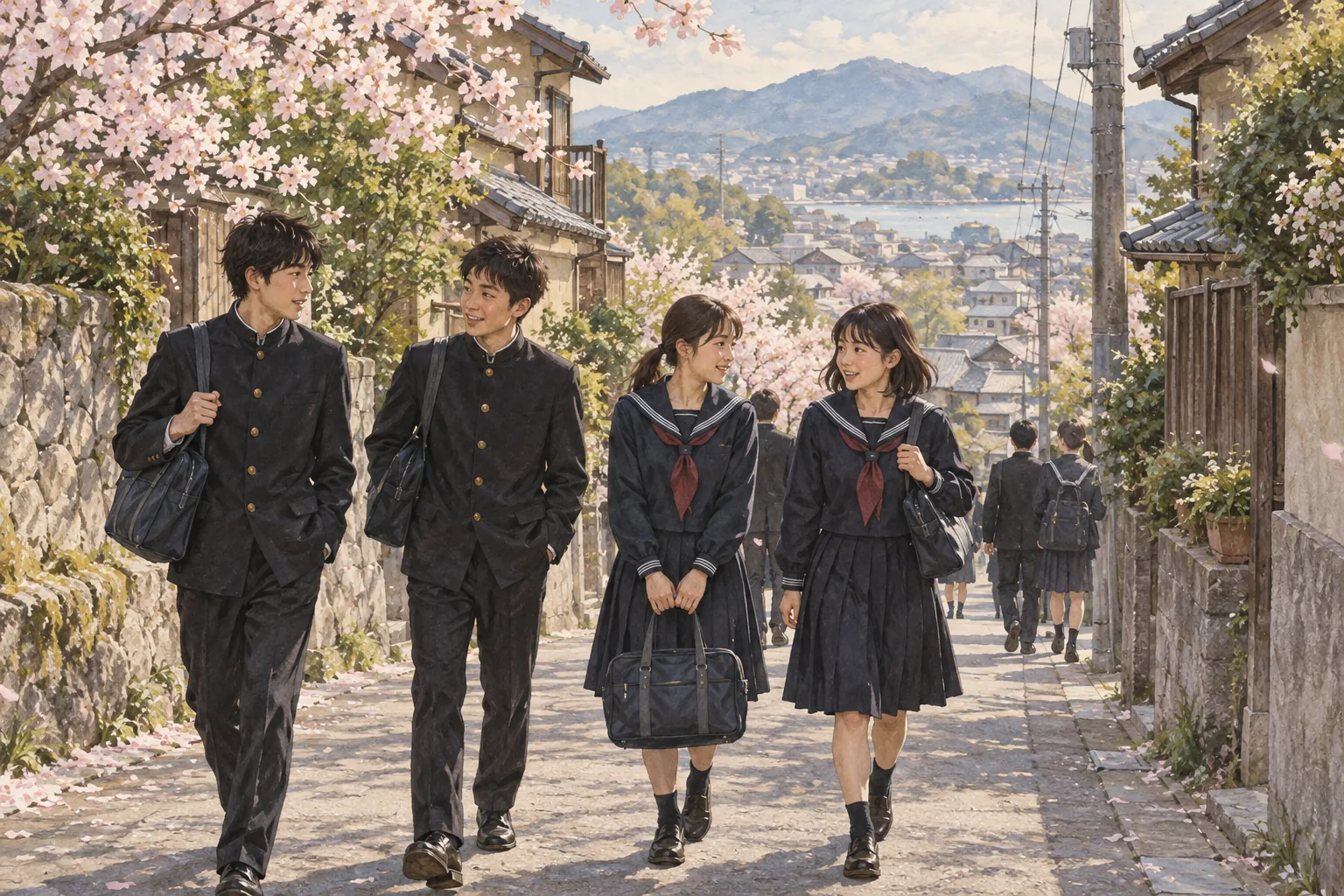
the classic Japanese school uniform: the stand-collar jacket and the sailor blouse
学生服(がくせいふく)
In one line
The shortest answer that works
The classic Japanese school uniform copies European military dress, not Japanese traditional clothing.
日本の伝統的な学生服は、和服ではなくヨーロッパの軍服をまねたものです。
In 30 seconds
The standard explanation
The two uniforms people picture when they think of Japan are the boys' black jacket with a stiff stand-up collar, and the girls' sailor blouse. Neither comes from Japanese clothing. The stand-collar jacket follows a European military pattern adopted in the Meiji era, and the sailor blouse copies a European naval style taken up by girls' schools in the 1920s. Many schools have since switched to blazers, but both are still worn.
日本と聞いて思い浮かぶ制服は、男子の詰襟の黒い上着と、女子のセーラー服でしょう。どちらも和服から来たものではありません。詰襟は明治期に取り入れられたヨーロッパの軍服の型を引き継いでおり、セーラー服はヨーロッパの海軍の様式を女学校が1920年代に採り入れたものです。その後ブレザーに変えた学校も多いですが、両方とも今も着られています。
As a short speech
A full paragraph you can read aloud
The Japanese school uniform is one of the most recognizable things about the country abroad, and most people assume it is somehow traditional. It is not. In the Meiji era, when Japan was rebuilding its institutions along European lines, universities and then schools adopted a jacket with a stiff standing collar, based on a European military pattern.
For girls, schools in the 1920s took up the sailor blouse, which was a European style for children at the time. Which school was first is disputed. So the uniform that looks most Japanese to foreigners is actually a record of the moment Japan decided to look Western.
Today many schools use blazers instead, and rules about skirt length and hair have been publicly criticized and loosened in a number of places. But if you go to a station at four in the afternoon, you will still see both.
日本の学生服は、海外でもっともよく知られたものの一つで、たいていの方は伝統的なものだと思っています。違います。明治期、日本が制度をヨーロッパに合わせて作り直していたころ、大学が、続いて学校が、ヨーロッパの軍服の型をもとにした硬い立ち襟の上着を採り入れました。
女子については、1920年代に女学校がセーラー服を採り入れました。当時のヨーロッパで子ども向けの様式だったものです。どの学校が最初かには諸説あります。つまり、外国の方にいちばん日本らしく見える制服は、日本が西洋に合わせようと決めた瞬間の記録なのです。
いまは多くの学校がブレザーに変えていますし、スカートの丈や髪の決まりは公に批判され、緩めた学校もあります。それでも午後4時の駅に行けば、どちらもまだ見られます。
Questions people actually ask
And how to answer them.
Do students choose their uniform?
No. Each school has one, and it is usually bought through a designated shop, which is one reason the cost is often criticized. A full set for a first-year student can come to around 100,000 yen or more.
選べません。学校ごとに決まっていて、たいてい指定の店で買います。費用が批判される理由のひとつがこれで、新入生の一式は10万円前後かそれ以上になることもあります。
Are the strict rules about hair and skirts real?
They are real and vary a lot by school. Rules that required a particular hair color or underwear color have been reported in the news and criticized as excessive, and a number of boards of education have told schools to review them.
本当にあり、学校によって差が大きいです。髪の色や下着の色まで指定する校則が報じられ、行きすぎだと批判されました。見直すよう学校に求めた教育委員会もあります。
Can students wear the uniform outside school?
They do constantly — going to cram school, meeting friends, on weekends. Because the uniform identifies the school, behaving badly in it is treated as reflecting on the school, which is part of why the rules exist.
日常的に着ています。塾へ行くとき、友達と会うとき、休日も。制服はどの学校かが分かるので、着たまま行儀が悪いと学校の評判に関わるとされます。校則がある理由のひとつでもあります。
A common misunderstanding
MYTHThe sailor uniform is traditional Japanese dress for girls.
FACTIt is a European naval style adopted by Japanese girls' schools in the 1920s. Traditional Japanese clothing for students would have been kimono with hakama.
Phrases you can use
- The uniform isn't traditional — it copies European military dress.制服は伝統的なものではなく、ヨーロッパの軍服をまねたものです。
- Each school has its own, and you can tell the school from it.学校ごとに決まっていて、見ればどこの学校か分かります。
- A lot of schools have switched to blazers.ブレザーに変えた学校も多いです。
- Students wear it outside school too, not just in class.授業のときだけでなく、学校の外でも着ています。
- The rules about hair and skirt length can be strict.髪やスカートの丈の決まりは、厳しいことがあります。
Words you need
- stand-up collar詰襟、立ち襟
- sailor blouseセーラー服
- blazerブレザー
- school rules校則
- designated shop指定店
Watch
From YouTubeBackground (Japanese)
詰襟の学生服は、明治期に大学の制服として洋式の立ち襟の上着が採用されたことに始まるとされ、のちに中学校へ広がった。俗称の「学ラン」の「ラン」は、江戸時代に洋服をオランダ由来のものとして「ランダ」と呼んだ名残という説があるが、由来には諸説ある。セーラー服は1920年代に女学校で採り入れられ、最初に導入した学校については複数の説がある。制服の価格や校則の厳しさは近年たびたび議論になり、ジェンダーに配慮してスカートとスラックスを選べるようにする学校も増えている。