haneri
the decorative collar sewn onto a kimono's underlayer, replaced more often than the kimono itself
半襟(はんえり)
In one line
The shortest answer that works
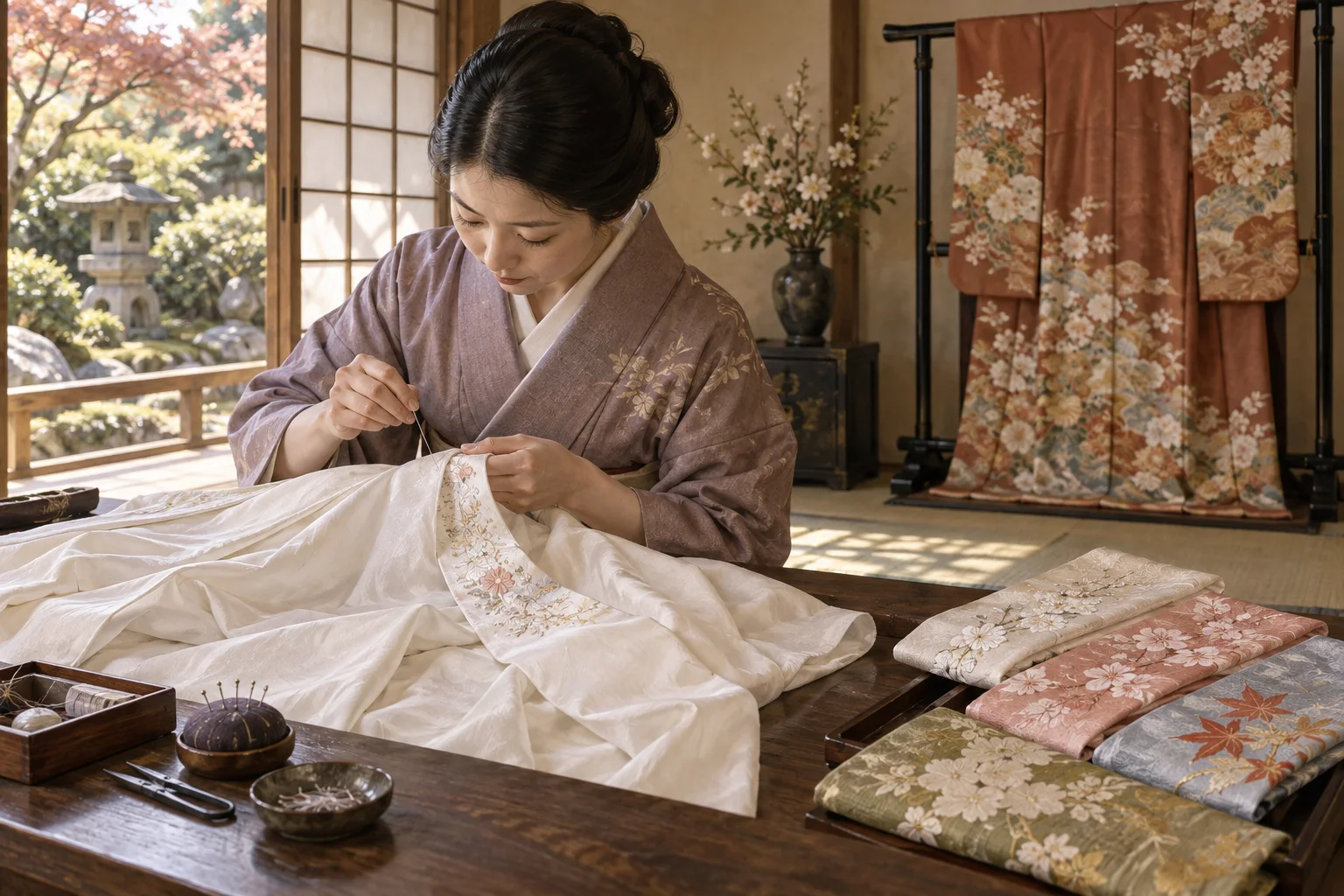
Haneri is the decorative collar sewn onto the underlayer worn beneath a kimono, not the kimono itself.
半襟とは、着物本体ではなく、その下に着る襦袢に縫い付ける飾り衿のことです。
In 30 seconds
The standard explanation
A haneri is a narrow strip of decorated fabric basted onto the collar of the nagajuban, the underlayer worn beneath a kimono, so only its edge shows at the neckline. Because it sits closest to the skin and the makeup around the neck, it gets dirty faster than the kimono or even the juban itself, so it's designed to be unstitched and swapped out easily rather than washed in place. Choosing one, plain white for formal wear, patterned or colored for something more casual, is one of the few decisions left to personal taste in an otherwise fixed outfit.
半襟とは、着物の下に着る襦袢の衿に、糸で仮止めして付ける細長い飾り布で、着物を着たときには衿元からその端だけがのぞきます。肌や首まわりの化粧品に最も近い部分にあるため、着物や襦袢本体よりも先に汚れやすく、洗うのではなく糸をほどいて簡単に付け替えられるように作られています。フォーマルな場では白無地、それ以外では柄物や色物を選ぶなど、ほぼ決まりきった装いの中で、数少ない個人の好みが出せる部分でもあります。
As a short speech
A full paragraph you can read aloud
Look closely at the neckline of someone wearing a kimono and the sliver of fabric peeking out just above the collar isn't the kimono at all — it's the haneri, a decorative strip basted onto the nagajuban, the under-robe worn beneath everything else. It exists because that spot touches the skin and neck makeup directly, taking more wear than any other part of the outfit, and a haneri is simple to remove and replace by hand, unlike the kimono, which is far harder to clean.
Rules around it are loose but real: plain white is the safe, formal choice for weddings or tea ceremony, while colored or embroidered haneri suit everyday or dressier occasions. In Kyoto's geisha districts, changing a maiko's red haneri to a geiko's white one has traditionally marked her graduation to full status. It's a small piece of cloth carrying a surprising amount of meaning.
着物姿の人の首元をよく見ると、衿のすぐ上からのぞく布は着物そのものではありません。それは半襟という、着物の下に着る長襦袢に仮止めされた飾り布です。首や首まわりの化粧品に直接触れる位置にあり、装いのどの部分よりも先に汚れるため、洗いにくい着物とは違い、手で簡単に外して付け替えられるように作られています。
半襟には緩やかながら実際の決まりがあり、白無地は結婚式や茶道にふさわしい無難でフォーマルな選択で、色物や刺繍入りは普段着や華やかな場に向いています。
京都の花街では、舞妓の赤い半襟を芸妓の白い半襟に替えることが、一人前になったことを示す伝統的な節目とされています。見た目以上の意味を背負った、小さな布なのです。
Questions people actually ask
And how to answer them.
Why does it need to be changed so often?
It sits directly against the neck and skin, absorbing makeup, oil and sweat before anything else does, so a haneri that stayed on for months would look dingy long before the kimono or juban underneath it did.
首や肌に直接触れる位置にあるため、ほかのどの部分よりも先に化粧品や皮脂、汗を吸い込みます。半襟を何か月もそのままにしておくと、下の着物や襦袢よりずっと先に汚れて見えてしまいます。
Does the color or pattern actually mean something?
Plain white signals formality and is standard for weddings, tea ceremony and funerals, while colored or embroidered haneri are reserved for everyday or festive wear, and in Kyoto's geisha districts, switching a maiko's red haneri to a geiko's white one marks her graduation to full status.
白無地はフォーマルさを表し、結婚式や茶道、葬儀の標準になっています。一方、色物や刺繍入りの半襟は普段着や華やかな場のためのもので、京都の花街では、舞妓の赤い半襟を芸妓の白い半襟に替えることが、一人前になった証とされています。
Can I sew a haneri onto any kimono underlayer myself?
Yes, it's meant to be basted on and off by hand with simple, temporary stitches, and many people who wear kimono regularly keep several haneri on hand to swap depending on the season or occasion.
はい、簡単な仮縫いの糸で自分で付け外しできるように作られています。着物をよく着る人の多くは、季節や場面に合わせて替えられるよう、何枚も半襟を持っています。
Phrases you can use
- This haneri matches your kimono nicely.この半襟、着物によく合っていますね。
- I need to sew on a new haneri.新しい半襟を付け替えないと。
- White is the safest choice for a formal event.フォーマルな場なら白が一番無難です。
- The haneri is basted on, not sewn permanently.半襟は仮縫いで付けてあって、本縫いではありません。
- Her collar changed from red to white today.今日、彼女の衿が赤から白に替わりました。
Words you need
- decorative collar半襟
- kimono underlayer襦袢
- to baste, to temporarily stitch仮縫いする
- collar-changing ceremony衿替え
- formal, informalフォーマル・カジュアル
Watch
From YouTubeBackground (Japanese)
半襟は着物本体ではなく、その下に着る長襦袢の衿に仮縫いで付ける布で、肌や首まわりの化粧品に触れる位置にあるため、着物より先に汚れる前提で作られている。素材は正絹から刺繍入り、季節限定の柄物までさまざまで、着物を着る人が数枚を使い分けるのが一般的とされる。京都の花街では、舞妓の赤い半襟を芸妓の白い半襟に替える「衿替え」が、一人前になったことを示す儀式として今も行われている。