shuha no chigai
the main branches of Japanese Buddhism and how they differ
宗派の違い(しゅうはのちがい)
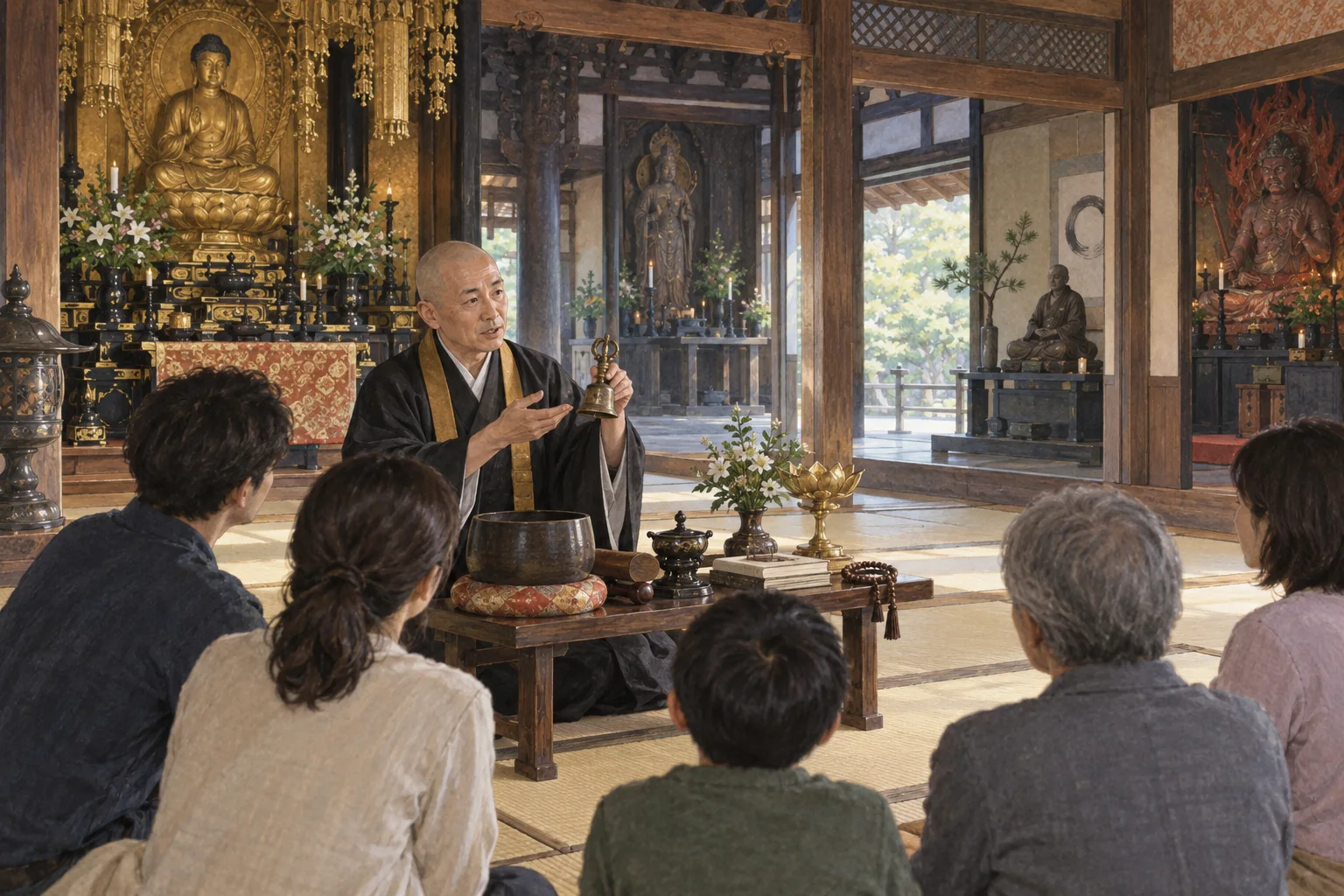
In one line
The shortest answer that works
Shuha no chigai, or the differences between Buddhist schools, is something most families rarely consider, though they belong to one.
宗派の違いとは、多くの家がどれかの宗派に属しながら、ふだんはほとんど意識しないものです。
In 30 seconds
The standard explanation
The main branches are Pure Land, which relies on calling the Buddha's name; Nichiren, which relies on the Lotus Sutra; Zen, which relies on seated meditation; and Shingon and Tendai, the older esoteric schools. Most Japanese families belong to one through the temple that handles their funerals, often without knowing much about its teaching.
主な宗派は、仏の名を称える浄土系、法華経による日蓮系、坐禅による禅系、そして古くからの密教である真言宗と天台宗です。多くの家は、葬儀を頼む寺を通じてどれかに属していますが、その教えについてはあまり知らないのがふつうです。
As a short speech
A full paragraph you can read aloud
If you ask a Japanese person what school of Buddhism their family belongs to, a lot of people have to phone their mother. For many families, affiliation runs through the temple that holds the family funerals rather than through personal belief. Still, the differences are real.
Pure Land schools, the largest, teach that you cannot reach enlightenment by your own effort in this age, so you entrust yourself to Amida Buddha and say his name. Nichiren schools chant the title of the Lotus Sutra instead. Zen schools say the answer is in seated meditation and daily work.
Shingon and Tendai are older and esoteric, with rituals, mantras and fire ceremonies. Practically, the school decides what is said at a funeral, what is carved on the grave, how the altar is arranged, and what the beads look like. If you are ever asked to bring beads to a funeral, any plain set is acceptable for a guest.
日本人に家の宗派を尋ねると、母親に電話しないと答えられない人が少なくありません。多くの家では、宗派は個人の信仰というより、家の葬儀を営む寺を通じてつながっています。とはいえ違いは本物です。
いちばん大きい浄土系は、この時代に自力で悟ることはできないので、阿弥陀仏に身をゆだね、その名を称えると説きます。日蓮系は代わりに法華経の題目を唱えます。禅は、答えは坐禅と日々の作務の中にあるとします。
真言と天台は古い密教で、儀礼と真言と護摩があります。実際には、宗派は葬儀で何を唱えるか、墓石に何を刻むか、仏壇の並べ方、数珠の形を決めます。葬儀に数珠を持ってくるよう言われたら、参列者なら飾りのない一連のもので構いません。
Questions people actually ask
And how to answer them.
How do families end up in a particular school?
Mostly by where an ancestor lived. In the Edo period every household had to register with a local temple, and that affiliation was inherited. Very few families chose a school because of its teachings.
たいていは先祖が住んでいた場所によります。江戸時代、すべての家は地元の寺に登録することを義務づけられ、その関係が受け継がれました。教えで選んだ家はごくわずかです。
Do the schools disagree with each other?
Historically yes, sometimes violently, and Nichiren in particular criticized others sharply. Today relations are mostly peaceful and joint ceremonies happen, though doctrinal differences are taken seriously by clergy.
歴史の上では対立し、武力に及んだこともあります。日蓮は特に他宗を厳しく批判しました。いまはおおむね穏やかで、合同の法要も行われますが、教義の違いは僧侶にとっては重いものです。
Which school should I visit as a tourist?
For gardens and the aesthetic most visitors have in mind, Zen temples in Kyoto. For scale and ritual, the Shingon complex on Mount Koya, where you can stay overnight and attend the morning service.
庭や、多くの人が思い描く雰囲気なら、京都の禅寺です。規模と儀礼なら、高野山の真言宗の伽藍です。宿坊に泊まって朝のお勤めに出られます。
A common misunderstanding
MYTHZen is the main form of Buddhism in Japan.
FACTBy number of temples and member households, the Pure Land schools taken together are the largest, though Soto Zen is also very big. Zen is the best known abroad mainly because it was the school most actively introduced to the West in the twentieth century.
Phrases you can use
- Most families belong through their funeral temple.多くの家は、葬儀を頼む寺を通じて属しています。
- Pure Land schools call the Buddha's name.浄土系は仏の名を称えます。
- Nichiren schools chant the Lotus Sutra title.日蓮系は法華経の題目を唱えます。
- Zen relies on seated meditation.禅は坐禅によります。
- The school decides the funeral wording and the grave.宗派で、葬儀の言葉も墓石も決まります。
Words you need
- school, denomination宗派
- head temple本山
- parishioner household檀家
- sutra経典
- esoteric Buddhism密教
Watch
From YouTubeBackground (Japanese)
日本の仏教は、奈良時代の南都六宗、平安時代の天台宗と真言宗、鎌倉時代に広がった浄土宗・浄土真宗・日蓮宗・臨済宗・曹洞宗という層で重なってできている。寺院数では浄土真宗と曹洞宗が多く、いずれも一万か寺を超える。江戸幕府の寺請制度により、すべての家がいずれかの寺に属することが義務づけられ、これが今日の檀家制度の土台になった。だから宗派は信仰の選択というより、家に受け継がれたものとして続いている。