 ワークシート
 ぬりえ
 迷路
月夜の密林に笛が響く。でも画家はジャングルに行ったことがない!A flute plays in a moonlit jungle. But the painter never saw a jungle!
この作品のお話
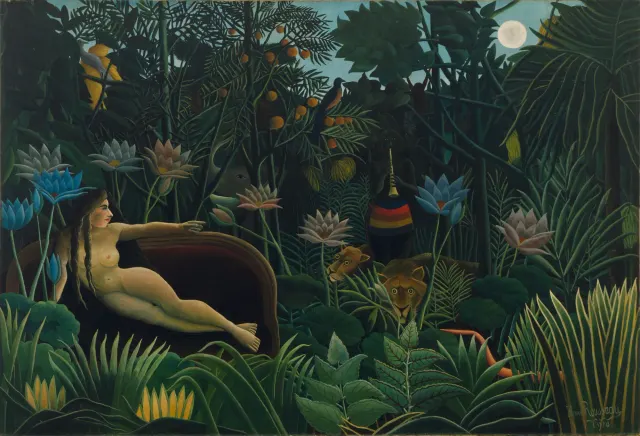
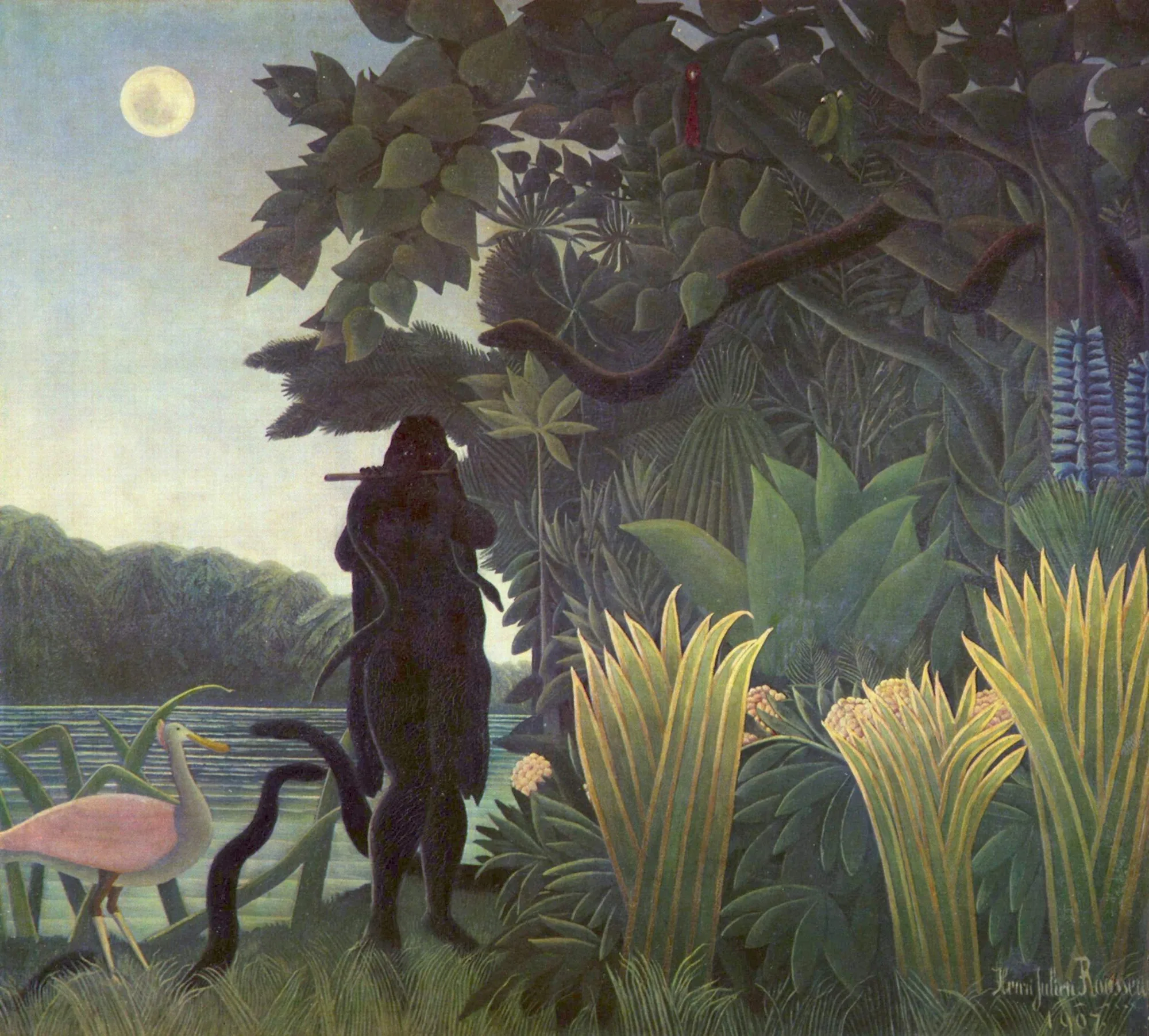
Story1907年、アンリ・ルソーが描いた大きな絵です。満月の夜、川辺の密林で、黒い姿の女の人が笛を吹いています。その音にさそわれるように、ヘビが木の枝や草むらから体をのばし、ピンク色の鳥も耳をすませています。目だけが光る女の人は、神秘的な夜の主人公です。今はパリのオルセー美術館にあります。
Henri Rousseau painted this large picture in 1907. On a night with a full moon, a woman seen as a dark silhouette plays a flute in a jungle by a river. Snakes stretch out from the branches and the grass, as if called by the music. A pink bird seems to listen too. Only her eyes shine, which makes her very mysterious. It is now in the Musée d'Orsay in Paris.
この絵は、画家ロベール・ドローネーの母、ベルト・ド・ドローネー伯爵夫人の注文で描かれました。ルソーにとって初めての大きな注文でした。ルソー自身は一度もフランスの外に出たことがなく、パリの植物園(ジャルダン・デ・プラント)の植物や、雑誌の図版をもとに、想像の密林を作り上げました。葉っぱを一枚一枚、ていねいに塗り分けているのが特徴です。
The picture was ordered by Berthe, Countess of Delaunay, the mother of the painter Robert Delaunay. It was Rousseau's first big commission. Rousseau never traveled outside France. He built his imaginary jungle from plants at the Jardin des Plantes in Paris and from pictures in magazines. He painted each leaf carefully, one by one.
絵は1907年のサロン・ドートンヌ(秋の展覧会)に出品されました。のちにファッションデザイナーで大コレクターのジャック・ドゥーセが持ち主となり、彼の遺贈によって1936年にフランスの国のものとなって、ルーヴル美術館に収められました。オルセー美術館は、この女の人を「あやしい楽園にいるイヴ」のようだと紹介しています。
The painting was shown at the Salon d'Automne in 1907. Later it belonged to Jacques Doucet, a fashion designer and great collector. Through his bequest, it became French state property in 1936 and went to the Louvre. The Musée d'Orsay describes the woman as an Eve in a strange, uneasy Garden of Eden.
密林の夜です。月の下で、女の人が笛を吹いています。ヘビたちが聞きに集まってきます。ルソーは本物のジャングルに行ったことがありません。パリの植物園でアイデアを集めたのです。
It is night in a jungle. A woman plays a flute under the moon. Snakes come to listen. Rousseau never went to a real jungle. He got ideas from a garden in Paris.
英語のレベルは上の「やさしい/ふつう」で切りかえられます。
えっ!?な裏ネタ
Secretsルソーは若いころ軍隊でメキシコに行き、そこで密林を見た、という話が広まりました。ルソー本人もそれを強く打ち消さなかったといわれます。しかし実際には、ルソーはフランスから一度も出たことがありません。密林はすべてパリで生まれたのです。
A story spread that Rousseau had gone to Mexico with the army and seen real jungles there. It is said that he did not really deny it. In fact, he never left France. All of his jungles were born in Paris.
1908年、ピカソはアトリエのあった建物「洗濯船」で、ルソーをたたえる宴会を開きました。ピカソは古道具屋で売られていたルソーの肖像画を、わずか5フランで見つけて買っていたといわれます。笑い半分、尊敬半分の、伝説のパーティーです。
In 1908, Picasso held a famous party for Rousseau in his studio building, the Bateau-Lavoir. Picasso had found a portrait by Rousseau in a junk shop and bought it, it is said, for only five francs. The party was half a joke and half real respect.
1912年、カンディンスキーとマルクがドイツで出した美術の本『青騎士』には、ルソーの絵がいくつも図版でのせられています。正式に絵を学ばなかったルソーの、まっすぐで力強い表現が、新しい絵を目指す画家たちのお手本になったのです。
In 1912, Kandinsky and Marc published an art book in Germany called 'The Blue Rider'. It included several pictures by Rousseau. His direct, strong style, made without any art school training, inspired artists who wanted to create a new kind of painting.
左下のピンクの鳥をよく見ると、くちばしの先が平たく、しゃもじのような形をしています。これはフラミンゴではなく、ヘラサギの仲間の特徴です。ルソーは図鑑や植物園で見た生きものを、絵の中に組み合わせていました。
Look closely at the pink bird at the lower left. The tip of its beak is flat, like a spoon. That is the shape of a spoonbill's beak, not a flamingo's. Rousseau mixed animals and plants he had seen in books and gardens.
ここを見て!
Look Closer1満月Full moon
空にうかぶ大きな満月。密林をあわく照らし、夜の静けさを感じさせます。
A big full moon hangs in the sky. Its soft light makes the night feel calm.
2蛇使いの女The snake charmer
全身が黒いシルエットで、目だけが光っています。首や体にもヘビが巻きついています。
She is a black silhouette, and only her eyes shine. Snakes are also wrapped around her neck and body.
3枝のヘビSnake on a branch
木の枝をつたって、笛の音のほうへ近づいてくるヘビ。
A snake slides along a branch toward the sound of the flute.
4ピンクの鳥Pink bird
平たいくちばしの鳥が、じっと耳をすませているように立っています。
A bird with a flat beak stands still, as if it is listening.
英語で名画を語ろう
Talk about Art in EnglishA woman plays her flute in the moonlight.
女の人が月明かりの中で笛を吹いています。
💡 in the sunlight(日の光の中で)、in the candlelight(ろうそくの光で)も同じ形。
英語で説明すると… Describe it
これは密林の夜の場面です。左には、川の上に満月がうかんでいます。まん中では、黒い姿の女の人が笛を吹いています。木々からヘビが出てきていて、手前にはピンクの鳥が立っています。
This is a night scene in a jungle. On the left, there is a full moon over a river. In the middle, a woman in dark silhouette is playing a flute. Snakes are coming out of the trees, and a pink bird stands in the foreground.
考えてみよう Think & Talk
- 女の人はどんな音楽を吹いていると思いますか?What kind of music do you think she is playing?
- ルソーは本物のジャングルを見たことがありませんでした。行ったことのない場所を描くには、どうすればいいでしょう?Rousseau never saw a real jungle. How can you paint a place you have never been to?
この作品の英単語
WordsThe snake charmer plays a flute.
蛇使いが笛を吹いています。
The snakes come closer to the sound of the flute.
ヘビたちは笛の音に近づいてきます。
Rousseau imagined the jungle in Paris.
ルソーはパリで密林を想像しました。
The woman's shining eyes look mysterious.
女の人の光る目は神秘的に見えます。
ミニクイズ
QuizQ. ルソーは密林の植物を、おもに何をもとに描いた?What did Rousseau mainly use to paint the jungle plants?
ルソーはフランスの外に出たことがなく、パリの植物園や本・雑誌をもとに想像で描きました。
Rousseau never left France. He used the Jardin des Plantes, books and magazines, and his imagination.
ウソ?ホント? この絵は、画家ドローネーの母の注文で描かれた。This painting was ordered by the mother of the painter Delaunay.
ベルト・ド・ドローネー伯爵夫人の注文です。インド旅行の話がきっかけになったといわれます。
It was ordered by Berthe, Countess of Delaunay. Her stories about a trip to India are said to have inspired it.
ウソ?ホント? 蛇使いの女は、色とりどりの服を着ている。The snake charmer wears colorful clothes.
女の人は全身が黒いシルエットで、目だけが光っています。
She is a black silhouette. Only her eyes shine.
 画像の出典とライセンス / Image credit
- PDHenri Rousseau 011.jpg(Wikimedia Commons)
ライセンス:Public domain(パブリックドメイン)/作者・撮影者の表記:Henri Rousseau
この作品は、作者の死後長い年月がたち著作権の保護期間が終わった「パブリックドメイン」の作品です。画像は平面の作品を忠実に写したもので、新しい著作権は生じません(Wikimedia Commons の PD-Art の考え方)。 所蔵:オルセー美術館(Musée d'Orsay)。画像は表示のために縮小・WebP 形式に変換しています。