 ワークシート
 ぬりえ
 迷路
背景がない!?少年はどこに立っているの?展覧会で落とされた問題作。No background!? Where is the boy standing? A painting the Salon rejected.
 美術館アンテナ:エドゥアール・マネの作品に会える展覧会
この作品のお話
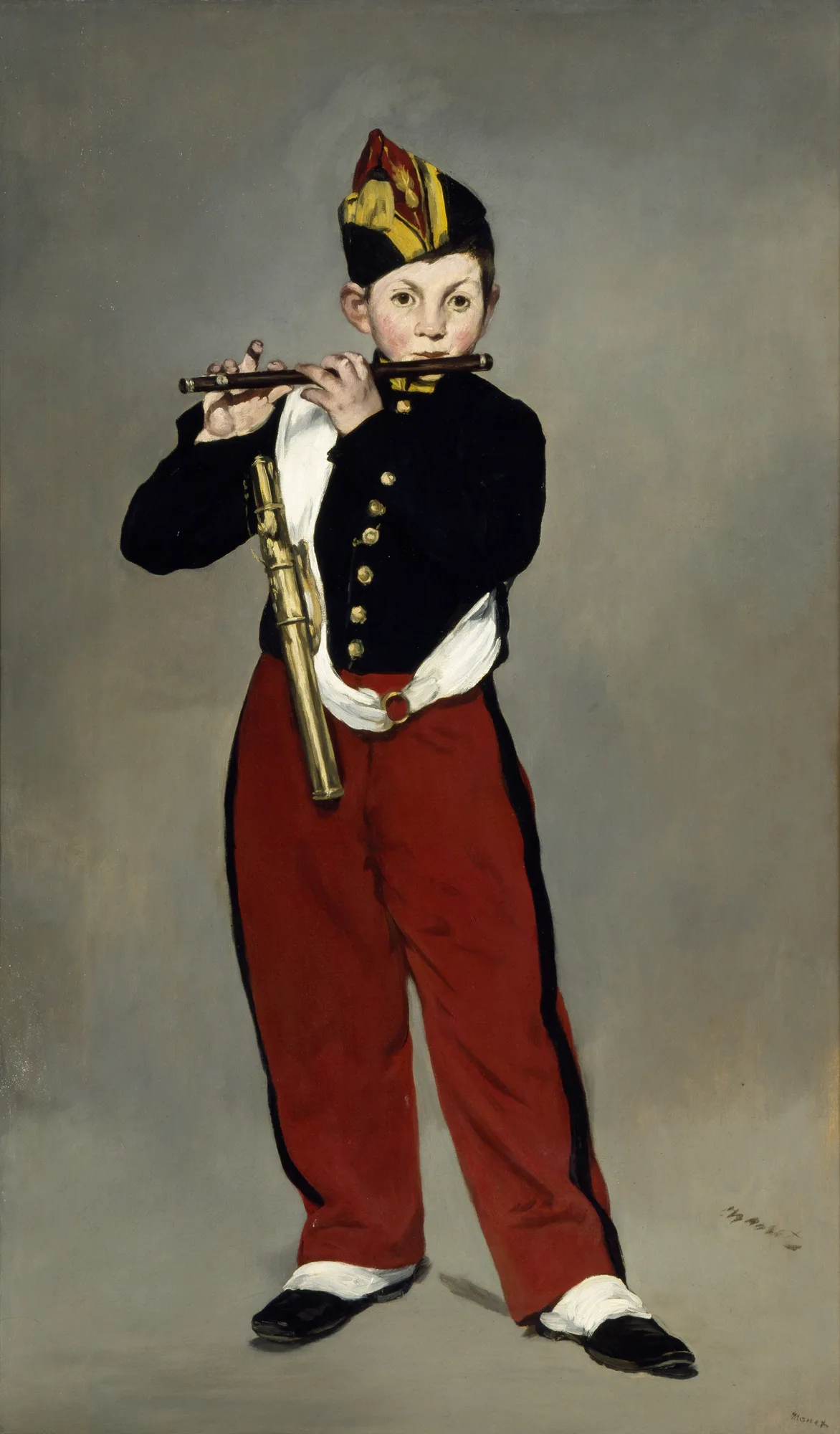
Story皇帝の近衛軍の軍楽隊の少年が、横笛(ファイフ)を吹いています。赤いズボン、黒い上着、白いベルト、金色の笛のケース。背景はほぼ灰色一色で、床と壁の境目はほとんど見えません。描いたのは「近代絵画の父」とも呼ばれるパリの画家マネ。1866年の作品です。高さは1.6メートルもあります。
A boy from the band of the Imperial Guard is playing a small flute called a fife. He wears red trousers, a black jacket, a white belt and a gold case for his fife. The background is almost entirely gray, and the line between the floor and the wall is barely visible. Édouard Manet, sometimes called the father of modern painting, painted it in 1866. It is 1.6 meters tall.
前の年、マネはスペインのマドリードを旅し、プラド美術館でベラスケスの『道化師パブロ・デ・バリャドリード』を見て感動しました。背景をなくし、空気の中に人物だけが立つその絵に学んで、この少年を描いたといわれます。モデルの少年は、知り合いの軍人が連れてきた本物の軍楽隊員でした。
The year before, Manet traveled to Madrid. At the Prado Museum, he was amazed by Velázquez's portrait of the actor Pablo de Valladolid. In that painting, there is no real background, and the man seems to stand in the air. Manet learned from it to paint this boy. The model was a real young band member, brought by a military friend.
ところが1866年のサロン(国の展覧会)では落選。平べったくて立体感がない、と批判されたのです。それでも作家エミール・ゾラは新聞でマネを強く応援します。この絵は1911年、銀行家イザーク・ド・カモンドの遺贈でルーヴル美術館に入り、今はオルセー美術館にあります。
However, the official Salon of 1866 rejected it. Critics said it looked too flat. But the writer Émile Zola strongly defended Manet in a newspaper. In 1911, the banker Isaac de Camondo left the painting to the Louvre, and today it hangs in the Musée d'Orsay.
少年が小さな笛を吹いています。赤いズボンと黒い上着を着ています。背景を見てください。床と壁の境目がほとんど見えません!ほとんど灰色だけです。この新しい描き方を、多くの人は気に入りませんでした。
A boy plays a small flute. He wears red trousers and a black jacket. Look at the background. You can hardly see where the floor ends and the wall begins! It is almost all gray. Many people did not like this new style.
英語のレベルは上の「やさしい/ふつう」で切りかえられます。
えっ!?な裏ネタ
Secrets背景では、床と壁の境目がかすかに見えるだけ。少年の足もとには小さな影があります。それなのに、ちゃんと床に立っているように見えます。マネは、背景をほとんど描かずに人物を立たせるという大胆な実験をしたのです。
The line between the floor and the background is only faintly visible. There is a small shadow at his feet. Yet he still seems to stand on a floor. Manet tried a bold experiment: a figure standing with almost no background.
マネはマドリードでベラスケスの肖像画を見て、背景が消えて人物が空気に包まれていると手紙に書いて感動を伝えています。ベラスケスは『ラス・メニーナス』で有名な17世紀の画家。マネは「画家の中の画家」と呼びました。
In Madrid, Manet saw a portrait by Velázquez. In a letter, he wrote with excitement that the background disappeared and the man was surrounded by air. Manet called Velázquez, the 17th-century painter of Las Meninas, 'the painter of painters'.
1866年、若き日のゾラは新聞『レヴェヌマン』の美術評でマネを大絶賛しました。ところが読者から抗議が殺到し、連載は途中で打ち切りに。それでもゾラはマネを応援し続け、翌年には長いマネ論を発表しました。
In 1866, the young Émile Zola praised Manet in his art reviews for the newspaper L'Événement. But many readers complained, and his series was stopped. Zola kept supporting Manet and published a long essay about him the next year.
ゾラはマネ論の中で、はっきりした色の面で形をつくるマネの絵を、日本の浮世絵にたとえました。影をほとんど描かず、赤・黒・白をぱっと置くこの少年は、まさにその代表例といえます。
In his essay on Manet, Zola compared Manet's simple areas of strong color to Japanese prints. This boy, with almost no shadows and bold red, black and white, is a perfect example.
ここを見て!
Look Closer1少年の顔The boy's face
まっすぐこちらを見つめる、まじめな顔。ほおを少しふくらませて笛を吹いています。
He looks straight at us with a serious face. His cheeks are a little puffed out as he plays.
2横笛(ファイフ)The fife
軍楽隊で使われる小さな横笛。指の形までしっかり描かれています。
This small flute was used in military bands. Even the positions of his fingers are carefully painted.
3金色の笛のケースGold fife case
白いたすきに下げた笛のケース。たった数筆で金属の光を表しています。
The case for the fife hangs from a white sash. Manet shows the shine of metal with only a few strokes.
4赤いズボンRed trousers
黒い線が入った赤いズボン。影をほとんどつけず、色の面だけで脚の形を見せています。
The red trousers have black stripes. With almost no shadow, Manet shows the legs with flat color alone.
英語で名画を語ろう
Talk about Art in EnglishThe Fifer is a full-length portrait of a young musician.
『笛を吹く少年』は、若い音楽家の全身の肖像画です。
💡 全身は full-length、腰から上は half-length、胸から上は bust-length と言います。
英語で説明すると… Describe it
これは少年の全身の肖像画です。少年は真ん中に立って、横笛を吹いています。黒い上着、赤いズボン、白いすね当てを身につけています。後ろには何もありません。背景は無地の灰色です。
This is a full-length portrait of a boy. He is standing in the middle and playing a fife. He is wearing a black jacket, red trousers and white spats. There is nothing behind him. The background is plain gray.
考えてみよう Think & Talk
- マネはなぜ背景を描かなかったと思いますか?Why do you think Manet did not paint a background?
- 少年はどんな曲を吹いていると思いますか?What music do you think the boy is playing?
この作品の英単語
WordsThe boy is playing a fife.
少年はファイフを吹いている。
His uniform has red trousers and a black jacket.
彼の制服は赤いズボンと黒い上着だ。
The Salon rejected this painting in 1866.
サロンは1866年、この絵を落選させた。
The background is plain gray.
背景は無地の灰色だ。
ミニクイズ
QuizQ. マネがこの絵のお手本にしたのは、どこの国の画家?What country did the painter who inspired this work come from?
マドリードで見たスペインの巨匠ベラスケスの肖像画に学びました。
Manet learned from a portrait by the Spanish master Velázquez, which he saw in Madrid.
ウソ?ホント? この絵は1866年のサロンで金メダルをとった。This painting won a gold medal at the 1866 Salon.
サロンでは落選しました。平べったいと批判されたのです。
The Salon rejected it. Critics said it was too flat.
ウソ?ホント? モデルは本物の軍楽隊の少年だった。The model was a real boy from a military band.
知り合いの軍人が、近衛軍の軍楽隊の少年を連れてきました。
A military friend brought a boy from the Imperial Guard's band.
 画像の出典とライセンス / Image credit
- PDManet, Edouard - Young Flautist, or The Fifer, 1866 (2).jpg(Wikimedia Commons)
ライセンス:Public domain(パブリックドメイン)/作者・撮影者の表記:Édouard Manet/提供元:The Yorck Project (2002) 10.000 Meisterwerke der Malerei (DVD-ROM), distributed by DIRECTMEDIA Publishing GmbH. ISBN: 3936122202.
この作品は、作者の死後長い年月がたち著作権の保護期間が終わった「パブリックドメイン」の作品です。画像は平面の作品を忠実に写したもので、新しい著作権は生じません(Wikimedia Commons の PD-Art の考え方)。 所蔵:オルセー美術館(Musée d'Orsay)。画像は表示のために縮小・WebP 形式に変換しています。