 ワークシート
 ぬりえ
 迷路
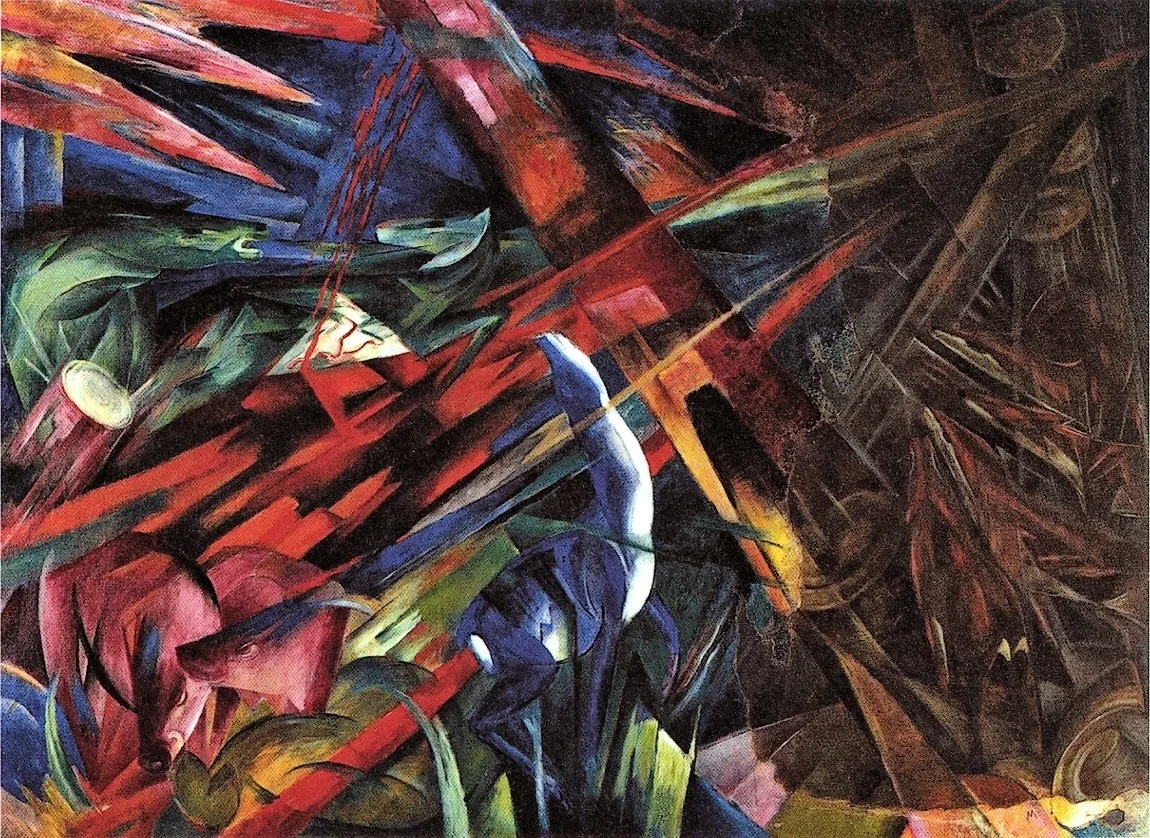
青い鹿が空を見上げる、くだける森。のちに戦争の予感と語られた絵。A blue deer looks up in a shattered forest. Marc later compared the picture to a premonition of war.
この作品のお話
Story1913年、ドイツの画家フランツ・マルクが描いた大きな絵です。画面いっぱいに赤や緑、青のするどい線や面が交差し、森がくずれ落ちるようなはげしい場面になっています。中央では青い鹿が首を大きくそらして上を見上げ、左下には赤い動物たちがうずくまっています。今はスイスのバーゼル市立美術館にあります。
Franz Marc, a German painter, made this large painting in 1913. Sharp lines and shapes of red, green and blue cross the whole picture, as if a forest is falling apart. In the center, a blue deer bends its neck back and looks up. At the lower left, red animals huddle together. It is now in the Kunstmuseum Basel in Switzerland.
マルクは動物を多く描き、人間よりも純粋な存在だと考えていました。この絵では、その動物たちが大きな災いに巻きこまれています。翌1914年に第一次世界大戦が始まると、マルクは兵士として出征しました。1915年、戦場から妻にあてた手紙で、この絵は「この戦争の予感のようだ」と書いています。
Marc often painted animals because he saw them as purer than humans. In this picture, those animals are caught in a great disaster. When the First World War began in 1914, Marc went to war as a soldier. In a 1915 letter to his wife from the front, he wrote that the painting was 'like a premonition of this war.'
マルクは1916年、フランスのヴェルダンの戦いで36歳で亡くなりました。その後、この絵は倉庫の火事にあい、右側のおよそ3分の1を失います。親友のパウル・クレーが1919年、下絵の水彩や写真をもとに復元し、焼けた部分を落ちついた茶色でぬり直しました。今も、その「傷あと」が見えるまま展示されています。
Marc died in 1916 at the Battle of Verdun in France, at the age of 36. After that, a fire in a storehouse destroyed about the right third of this painting. In 1919, his close friend Paul Klee restored it, using Marc's watercolor study and photographs, and repainted the burned part in calm brown. The 'scar' can still be seen today.
森の中に動物たちがいます。森がこわれていきます。青い鹿が空を見上げています。マルクは大きな戦争の前にこの絵を描きました。のちに火事で一部が焼け、友だちのクレーが直しました。
Animals are in a forest. The forest is breaking. A blue deer looks up at the sky. Marc painted this before a big war. Later, a fire burned part of it, and his friend Klee fixed it.
英語のレベルは上の「やさしい/ふつう」で切りかえられます。
えっ!?な裏ネタ
Secretsキャンバスの裏には、マルクの手で「そしてすべての存在は燃えさかる苦しみである」という言葉が書かれています。古代インドの思想から取った言葉だといわれます。はげしい色の画面は、この言葉を絵にしたものとも考えられます。
On the back of the canvas, Marc wrote: 'And all being is flaming suffering.' The words are said to come from ancient Indian thought. The fiery picture may be a painting of these words.
焼けた右側の3分の1ほどを直したのは、マルクの親友クレーでした。手がかりは、マルクの下絵の水彩と、古い写真。クレーは焼けた部分を、あえてくすんだ茶色の調子でまとめ、修復したところが見分けられるようにしました。友情が残した、珍しい修復のあとです。
The burned right part, about one third of the picture, was repaired by Marc's close friend Klee. He worked from Marc's watercolor study and old photographs. Klee painted the burned part in dull browns, so the repair can still be told apart. It is a rare repair left by friendship.
この絵はドイツのハレの美術館にありましたが、1937年にナチスに「退廃芸術」として没収されました。1939年、バーゼル市立美術館の館長が、美術商ヒルデブラント・グルリットを通じて6900スイスフランで買い取り、絵はスイスに移りました。
This painting was in a museum in Halle, Germany, but in 1937 the Nazis took it as 'degenerate art'. In 1939, the director of the Kunstmuseum Basel bought it for 6,900 Swiss francs through the art dealer Hildebrand Gurlitt, and it moved to Switzerland.
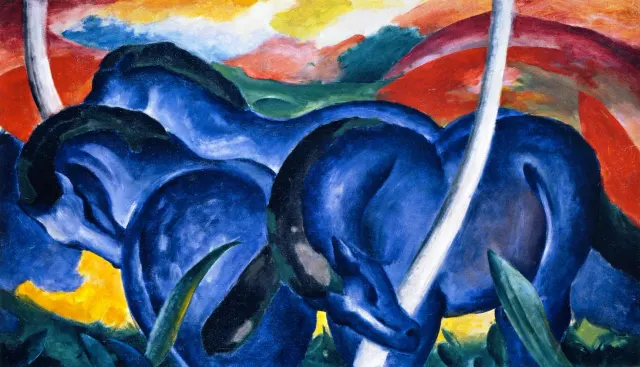
マルクの代表作のひとつ『青い馬の塔』(1913年)も、ナチスに没収されました。そして第二次世界大戦の終わりごろから行方がわからなくなり、今もどこにあるのかわかっていません。この『動物たちの運命』は、運よく生きのびた一枚なのです。
Another of Marc's masterpieces, 'The Tower of Blue Horses' (1913), was also taken by the Nazis. It disappeared around the end of the Second World War, and no one knows where it is today. 'The Fate of the Animals' is one that was lucky to survive.
ここを見て!
Look Closer1青い鹿The blue deer
首を大きくそらして天を見上げる青い鹿。助けを求めているようにも見えます。
A blue deer throws its head back and looks up. It seems to be crying for help.
2赤い動物たちRed animals
左下でうずくまる赤い動物たち。身を寄せ合ってたえているようです。
Red animals huddle at the lower left, as if holding on together.
3切り株Tree stump
切り口の見える木の幹。たおれた木が、森のこわれ方を伝えています。
A tree trunk with a cut end. The fallen tree shows how the forest is breaking.
4焼けたあとの部分The burned part
右側の茶色っぽい部分。火事のあと、クレーが下絵や写真を参考にぬり直したところです。
The brownish right side. Klee repainted it after the fire, using a study and photos.
英語で名画を語ろう
Talk about Art in EnglishThe forest seems to break into pieces.
森がばらばらにくだけていくように見えます。
💡 物がこわれる様子をいきいきと伝える表現。fall to pieces も似た意味です。
英語で説明すると… Describe it
この絵は、くずれていく森の中の動物たちを描いています。赤・緑・青のするどい線が画面を横切っています。まん中には、上を見上げる青い鹿がいます。右側は色が暗く、茶色っぽくなっています。
This painting shows animals in a forest that is breaking apart. Sharp red, green and blue lines cross the picture. In the middle, there is a blue deer looking up. On the right side, the colors are dark and brown.
考えてみよう Think & Talk
- 動物たちに何が起きていると思いますか?What do you think is happening to the animals?
- 傷ついた絵は新品のように直すべき?それとも傷あとを残すべき?それはなぜ?Should a damaged painting be repaired to look new, or should the damage stay visible? Why?
この作品の英単語
WordsThe animals cannot escape their fate.
動物たちは運命からのがれられません。
The right side of the painting burned in a fire.
絵の右側は火事で焼けました。
Klee restored his friend's painting.
クレーは友人の絵を修復しました。
Sharp lines cut across the forest.
するどい線が森を横切っています。
ミニクイズ
QuizQ. 火事で焼けた右側を修復したのはだれ?Who restored the burned right side?
マルクは1916年に戦死していたため、親友のクレーが修復しました。
Marc had died in the war in 1916, so his close friend Klee repaired it.
ウソ?ホント? マルクは第一次世界大戦で亡くなった。Marc died in the First World War.
1916年、ヴェルダンの戦いで36歳で亡くなりました。
He died at the Battle of Verdun in 1916, at 36.
ウソ?ホント? この絵は描かれてから一度も傷ついたことがない。This painting has never been damaged.
火事で右側が焼け、クレーが修復しました。
Its right side was burned in a fire, and Klee restored it.
 画像の出典とライセンス / Image credit
- PDFranz Marc-The fate of the animals-1913.jpg(Wikimedia Commons)
ライセンス:Public domain(パブリックドメイン)/作者・撮影者の表記:Franz Marc
この作品は、作者の死後長い年月がたち著作権の保護期間が終わった「パブリックドメイン」の作品です。画像は平面の作品を忠実に写したもので、新しい著作権は生じません(Wikimedia Commons の PD-Art の考え方)。 所蔵:バーゼル市立美術館(Kunstmuseum Basel)。画像は表示のために縮小・WebP 形式に変換しています。