 ワークシート
 ぬりえ
 迷路
事件からわずか数か月。画家が友のために描いた「革命の聖人」。Painted just months after the event: a friend's portrait of a 'saint of the Revolution'.
この作品のお話
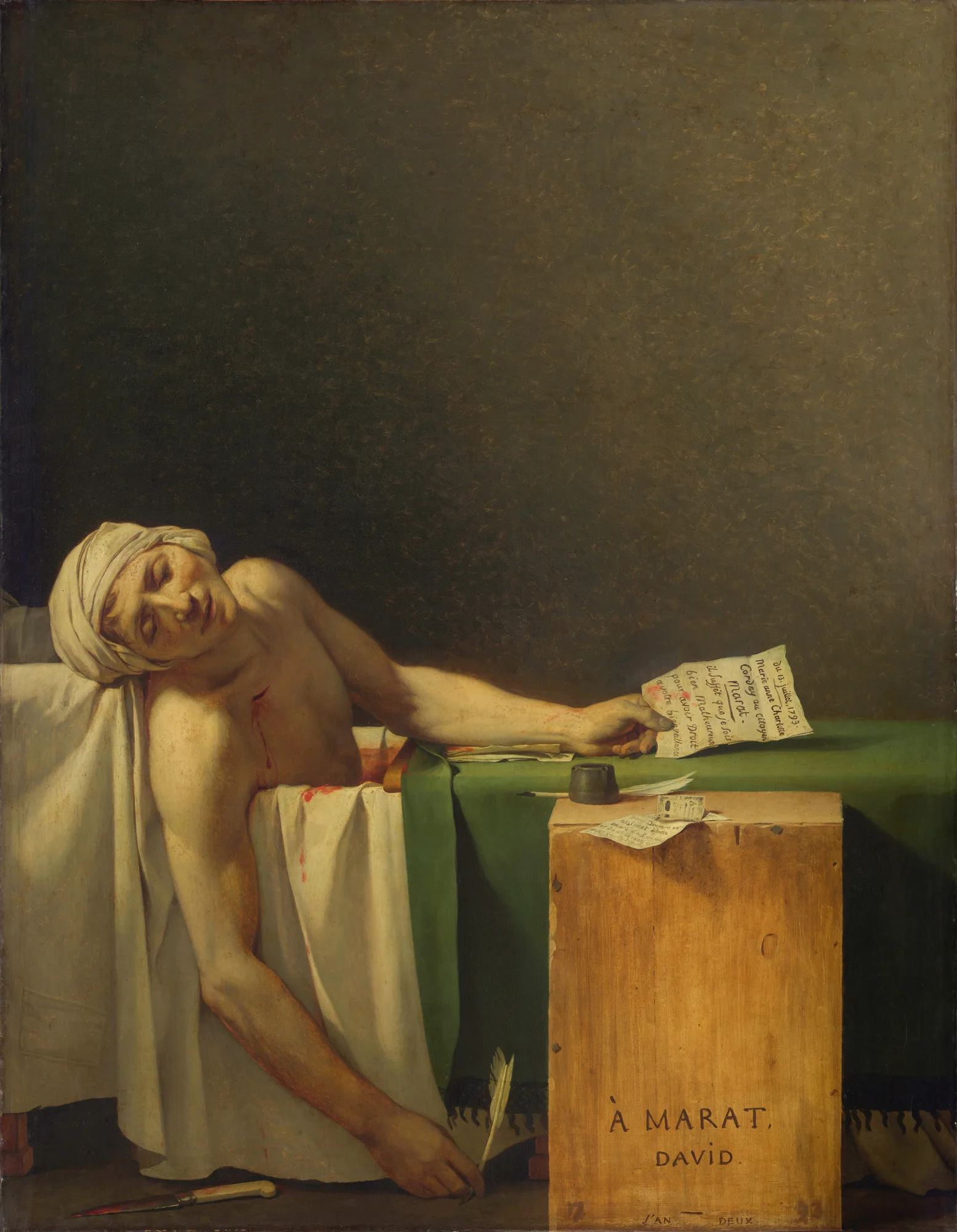
Storyフランス革命のさなかの1793年7月13日、革命の指導者のひとりジャン=ポール・マラーが、自宅の浴室で命をうばわれました。マラーは皮膚の病気のため、薬の入った浴槽につかったまま仕事をしていたのです。友人で革命派の画家だったダヴィッドは、その姿を描きました。
On 13 July 1793, during the French Revolution, Jean-Paul Marat, one of its leaders, was killed in his bathroom at home. Because of a skin disease, he often worked while sitting in a medicinal bath. His friend David, a painter who supported the Revolution, painted this scene.
ダヴィッドは事件のあと数か月でこの絵を仕上げました。背景はほとんど何もない暗い壁。光に照らされたマラーは、眠るような安らかな顔で、片腕をだらりと下げています。このポーズはミケランジェロの「ピエタ」などのキリストの姿とよく比べられ、マラーを「革命のために死んだ聖人」のように見せています。
David finished the painting within a few months. The background is an almost empty, dark wall. Marat is lit softly, his face calm as if he is asleep, with one arm hanging down. This pose is often compared to images of Christ, such as Michelangelo's Pietà. It makes Marat look like a saint who died for the Revolution.
やがて政治の風向きが変わると、この絵は危険なものになりました。ダヴィッドがベルギーへ亡命していた間、弟子のグロが絵をフランスのどこかに隠したといわれます。のちにダヴィッドの子孫からベルギーへ贈られ、1893年、事件からちょうど100年後にブリュッセルの美術館に入りました。ムンクやピカソなど、後の画家たちにも大きな影響をあたえています。
Later, when politics changed, the painting became dangerous to own. While David lived in exile in Belgium, his pupil Gros is said to have hidden it somewhere in France. David's descendants later gave it to Belgium, and it entered the museum in Brussels in 1893, exactly 100 years after Marat's death. It inspired later artists such as Munch and Picasso.
これは浴槽の中にいる男の人です。名前はマラーです。彼はフランス革命のリーダーでした。病気だったので、お風呂の中で仕事をしました。友だちのダヴィッドがこの絵を描き、木箱に「マラーへ」と書きました。
This is a man in a bathtub. His name is Marat. He was a leader in the French Revolution. He was sick, so he worked in the bath. His friend David painted this picture, and wrote 'To Marat' on the box.
英語のレベルは上の「やさしい/ふつう」で切りかえられます。
えっ!?な裏ネタ
Secretsマラーが持つ手紙には「1793年7月13日、マリー・アンヌ・シャルロット・コルデーより市民マラーへ」と書かれています。でも続く文は本物の手紙の引用ではなく、彼女が言いそうなことをもとにダヴィッドが考えた文です。
The letter in Marat's hand says it is from Marie-Anne Charlotte Corday to 'citizen Marat', dated 13 July 1793. But the words after that are not copied from a real letter. David invented them, based on what she might have said.
木箱の上には紙幣と短いメモがあります。メモには「この紙幣を、夫を祖国のために亡くした5人の子の母親にわたすように」という意味の言葉が読めます。ダヴィッドはマラーを、貧しい人を助ける人物として見せたかったのです。
On the wooden box there is a banknote and a short note. It says, in effect: give this banknote to a mother of five whose husband died for his country. David wanted to show Marat as a man who helped the poor.
木箱には大きく「À MARAT, DAVID(マラーへ、ダヴィッド)」と刻まれ、まるでお墓のようです。その下には「L'AN DEUX(2年)」の文字。これは革命でつくられた新しい暦の「共和暦2年」を指しています。
The box is carved with 'À MARAT, DAVID' (To Marat, from David), like a gravestone. Below it is 'L'AN DEUX' (Year Two). This means Year Two of the new calendar created during the French Revolution.
この絵は大人気になり、1793〜94年にダヴィッドの弟子たちが何枚もの写しを描きました。そのうちの1枚はルーヴル美術館に展示されています。本物はブリュッセル、写しはパリというわけです。
The picture became very popular, and David's pupils painted several copies in 1793 and 1794. One of these studio copies hangs in the Louvre. So the original is in Brussels, and a copy is in Paris.
ここを見て!
Look Closer1眠るような顔A peaceful face
頭にタオルを巻いたマラーの顔は、苦しみではなく安らかさをたたえています。ダヴィッドはわざと美しく、静かに描きました。
Marat's face, with a towel around his head, looks peaceful, not painful. David made it calm and beautiful on purpose.
2手紙The letter
日付と差出人の名前がはっきり読めます。絵の中の文字が、事件の記録のような役わりをしています。
You can clearly read the date and the sender's name. The writing works like a record of the event.
3紙幣とメモBanknote and note
インク壺のそばの木箱の上に、小さな紙幣とメモ。マラーのやさしさを伝えるための小道具です。
On the box, near the inkpot, are a small banknote and a note. They are there to show Marat's kindness.
4木箱の文字Words on the box
「À MARAT, DAVID」。ただの仕事机の木箱が、まるで記念碑のように見えてきます。
'À MARAT, DAVID.' A simple wooden box becomes something like a monument.
英語で名画を語ろう
Talk about Art in EnglishMarat is holding a letter in his left hand.
マラーは左手に手紙を持っています。
💡 人物が手に持つ物は「is holding +物」。手紙・剣・旗など、名画の説明で大活躍します。
英語で説明すると… Describe it
男の人が浴槽で後ろにもたれています。頭に白いタオルを巻き、目を閉じています。左手には手紙を持っています。右には文字が書かれた木箱があります。絵の上半分は、暗くて何もない壁です。
A man is lying back in a bathtub. He has a white towel on his head, and his eyes are closed. In his left hand, he is holding a letter. On the right, there is a wooden box with words on it. The top half of the picture is a dark, empty wall.
考えてみよう Think & Talk
- ダヴィッドはなぜ絵の上半分をほとんど何も描かずに残したと思いますか?Why do you think David left the top half of the painting almost empty?
- 画家がその人の友人だったとき、絵は「本当にあったこと」をそのまま伝えられるでしょうか?Can a painting show what really happened, if the artist was the person's friend?
この作品の英単語
WordsMarat often worked in his bathtub.
マラーはよく浴槽の中で仕事をしていました。
David painted Marat as a martyr of the Revolution.
ダヴィッドはマラーを革命の殉教者として描きました。
The inscription on the box reads 'To Marat'.
箱に刻まれた文字は「マラーへ」と読めます。
His face looks calm, as if he is sleeping.
彼の顔は眠っているかのようにおだやかに見えます。
ミニクイズ
QuizQ. マラーはなぜ浴槽の中で仕事をしていた?Why did Marat work in a bathtub?
皮膚の病気のつらさをやわらげるため、薬の入った浴槽につかったまま書き物をしていました。
He had a painful skin disease, so he sat in a medicinal bath while he wrote.
ウソ?ホント? 木箱には「マラーへ、ダヴィッド」という意味の文字が書かれている。The wooden box has words meaning 'To Marat, from David'.
「À MARAT, DAVID」と、お墓の文字のように書かれています。
It says 'À MARAT, DAVID', like the words on a gravestone.
ウソ?ホント? この絵の本物は、パリのルーヴル美術館にある。The original painting is in the Louvre in Paris.
本物はブリュッセルのベルギー王立美術館。ルーヴルにあるのは弟子たちによる写しです。
The original is in Brussels. The Louvre has a copy made in David's studio.
 画像の出典とライセンス / Image credit
- PDDeath of Marat by David.jpg(Wikimedia Commons)
ライセンス:Public domain(パブリックドメイン)/作者・撮影者の表記:Jacques-Louis David/提供元:Google Art & Culture: upload by user FDRMRZUSA. Web Gallery of Art
この作品は、作者の死後長い年月がたち著作権の保護期間が終わった「パブリックドメイン」の作品です。画像は平面の作品を忠実に写したもので、新しい著作権は生じません(Wikimedia Commons の PD-Art の考え方)。 所蔵:ベルギー王立美術館(Royal Museums of Fine Arts of Belgium)。画像は表示のために縮小・WebP 形式に変換しています。