 ワークシート
 ぬりえ
 迷路
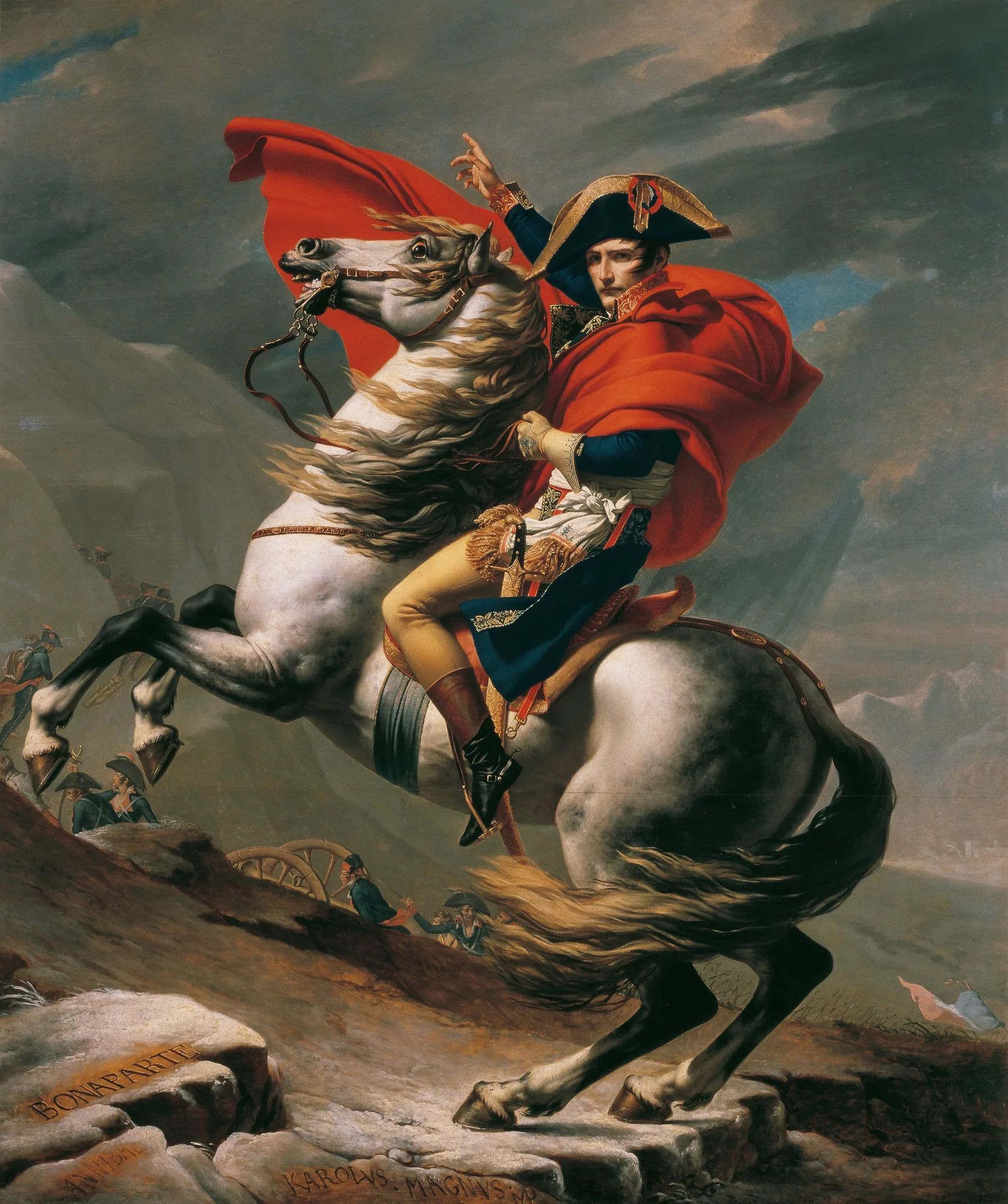
本当はラバで越えた!?ナポレオンの「盛りすぎ」ヒーロー肖像。He really crossed on a mule!? Napoleon's over-the-top hero portrait.
この作品のお話
Story1800年、ナポレオン(当時はまだ皇帝ではなく第一執政)は、軍を率いてアルプスのグラン・サン=ベルナール峠を越え、イタリアへ攻めこみました。ダヴィッドはその場面を、前足をあげる馬にまたがり、山頂を指さす英雄の姿で描きました。この絵はそのうちの1枚で、ミラノへ送られたものです。
In 1800, Napoleon, who was not yet emperor, led his army over the Great St Bernard Pass in the Alps to fight in Italy. David showed him as a hero on a rearing horse, pointing to the top of the mountain. This version was made for Milan.
最初の1枚はスペイン国王の注文でした。ナポレオンは「荒れ馬の上で落ち着いている姿に」と注文をつけ、ポーズをとることは断りました。そこでダヴィッドは、マレンゴの戦いで使われた軍服と帽子を借り、胸像を参考に顔を描きました。気に入ったナポレオンは同じ絵を追加で注文し、全部で5つの版ができました。
The first version was ordered by the King of Spain. Napoleon asked to be shown 'calm on a fiery horse', but he refused to pose. So David borrowed the uniform and hat Napoleon wore at the Battle of Marengo, and used a bust for the face. Napoleon liked it and ordered more copies. In the end, there were five versions.
この版は1803年にミラノへ届けられました。ナポレオンの没落後、オーストリアが1816年に引きわたしを求めましたが、ミラノの人々は1825年まで手放さなかったといいます。1834年にウィーンへ移り、今はベルヴェデーレ宮殿で見ることができます。この絵は「強いリーダー」のイメージとして、今もポスターやパロディに使われ続けています。
This version arrived in Milan in 1803. After Napoleon's fall, Austria demanded it in 1816, but the people of Milan did not give it up until 1825. It moved to Vienna in 1834, and today you can see it at the Belvedere. The image is still used in posters and parodies about strong leaders.
山の中で、男の人が白い馬に乗っています。ナポレオンです。赤いマントが風になびいています。とても勇ましく見えます。でも本当は、晴れた日にラバに乗っていたのです!
A man rides a white horse in the mountains. He is Napoleon. His red cloak flies in the wind. He looks very brave. But in real life, he rode a mule on a sunny day!
英語のレベルは上の「やさしい/ふつう」で切りかえられます。
えっ!?な裏ネタ
Secrets実際のナポレオンは、天気のよい日に、案内人に引かれたラバに乗って峠を越えたとされます。1850年にはドラローシュが、ラバに乗ったナポレオンの「現実版」を描いています。
In reality, Napoleon crossed the pass on a mule led by a guide, on a fine day. In 1850, the painter Paul Delaroche painted a more realistic version, with Napoleon on a mule.
ナポレオンがポーズをとらなかったため、ダヴィッドは自分の息子をはしごの上に乗せ、馬に乗る姿勢のモデルにしたといいます。馬のモデルには、ナポレオンの愛馬たちが使われました。
Because Napoleon would not pose, David is said to have had his own son sit on top of a ladder as a model for the riding pose. Napoleon's own horses were used as models for the horse.
左下の岩には「BONAPARTE」のほか「HANNIBAL(ハンニバル)」「KAROLVS MAGNVS(カール大帝)」の文字。アルプスを越えた昔の英雄と自分を並べる、ナポレオンらしい自己アピールです。
The rocks at the bottom left say 'BONAPARTE', and also 'HANNIBAL' and 'KAROLVS MAGNVS' (Charlemagne). Both earlier heroes crossed the Alps. Napoleon is putting himself in their company.
5つの版は、マントの色や馬の毛色が少しずつちがいます。最初のマルメゾン版はオレンジのマントに白黒ぶちの馬、ベルリンのシャルロッテンブルク版は赤いマントに栗毛の馬です。見くらべると「まちがい探し」のようです。
The five versions use different colours for the cloak and the horse. The first, at Malmaison, has an orange cloak and a black-and-white horse. The Charlottenburg version in Berlin has a red cloak and a chestnut horse. Comparing them is like a spot-the-difference game.
ここを見て!
Look Closer1山頂を指す手The pointing hand
まっすぐ上を指す手。「あの先へ進め!」という前向きなメッセージです。
His hand points straight up. The message is: 'Forward, to the top!'
2荒れ馬The rearing horse
目をむき、たてがみをなびかせる馬。乗り手の落ち着いた顔との対比がポイントです。
The horse has wild eyes and a flying mane. Compare it with the rider's calm face.
3岩の文字Names on the rocks
BONAPARTE、HANNIBAL、KAROLVS MAGNVS。歴史の英雄たちの名前が刻まれています。
BONAPARTE, HANNIBAL, KAROLVS MAGNVS: names of great heroes are carved here.
4大砲を運ぶ兵士Soldiers with a cannon
馬の足元の奥で、兵士たちが大砲を引いて坂をのぼっています。主役の大きさがいっそう目立ちます。
Behind the horse's legs, soldiers pull a cannon up the slope. They make the hero look even bigger.
英語で名画を語ろう
Talk about Art in EnglishNapoleon is pointing to the top of the mountain.
ナポレオンは山の頂上を指さしています。
💡 指さす先を言うときは point to / point at。上を指すだけなら points up とも言えます。
英語で説明すると… Describe it
中央では、大きな帽子をかぶった男の人が白い馬に乗っています。馬は後ろ足で立っています。男の人の赤いマントは風になびき、彼は上を指さしています。奥では兵士たちが山をのぼっています。
In the center, a man in a big hat is riding a white horse. The horse is standing on its back legs. The man's red cloak is blowing in the wind, and he is pointing up. In the background, soldiers are climbing the mountain.
考えてみよう Think & Talk
- 絵が、実際の出来事を本当よりもかっこよく見せるのは、よいことでしょうか?Is it OK for a painting to make a real event look more exciting than it was?
- 自分の肖像画を注文できるとしたら、どんな姿で描いてほしいですか?If you could ask for a portrait of yourself, how would you want to look?
この作品の英単語
WordsThe white horse rears up on its back legs.
白い馬が後ろ足で立ち上がっています。
His red cloak is blowing in the wind.
彼の赤いマントが風になびいています。
In real life, he crossed the Alps on a mule.
実際には、彼はラバに乗ってアルプスを越えました。
David made the scene look heroic.
ダヴィッドはその場面を勇ましく見せました。
ミニクイズ
QuizQ. 実際のナポレオンは、何に乗ってアルプスを越えたとされる?What did Napoleon really ride across the Alps?
山道に強いラバに乗り、案内人に引かれて越えたとされます。ゾウでアルプスを越えたのは、岩に名前のあるハンニバルです。
He rode a sure-footed mule led by a guide. It was Hannibal, named on the rock, who crossed the Alps with elephants.
ウソ?ホント? ナポレオンは、この絵のために何日もじっとポーズをとった。Napoleon posed for many days for this painting.
ナポレオンはポーズを断りました。ダヴィッドは借りた軍服や胸像、はしごに乗せた息子などを使って描きました。
He refused to pose. David used his borrowed uniform, a bust, and his own son on a ladder.
ウソ?ホント? ダヴィッドは同じ構図の絵を5つ描いた。David made five versions of this picture.
ウィーン、マルメゾン、ベルリン、ヴェルサイユ(2点)に、マントや馬の色がちがう版があります。
There are versions in Vienna, Malmaison, Berlin and two at Versailles, each with different colours.
 画像の出典とライセンス / Image credit
- PDNapoleon at the Great St. Bernard - Jacques-Louis David - Google Cultural Institute.jpg(Wikimedia Commons)
ライセンス:Public domain(パブリックドメイン)/作者・撮影者の表記:Jacques-Louis David/提供元:Google Art Project
この作品は、作者の死後長い年月がたち著作権の保護期間が終わった「パブリックドメイン」の作品です。画像は平面の作品を忠実に写したもので、新しい著作権は生じません(Wikimedia Commons の PD-Art の考え方)。 所蔵:ベルヴェデーレ宮殿美術館(オーストリア・ギャラリー)(Österreichische Galerie Belvedere)。画像は表示のために縮小・WebP 形式に変換しています。