

 ワークシート
 ぬりえ
 迷路
台座に取っ手!?ぐるっと回して見る、大理石のラブストーリー。A handle on the base!? A marble love story made to be turned around.
この作品のお話
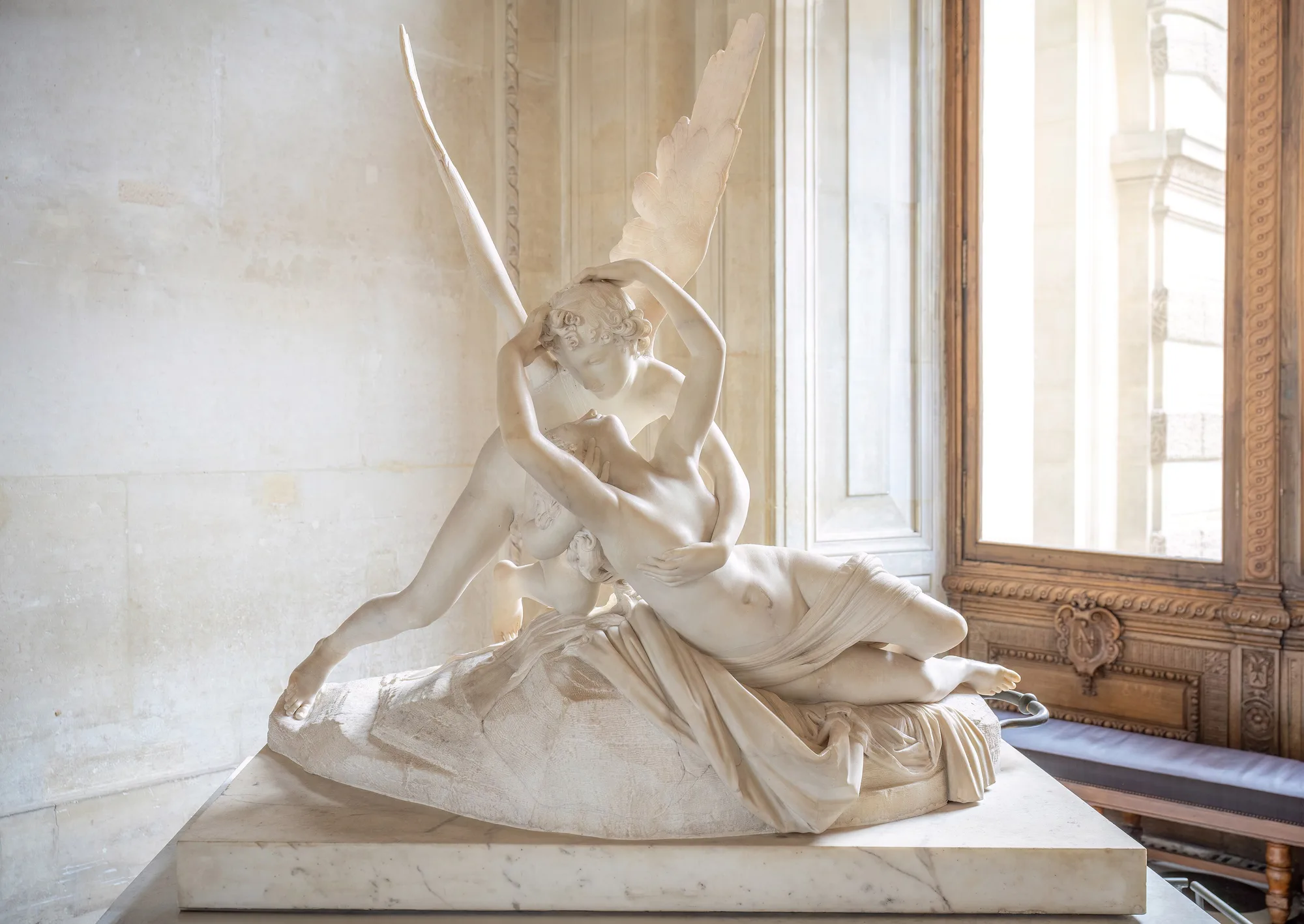
Storyローマ神話の愛の神アモル(キューピッド)と、人間の娘プシュケの物語です。プシュケは「開けてはいけない」と言われた小箱を開けてしまい、死んだような眠りに落ちます。古い物語では、アモルは眠りを取りのぞき、矢で軽くつついて彼女を起こします。カノーヴァはそれを、口づけでよみがえる一瞬として白い大理石で表しました。写真はルーヴル美術館の展示のようすです。
This is a story from Roman myth about Cupid, the god of love, and Psyche, a human girl. Psyche opened a box she had been told never to open, and she fell into a deathlike sleep. In the ancient story, Cupid takes away the sleep and wakes her with a prick of his arrow. Canova imagined the rescue as a kiss and showed that moment in marble. The photo shows it on display in the Louvre.
作者はイタリアの彫刻家カノーヴァ。1787年、イギリスの軍人ジョン・キャンベルの注文で作りはじめ、1793年に完成しました。二人の腕がつくる輪の中に顔が向きあう、Xのような大胆な形。広げた羽はうすく、肌はなめらかで、石とは思えないやわらかさです。古代彫刻の美しさと、ロマン主義の感情が合わさった名作です。
The sculptor was the Italian artist Antonio Canova. He began it in 1787 for a British officer, John Campbell, and finished it in 1793. Their arms make a ring around their faces, and their bodies form a bold X shape. The wings are thin and the skin is smooth, so the stone looks soft. It mixes the beauty of ancient sculpture with Romantic feeling.
完成した像は注文主には届かず、1800年にナポレオンの妹の夫ミュラが手に入れました。その後1824年にルーヴル美術館に入り、今では館内でもとくに人気の彫刻のひとつです。カノーヴァはロシアの貴族のために2つ目の版も作り、こちらはサンクトペテルブルクのエルミタージュ美術館にあります。
The statue never reached the man who ordered it. In 1800, Joachim Murat, Napoleon's brother-in-law, bought it. It entered the Louvre in 1824 and is now one of the museum's most popular sculptures. Canova also made a second version for a Russian prince, which is now in the Hermitage Museum in St Petersburg.
これは白い石でできた像です。羽のある少年はアモル(キューピッド)です。少女はプシュケです。彼女は眠っています。この像では、アモルが口づけで彼女を目覚めさせます。台には、像を回すための取っ手がついています!
This is a statue made of white stone. The boy with wings is Cupid. The girl is Psyche. She is sleeping. In this statue, Cupid wakes her with a kiss. There is a handle on the base to turn it!
英語のレベルは上の「やさしい/ふつう」で切りかえられます。
えっ!?な裏ネタ
Secretsプシュケの足の近くに金属の取っ手がついています。これは像を台ごと回転させて、いろいろな角度から見るためのものと考えられています。カノーヴァはこうした回る台をよく使いました。
Near Psyche's foot, there is a metal handle. It suggests the statue was meant to turn on its base, so people could see it from every angle. Canova often used turning bases like this.
当時の批評家フェルノウは、この像には決まった正面がなく「まわりを走り回り、上から下から見なければならない」と不満を書きました。今ではそれこそが、この像のすごさとされています。
The critic Carl Ludwig Fernow complained that it had no single best view: 'you must run around it, look at it from high and low.' Today, that is seen as its greatest strength.
注文主はイギリスのキャンベル大佐でしたが、像は彼のもとへは行かず、ナポレオンの義理の弟ミュラが手に入れました。ミュラの死後、1824年にルーヴルへ入りました。今はパリで、だれでも見ることができます。
It was ordered by Colonel John Campbell of Britain, but it never went to him. Napoleon's brother-in-law, Joachim Murat, got it. After Murat's death, it entered the Louvre in 1824. Today anyone can see it in Paris.
大理石を彫る前に、彫刻家はまず石こうなどで原寸大の模型を作ります。2つ目の版のための原寸大模型は、ニューヨークのメトロポリタン美術館が持っています。完成作とはちがう「制作の途中」の姿が見られる、貴重な作品です。
Before carving marble, sculptors first made a full-size model. The full-size model for Canova's second version belongs to the Metropolitan Museum of Art in New York. It shows a rare stage in the making of a sculpture.
ここを見て!
Look Closer1見つめあう顔Faces close together
プシュケの腕の輪の中で、二人の顔が今にもふれあいそう。この「すきま」に物語の緊張がつまっています。
Inside the ring of Psyche's arms, their faces almost touch. All the tension of the story is in that small gap.
2アモルの羽Cupid's wings
大きく広がる2枚の羽。大理石をうすく彫りこみ、羽根の一枚一枚まで表しています。
Two wings open wide. Canova carved the marble very thin, showing each feather.
3プシュケの体と布Psyche's body and cloth
やわらかな肌と、しわの寄った布。同じ石とは思えない質感のちがいに注目です。
Smooth skin and soft folds of cloth. It is hard to believe they are the same stone.
4台座の取っ手The handle
足先の右にある金属の取っ手。像を回して見るための工夫と考えられています。
The metal handle by her foot. It was probably used to turn the statue.
英語で名画を語ろう
Talk about Art in EnglishThe statue is carved from a single block of white marble.
この像は白い大理石のかたまりから彫られています。
💡 彫刻の素材は is carved from +石の名前。is made of より「彫った」感じがはっきり出ます。
英語で説明すると… Describe it
これは白い大理石の像です。大きな羽のある少年が、少女をかかえています。少女は後ろにもたれ、腕で彼の頭をつつんでいます。二人の顔はとても近くにあります。右側には、窓と木の壁が見えます。
This is a white marble statue. A boy with big wings is holding a girl. The girl is lying back, and her arms are around his head. Their faces are very close. On the right, you can see a window and a wooden wall.
考えてみよう Think & Talk
- カノーヴァはなぜ、人々に像のまわりを歩いて見てほしかったのだと思いますか?Why do you think Canova wanted people to walk around his statue?
- 固い石が、どうしてやわらかく見えるのでしょう?どんな工夫が見つかりますか?How can a hard stone look soft? What tricks can you find?
この作品の英単語
WordsThe sculpture is carved from white marble.
この彫刻は白い大理石から彫られています。
Cupid's wings are spread wide.
アモルの羽は大きく広げられています。
The sculpture shows Cupid reviving Psyche with a kiss.
この彫刻では、アモルが口づけでプシュケをよみがえらせています。
Their bodies make a graceful shape.
二人の体は優美な形をつくっています。
ミニクイズ
QuizQ. 台座についている金属の取っ手は、何のためと考えられている?What was the metal handle on the base probably for?
台ごと回して、いろいろな方向から見られるようにしたと考えられています。
It probably let people turn the statue to see it from every side.
ウソ?ホント? この像は、注文したイギリスの軍人の家にずっと飾られていた。This statue stayed in the house of the British officer who ordered it.
注文主には渡らず、ミュラの手を経て1824年にルーヴルに入りました。
It never went to him. It passed to Murat and then to the Louvre in 1824.
ウソ?ホント? カノーヴァは、この像の2つ目の版も作った。Canova made a second version of this statue.
2つ目の版はロシアのユスポフ公が買い、今はエルミタージュ美術館にあります。
Prince Yusupov of Russia bought it. It is now in the Hermitage Museum.
 画像の出典とライセンス / Image credit
- CC0Psyché ranimée par le baiser de l'Amour, Louvre.jpg(Wikimedia Commons)
ライセンス:CC0(パブリックドメイン提供)/作者・撮影者の表記:Antonio Canova/提供元:Own work
この作品は、作者の死後長い年月がたち著作権の保護期間が終わっています。写真は撮影者がパブリックドメインとして公開したもの、または著作権の保護期間が終わった古い写真です。 所蔵:ルーヴル美術館(Musée du Louvre)。画像は表示のために縮小・WebP 形式に変換しています。
