
 テクノロジー・未来ホント
トンネル効果とは? 壁をすり抜ける量子の不思議が、スマホと太陽の光を支えていた
 2026.10.02
 English Corner(A2〜B2・4択クイズ)
 読む前に予想してみよう!
トンネル効果は、目に見えないほど小さな粒子でしか起きないことが確かめられている
2025年のノーベル物理学賞は、手に持てるサイズの電子回路全体でトンネル効果が起きることを示した研究に贈られた。
 研究カード(どんな研究?)
- 対象
- 電子・原子・超伝導回路
- 規模
- 複数の実験
- 研究の種類
- 物理学の理論・実験研究
- 確かさ
- ★★★★★
トンネル効果は、電子などの粒子が本来越えられない壁を確率的にすり抜ける量子現象。スマホのメモリや太陽の核融合に関わり、2025年ノーベル物理学賞のテーマにも。
ひとことで言うと小さな粒は、越えられないはずの壁を「すり抜ける」ことがある!
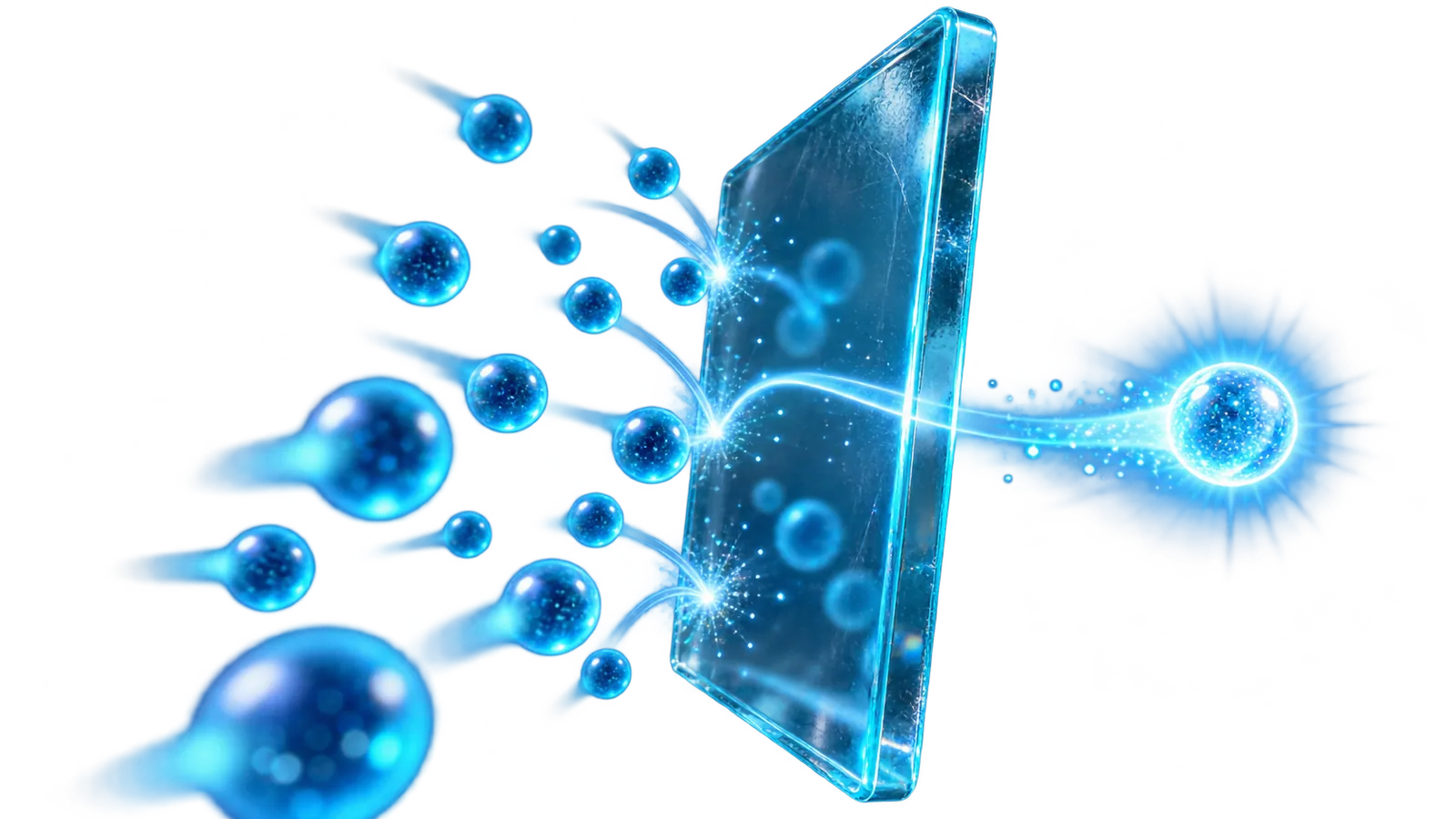
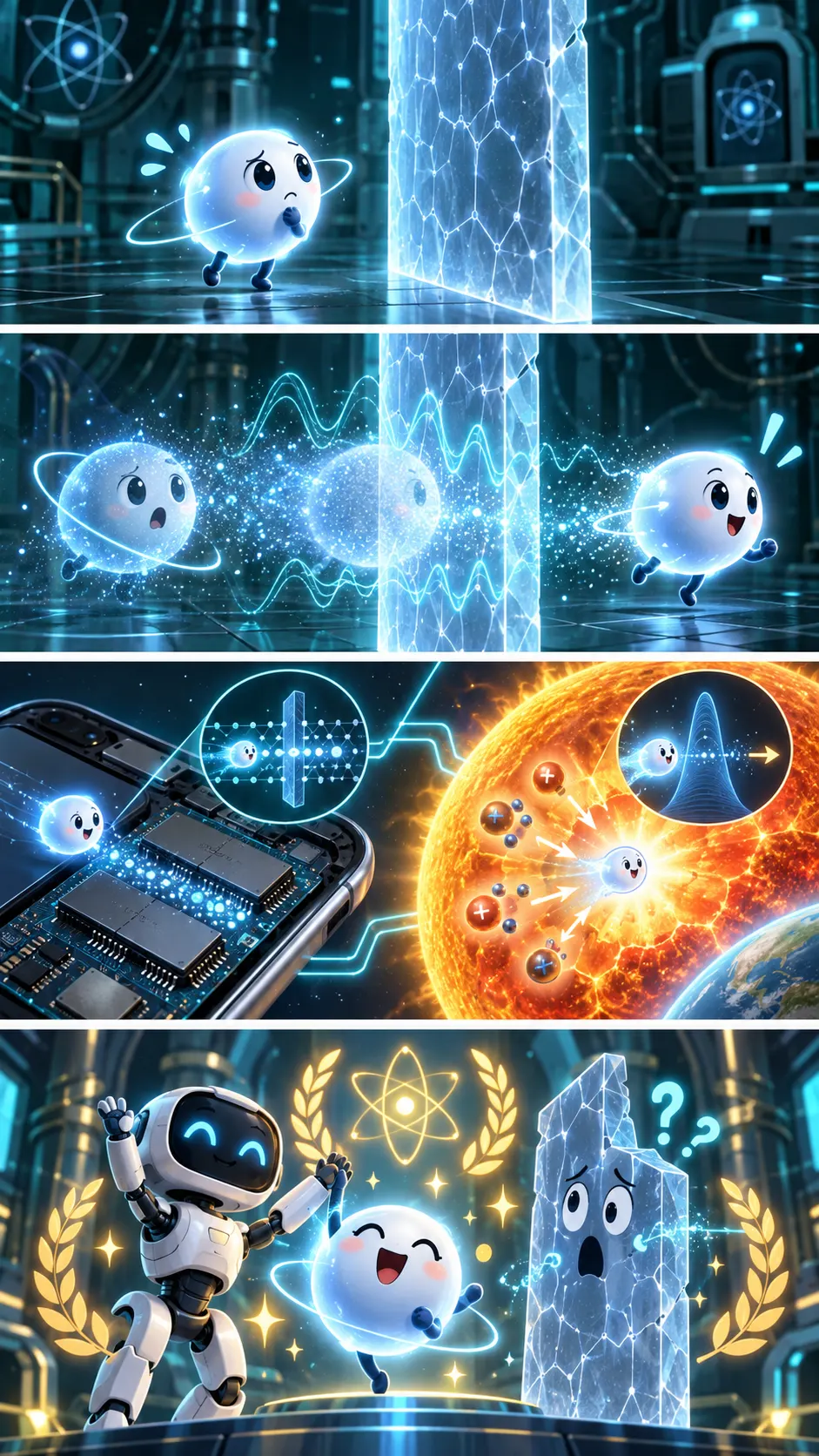
トンネル効果とは、電子などのとても小さな粒子が、本来なら越えられないはずのエネルギーの「壁」を、ある確率ですり抜けてしまう現象です。普通のボールを壁に投げれば必ず跳ね返りますが、量子の世界の粒子は波のような性質を持つため、壁の向こう側にも少しだけ「しみ出す」ことができるのです。
これはただの理屈ではありません。あなたのスマホに写真を保存できるのも、太陽が光っているのも、このすり抜けのおかげです。
01なぜ壁をすり抜けられるのか
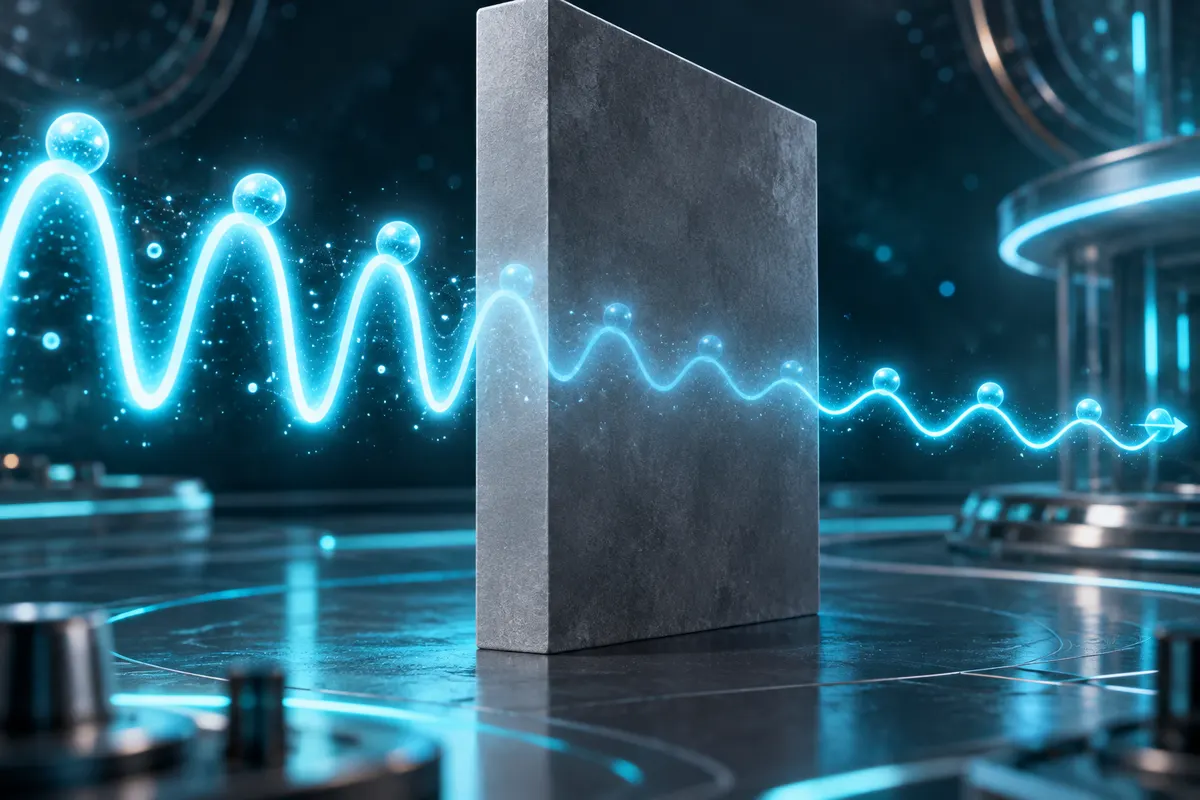
量子力学では、粒子が「どこにいるか」は確率の波で表されます。壁にぶつかると、この波は壁の中でどんどん小さくなりますが、ゼロにはなりません。
壁が十分に薄ければ、反対側にも小さな波が残ります。つまり、ある確率で、粒子は壁の向こう側に現れるのです。壁が厚くなるほど、高くなるほど、その確率は急激に小さくなります。
021928年、原子核の謎を解く鍵に
トンネル効果が大活躍した最初の舞台は、放射性物質でした。ウランなどの原子核から飛び出すアルファ粒子は、原子核の「壁」を越えるほどのエネルギーを持っていないのに、なぜか外に出てきます。
1928年、ソ連の若い物理学者ガモフは、これをトンネル効果で説明しました。ほぼ同じころ、米国プリンストン大学のガーニーとコンドンも同じ考えにたどり着いています。同じ年、ファウラーとノルドハイムは、強い電場をかけた金属から電子がトンネルで飛び出す仕組みを理論化しています。
03太陽が光るのも、スマホが記憶するのも
太陽の中心では、水素の原子核どうしがくっつく核融合が起きています。ところが、原子核どうしは電気の力で強く反発し合うので、太陽の中心の温度でも、本来はなかなかくっつけません。それでも核融合が起きるのは、トンネル効果で反発の壁をすり抜けることがあるからです。
スマホのメモリ(フラッシュメモリ)では、ごく薄い絶縁体の壁ごしに、電子をトンネル効果で出し入れして0と1を記録しています。電源を切っても写真が消えないのは、壁の向こうに電子を閉じ込めておけるからです。
04まとめ
トンネル効果は、「越えられない壁を、確率ですり抜ける」という、量子の世界ならではの現象です。
それは教科書の中だけの話ではなく、太陽の光から、スマホの写真、未来の量子コンピューターまで、私たちの世界を支えています。ポケットの中のスマホも、量子の不思議で動いているのです。
この研究を英語で読もう原田英語の English CornerQuantum tunneling is a strange effect in which tiny particles, such as electrons, pass through barriers… 音声
音声 4択クイズ9問A2・B1・B2タップして開く
原田英語の English Corner
この研究を英語で読もう
If you throw a ball at a wall, it always comes back. But very tiny things, like electrons, are different.
Sometimes they can pass through a wall. This is called quantum tunneling. It sounds like magic, but it is real. Your smartphone uses it to save photos.
The Sun also needs it to shine. Can people walk through walls? No. For big things, the chance is almost zero.
68 words ・ CEFR A2
和訳を見る
ボールを壁に投げると、いつも跳ね返ってきます。でも、電子のようなとても小さなものは違います。
ときどき壁を通り抜けることができるのです。これはトンネル効果と呼ばれます。魔法のように聞こえますが、本当に起きていることです。あなたのスマホは、写真を保存するのにこれを使っています。太陽も、光るためにこれを必要としています。
人は壁をすり抜けられるでしょうか。いいえ。大きなものでは、その確率はほとんどゼロです。
4択リーディングクイズ
Q1. What is the passage mainly about?
とても小さなものが壁を通り抜ける「トンネル効果」について説明しているので B。
Q2. What does your smartphone use tunneling for?
Your smartphone uses it to save photos. とあるので A。
Q3. In this passage, "the chance is almost zero" means it ...
chance は「可能性・確率」。それがほぼゼロ=ほとんど起きない、なので D。
Quantum tunneling is a strange effect in which tiny particles, such as electrons, pass through barriers that they do not have enough energy to cross. This is possible because, in the quantum world, particles behave like waves. When a wave hits a barrier, it becomes smaller inside it, but it does not disappear completely.
If the barrier is thin, a small part of the wave reaches the other side, so the particle may appear there. Tunneling is part of everyday life. Flash memory in smartphones moves electrons through very thin walls to store data. The Sun shines because atomic nuclei can tunnel through the force that pushes them apart, which allows nuclear fusion to happen.
115 words ・ CEFR B1
和訳を見る
トンネル効果とは、電子のような小さな粒子が、越えるのに十分なエネルギーを持っていない壁を通り抜けてしまう、不思議な現象です。これが可能なのは、量子の世界では粒子が波のようにふるまうからです。波が壁にぶつかると、壁の中では小さくなりますが、完全には消えません。
壁が薄ければ、波の小さな一部が反対側に届くので、粒子がそこに現れることがあるのです。トンネル効果は日常生活の一部になっています。スマホのフラッシュメモリは、とても薄い壁ごしに電子を動かしてデータを保存しています。太陽が光るのは、原子核どうしを押し離す力を原子核がトンネル効果ですり抜けられるからで、それによって核融合が起こるのです。
4択リーディングクイズ
Q1. What is the passage mainly about?
前半でトンネル効果のしくみを、後半でフラッシュメモリや太陽という身近な例を説明しているので D。
Q2. Why can particles pass through barriers?
particles behave like waves と、it does not disappear completely から B。D は「十分なエネルギーがない」という第1文に反する。
Q3. What would probably happen if the barrier were much thicker?
If the barrier is thin, a small part of the wave reaches the other side とあるので、壁が厚ければ反対側に届きにくくなると推測できる。正解は A。
Quantum tunneling allows particles such as electrons to cross energy barriers that, according to classical physics, they could never overcome. Because quantum objects are described by probability waves, a wave meeting a barrier decays inside it without vanishing entirely; if the barrier is thin enough, some of it emerges on the far side, and the particle has a certain probability of appearing there. That probability falls sharply as the barrier grows thicker or higher. In 1928, Gamow used tunneling to explain why alpha particles escape from atomic nuclei despite lacking the energy to do so, and in the same year Fowler and Nordheim described electrons tunneling out of metals in strong electric fields.
Today the effect is indispensable: flash memory stores data by moving electrons through ultra-thin insulating layers, and fusion in the Sun's core depends on nuclei tunneling through their mutual repulsion. Leo Esaki's 1958 tunnel diode earned him the 1973 Nobel Prize, and in 2025 Clarke, Devoret and Martinis received the Nobel Prize for showing in the 1980s that an entire superconducting circuit could tunnel like a single particle. For objects as large as humans, however, the probability is so tiny that it would essentially never occur.
199 words ・ CEFR B2
和訳を見る
トンネル効果によって、電子などの粒子は、古典物理学によれば決して越えられないはずのエネルギーの壁を越えることができます。量子的な物体は確率の波で表されるため、壁にぶつかった波は壁の中で減衰しても完全には消えません。壁が十分に薄ければ、その一部は反対側に現れ、粒子はある確率でそこに出現するのです。この確率は、壁が厚く、あるいは高くなるにつれて急激に下がります。1928年、ガモフはトンネル効果を使って、アルファ粒子がそのためのエネルギーを持っていないのに原子核から飛び出す理由を説明しました。同じ年、ファウラーとノルドハイムは、強い電場の中で電子が金属からトンネル効果で飛び出すしくみを示しました。
今日、この効果は欠かせないものになっています。フラッシュメモリは極めて薄い絶縁層ごしに電子を動かしてデータを保存し、太陽の中心での核融合は、原子核が互いの反発をトンネル効果ですり抜けることにかかっています。江崎玲於奈は1958年のトンネルダイオードで1973年のノーベル賞を受賞し、2025年にはクラーク、デヴォレ、マルティニスが、超伝導回路全体が1つの粒子のようにトンネル効果を起こしうることを1980年代に示した業績でノーベル賞を受賞しました。しかし、人間ほど大きな物体では、その確率はあまりに小さく、事実上決して起こらないでしょう。
4択リーディングクイズ
Q1. What is the main purpose of the passage?
しくみ(確率の波)、歴史(1928年の理論、ノーベル賞)、現代での重要性(フラッシュメモリ、太陽)を説明しているので C。
Q2. What did the work honored by the 2025 Nobel Prize show?
showing ... that an entire superconducting circuit could tunnel like a single particle とあるので D。
Q3. Why would people never pass through walls by tunneling?
最終文 For objects as large as humans, however, the probability is so tiny that it would essentially never occur. から B。
重要単語
- tunnelingC1名詞トンネル効果Tunneling lets electrons pass through a barrier.
 tunnel は動詞で「トンネルを掘って進む」。イギリス英語では tunnelling とつづる。
 - barrierB2名詞障壁・壁The barrier is only a few nanometers thick. language barrier「言葉の壁」のように比喩でもよく使う。barrier-free「バリアフリー」も同じ語。
- probabilityB2名詞確率There is a small probability of passing through. a high/low probability「高い/低い確率」。形容詞 probable、副詞 probably。
- semiconductorC1名詞半導体Semiconductors are used in every smartphone. semi-(半分)+conductor(伝導体)。semifinal「準決勝」の semi- と同じ。
- fusionC1名詞核融合・融合Fusion in the Sun depends on tunneling. nuclear fusion「核融合」、nuclear fission「核分裂」の区別が頻出。料理の「フュージョン(融合)」も同じ語。
- indispensableC1形容詞欠かせない・不可欠なTunneling is indispensable to modern electronics. in-(否定)+dispense with(~なしで済ます)+-able。be indispensable to/for ~ の形。essential の言いかえで入試頻出。
 入試に出る順の単語帳を印刷する →
 全5903語の「科学英単語カード」で復習する →
 公式・一次情報をチェック
 4コマでわかる
このネタ、誰かに教えたくなった?
ボールを壁に投げたら、たまに壁の向こうに出てくる――ミクロの世界ではそれが本当に起きる。これが「トンネル効果」。スマホに写真を保存できるのも、太陽が光っているのも、このすり抜けのおかげらしい。
押すと「マジかリスト」に保存されます
 出典・参考文献(5件)タップで表示
- Gamow (1928) Zur Quantentheorie des Atomkernes, Zeitschrift für Physikdoi.org
- Fowler & Nordheim (1928) Electron emission in intense electric fields, Proceedings of the Royal Society Adoi.org
- Esaki (1958) New Phenomenon in Narrow Germanium p-n Junctions, Physical Reviewdoi.org
- Devoret, Martinis & Clarke (1985) Measurements of Macroscopic Quantum Tunneling out of the Zero-Voltage State of a Current-Biased Josephson Junction, Physical Review Lettersdoi.org
- Ramos et al. (2020) Measurement of the time spent by a tunnelling atom within the barrier region, Naturedoi.org

※本記事は上記の研究・公開資料をもとに、原田英語が独自の言葉で解説したものです。引用は著作権法第32条の範囲で行い、出典を明記しています。画像はすべてオリジナルのイメージです。研究結果には限界や個人差があります。誤りのご指摘は原田英語のお問い合わせフォームから。


 地球・歴史
地球・歴史