shugaku ryoko
the school trip everyone goes on
修学旅行(しゅうがくりょこう)
In one line
The shortest answer that works
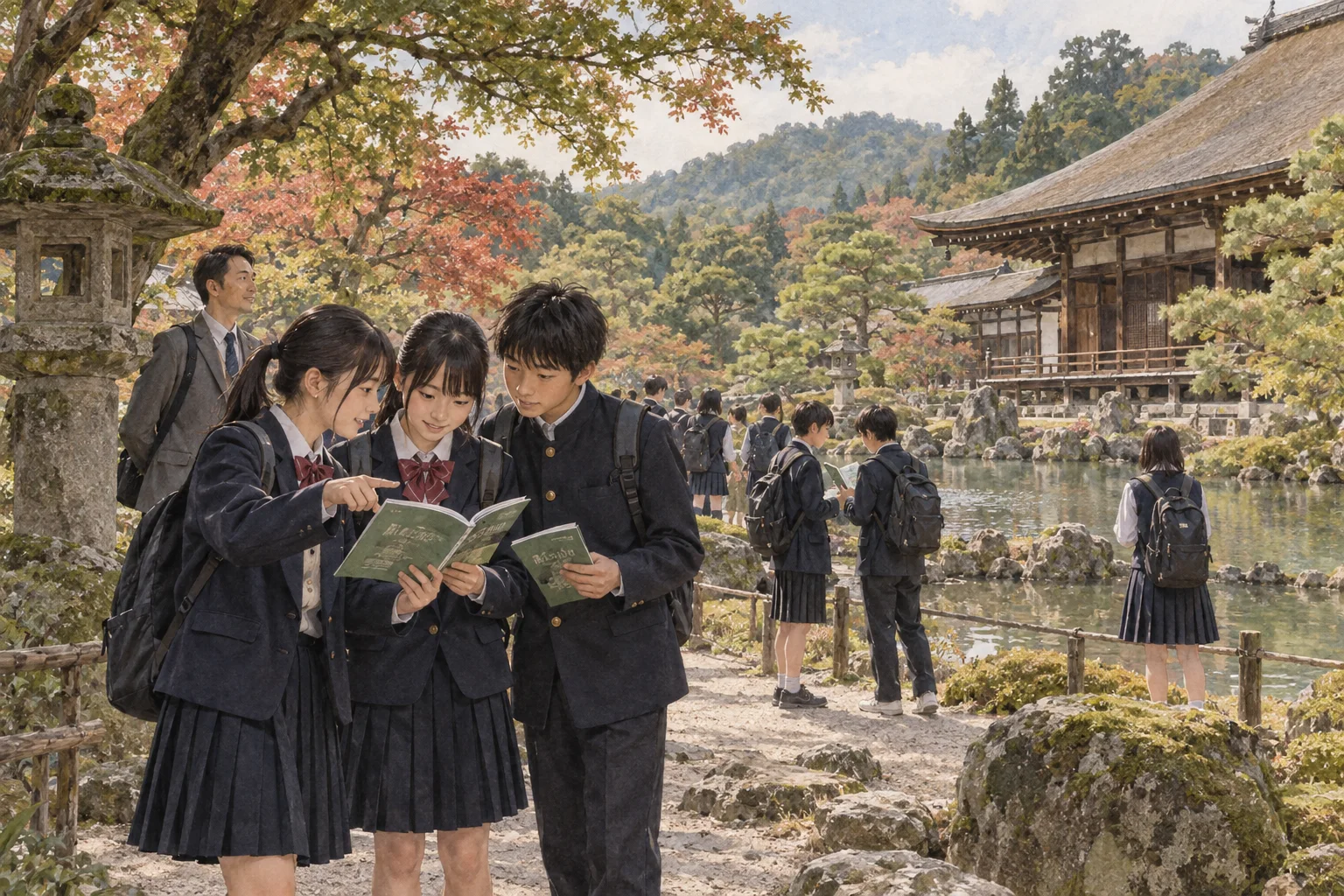
Shugaku ryoko is the multi-day school trip that a whole year group takes together.
修学旅行とは、学年全員で行く泊まりがけの学校行事の旅行です。
In 30 seconds
The standard explanation
Japanese schools take an entire year group away for several days, usually near the end of each stage of schooling. Destinations are traditional rather than chosen: Kyoto and Nara for temples, Hiroshima or Okinawa for war history, Tokyo for students from rural areas. It is part of the curriculum, not an optional extra.
日本の学校は学年全体を数日間連れて出かけます。たいてい小・中・高それぞれの終わりに近い学年です。行き先は選ぶというより定番があり、寺社なら京都・奈良、戦争の歴史なら広島や沖縄、地方の学校なら東京。任意の課外行事ではなく、教育課程の一部です。
As a short speech
A full paragraph you can read aloud
Almost every Japanese student goes on a shugaku ryoko, a school trip lasting several days, usually in the last year of primary school, the last year of junior high, and the second year of high school. The whole year group goes, it is part of the curriculum rather than optional, and families pay into a savings scheme over the preceding years to cover it.
The destinations are traditional. Kyoto and Nara are the standard choice for temples and history. Hiroshima and Okinawa are often chosen specifically so that students visit the sites of the atomic bombing and the Battle of Okinawa, and hear from people connected to them.
For students in rural areas the trip is often to Tokyo. What people remember afterwards is rarely the temples. It is the night in the hotel room with friends, being told to go to sleep, and not going to sleep. Ask most Japanese adults about their school trip and that is the part they will describe.
日本の生徒のほぼ全員が、修学旅行に行きます。数日間の旅行で、たいてい小学6年、中学3年、高校2年に行われます。学年全員が行き、任意の行事ではなく教育課程の一部で、費用は数年かけて積み立てます。
行き先には定番があります。寺社と歴史なら京都・奈良。広島と沖縄は、原爆と沖縄戦の跡を訪ね、関わりのある方の話を聞くために選ばれます。地方の学校では東京になることも多いです。
あとになって覚えているのは、たいてい寺ではありません。友人と過ごしたホテルの部屋の夜、寝なさいと言われて、寝なかったこと。日本の大人に修学旅行のことを聞けば、たいてい語られるのはその部分です。
Questions people actually ask
And how to answer them.
Is it optional?
No, it is part of the school curriculum, and non-participation is unusual. Costs are covered by a long-running savings scheme that families pay into monthly.
任意ではありません。教育課程の一部で、不参加はまれです。費用は毎月の積立で数年かけて用意します。
Why Hiroshima and Okinawa?
Both are chosen for peace education. Students visit the Peace Memorial Museum or sites from the Battle of Okinawa, and schools often arrange for them to hear testimony directly.
どちらも平和学習のために選ばれます。平和記念資料館や沖縄戦の跡を訪ね、体験者の話を直接聞く機会を設ける学校も多くあります。
How strict is it?
Quite. There are set groups, timetables, curfews and room checks, and the trip is treated as an extension of school rather than a holiday. Students test those limits anyway.
かなり厳しいです。班分け、日程、消灯時間、部屋の点呼があり、休暇ではなく学校の延長として扱われます。それでも生徒はその線を試します。
Phrases you can use
- The whole year group goes together.学年全員で行きます。
- Families save for it monthly over several years.費用は数年かけて毎月積み立てます。
- Kyoto and Nara are the classic destinations.京都と奈良が定番の行き先です。
- Hiroshima is chosen for peace education.広島は平和学習のために選ばれます。
- People forget the temples — they remember the hotel room.寺のことは忘れても、ホテルの部屋のことは覚えています。
Words you need
- school trip修学旅行
- year group学年
- curfew消灯時間、門限
- peace education平和学習
- savings scheme積立
Watch
From YouTubeBackground (Japanese)
修学旅行の起源は、1886年に東京師範学校が実施した「長途遠足」とされることが多い。当初は行軍訓練の性格を帯びていた。戦後は教育課程に位置づけられ、1950年代以降に鉄道網の整備とともに全国へ広がった。行き先として京都・奈良が多いのは寺社と歴史学習、広島・長崎・沖縄が多いのは平和学習によるもので、公益財団法人日本修学旅行協会の調査でも上位に挙がる。近年は海外への修学旅行や、体験学習・民泊を組み込む形も増えている。一方で費用負担の重さが指摘され、簡素化や積立額の見直しを行う学校もある。