nyugakushiki to sotsugyoshiki
the formal ceremonies that open and close a school year
入学式と卒業式(にゅうがくしきとそつぎょうしき)
In one line
The shortest answer that works
Japanese schools hold a formal entrance ceremony in April and a graduation ceremony in March, both attended by parents.
日本の学校は4月に入学式、3月に卒業式という正式な式典を行い、どちらにも保護者が出席します。
In 30 seconds
The standard explanation
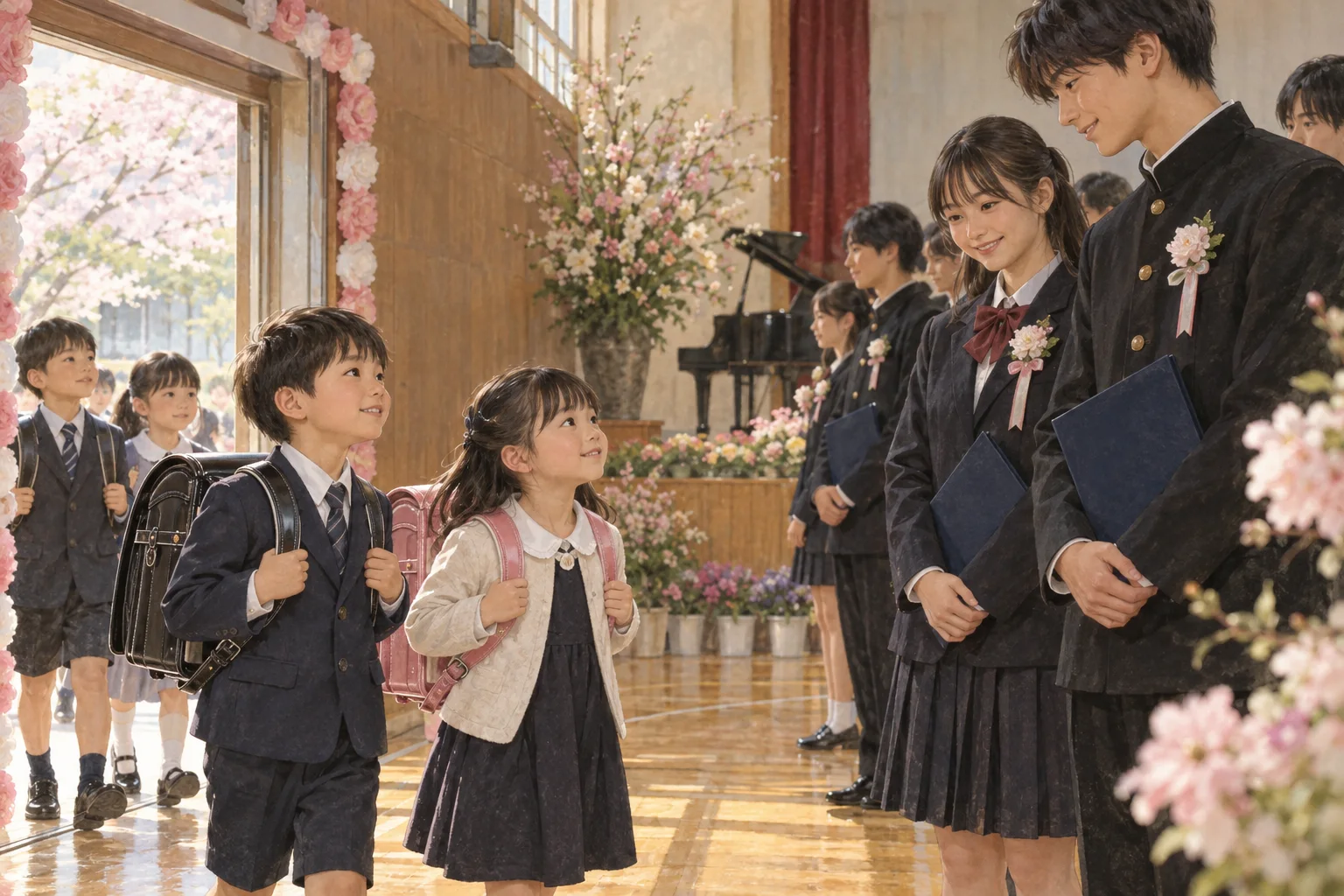
The Japanese school year runs from April to March, so in much of the country it opens with cherry blossom and closes just before it. Both ends are marked with a formal ceremony in the gymnasium: speeches, the national anthem, the school song, and students called up one by one. Parents attend in formal clothes and photograph everything.
日本の学年は4月から3月までなので、多くの地域では桜とともに始まり、桜の少し前に終わります。その両端に、体育館で正式な式典が行われます。式辞、国歌、校歌、そして一人ずつ名前を呼ばれる。保護者は礼服で出席し、あらゆる場面を撮影します。
As a short speech
A full paragraph you can read aloud
The Japanese school year begins in April and ends in March, which means that in much of the country it opens just as the cherry blossoms do. Both ends are marked formally. At the entrance ceremony in April, new students sit in the gymnasium with their parents behind them, the principal gives an address, everyone sings, and the new students are formally welcomed.
At graduation in March, each student is called by name and walks up to receive their certificate with both hands. There is singing, there are speeches from a departing student and a remaining one, and there is a great deal of crying. Both are treated as genuinely significant, not as routine.
Many parents take the day off work, wear formal clothes, and photograph their child under the school gate sign. If you are ever invited to one, the thing to know is that it is more solemn than a Western graduation: no cheering, no throwing caps, and applause at set moments.
日本の学年は4月に始まり3月に終わります。つまり、多くの地域では、ちょうど桜が咲くころに始まるわけです。その両端が式典で区切られます。4月の入学式では、新入生が体育館に座り、その後ろに保護者が並び、校長が式辞を述べ、全員で歌い、新入生が正式に迎えられます。
3月の卒業式では、一人ずつ名前を呼ばれ、両手で証書を受け取りに行きます。歌があり、送る側と送られる側の言葉があり、そしてたくさんの涙があります。どちらも本当に重要な行事として扱われ、形式的な通過点ではありません。
多くの保護者が仕事を休み、礼服を着て、校門の看板の前で子どもを撮影します。もし招かれることがあれば、知っておくとよいのは、欧米の卒業式より厳粛だということです。歓声も帽子を投げることもなく、拍手は決められた場面で起こります。
Questions people actually ask
And how to answer them.
Why does the school year start in April?
It was aligned with the government's fiscal year, which begins in April, during the modernization of the late nineteenth century. The cherry blossom association came with it rather than causing it.
19世紀後半の近代化のなかで、4月始まりの国の会計年度に合わせたためです。桜との結びつきは、その結果として生まれたもので、原因ではありません。
Do parents really attend?
Yes, and many take the day off to do it. Entrance and graduation ceremonies are family events, and grandparents often come too. Formal dark clothing is standard.
出席しますし、そのために仕事を休む人も多いです。入学式も卒業式も家族の行事で、祖父母が来ることも多いです。服装は黒などの礼服が基本です。
What is the song everyone sings?
The school song, which every school has and every student knows. Graduation also has a set of standard farewell songs that most Japanese adults can still sing from memory.
校歌です。どの学校にもあり、生徒全員が覚えています。卒業式には定番の別れの歌もあり、日本の大人の多くは今でも歌えます。
Phrases you can use
- The school year starts in April here.日本の学年は4月に始まります。
- Many parents take the day off to attend.仕事を休んで出席する保護者も多いです。
- Each student is called up by name.一人ずつ名前を呼ばれます。
- Receive it with both hands.両手で受け取ります。
- It's more solemn than a Western graduation.欧米の卒業式より厳粛です。
Words you need
- ceremony式典
- certificate証書
- principal校長
- school song校歌
- fiscal year会計年度
Watch
From YouTubeBackground (Japanese)
日本の学校が4月始まりになったのは明治期で、国の会計年度が4月からに定まったことに合わせたとされる。それ以前は9月始まりの時期もあった。世界的には9月始まりの国が多く、留学や国際的な人材の移動の妨げになるとして、9月入学への移行が繰り返し議論されてきたが、実現していない。卒業式で歌われる曲は時代とともに変わり、「仰げば尊し」「蛍の光」から、近年は「旅立ちの日に」などが定番になっている。卒業証書を両手で受け取り、一礼してから戻る所作は、多くの学校で事前に練習が行われる。学校によっては予行演習の時間が正式に設けられている。