kokyo no ba de no kesho
why it is frowned on
公共の場での化粧(こうきょうのばでのけしょう)
In one line
The shortest answer that works
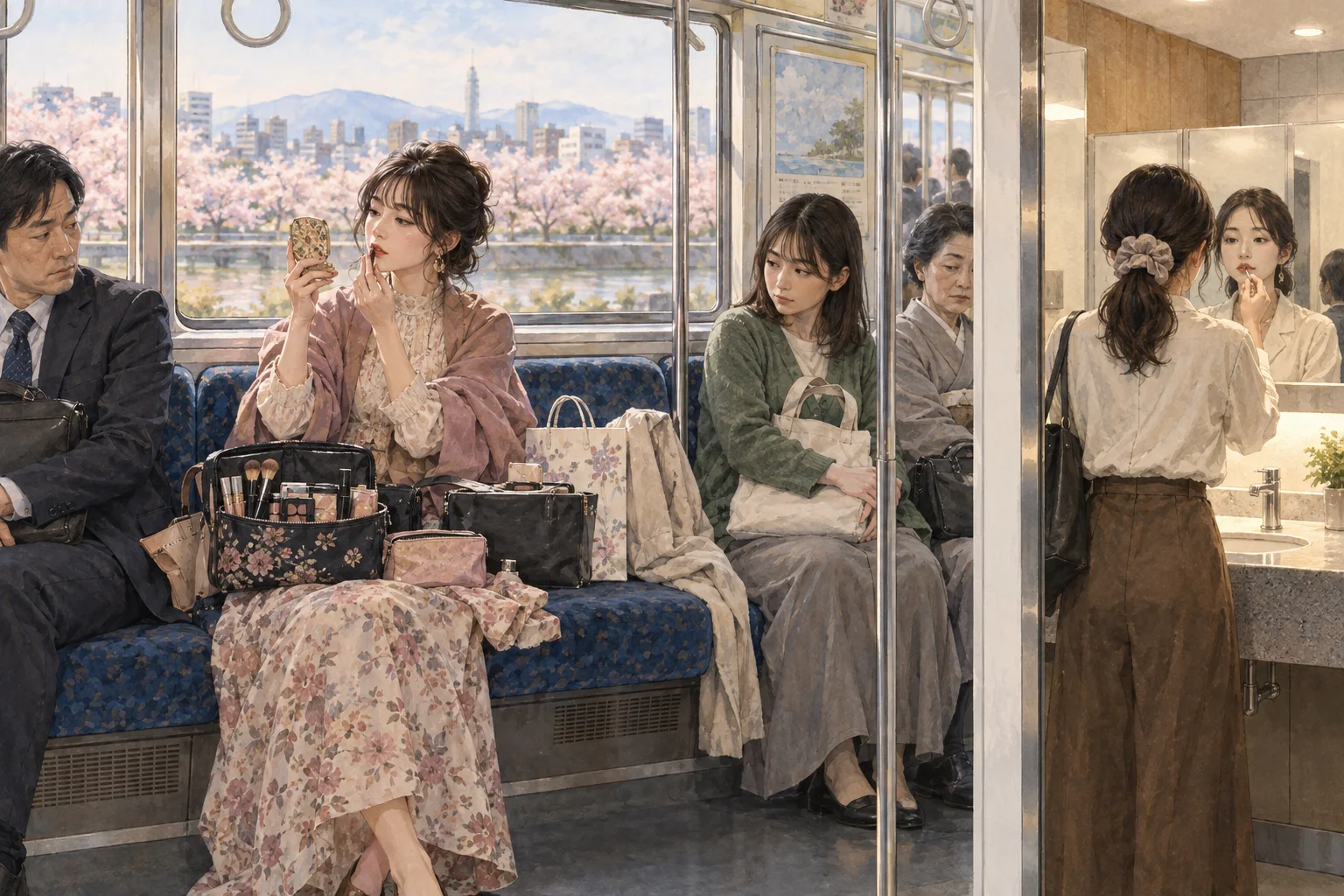
Kokyo no ba de no kesho, or makeup in public, is widely thought rude on trains, yet few say so.
公共の場での化粧とは、電車などで化粧をすることで、行儀が悪いと広く見なされながら、口に出す人はまずいません。
In 30 seconds
The standard explanation
Applying makeup on a train or in another public space is regarded as impolite by many Japanese people, and rail companies have run manner campaigns about it. The reasoning given is that it is a private act performed in a shared space, along with practical objections about powder and smell. Opinion is divided and generational.
電車など公共の場で化粧をすることは、多くの日本人に行儀が悪いと見なされていて、鉄道会社がマナーの広告で扱ったこともあります。挙げられる理由は、私的な行いを共有の場で行うことと、粉や匂いについての実際的な苦情です。意見は分かれていて、世代による差もあります。
As a short speech
A full paragraph you can read aloud
Doing your makeup on a train is one of the sharper manner disputes in Japan, and worth knowing because it is invisible to visitors. Many people, particularly older ones, regard it as clearly impolite: the argument is that grooming is a private activity and a train is a shared space, and that doing it in front of strangers is a kind of imposition.
There are practical objections too, about loose powder and the smell of products in an enclosed train car. Rail companies have run poster campaigns discouraging it, alongside campaigns about backpacks and phone calls.
The counter-argument, made openly and mostly by younger women, is that the objection falls almost entirely on women, that commuting time is squeezed by long hours, and that nobody complains about men shaving with an electric razor in the same seat. There is no rule and no penalty, and nobody will speak to you. But you are being looked at, and that is the part visitors do not realize.
電車で化粧をすることは、日本のマナーをめぐる論争の中でも鋭いもののひとつで、訪れた人には見えないだけに、知っておく値打ちがあります。多くの人、とくに年配の層は、これをはっきり行儀が悪いと見なします。身支度は私的な行いであり、電車は共有の場であって、見知らぬ人の前でそれを行うのは押しつけの一種だ、という理屈です。
実際的な苦情もあります。閉じた車内に散る粉と、化粧品の匂いについてです。鉄道会社は、背負った鞄や通話についての広告と並べて、これを控えるよう促す掲示を出してきました。反論も公然と述べられていて、その多くは若い女性からのものです。
この非難はほとんど女性だけに向かうこと、長い労働時間が通勤の時間を圧迫していること、そして同じ座席で電気剃刀を使う男性には誰も文句を言わないこと。規則はなく、罰もなく、誰も声をかけてきません。しかし見られています。そこが訪れた人には分からない部分です。
Questions people actually ask
And how to answer them.
Will anyone actually say something?
Almost never. Direct confrontation with a stranger is avoided in Japan, so disapproval is expressed by looking and by not looking. That is why visitors can do it for years without realizing anyone minds.
まずありません。日本では見知らぬ人と正面からぶつかることが避けられるので、不快さは視線と、視線を外すことで表されます。だから訪れた人は、誰も気にしていないと思ったまま何年も過ごせるのです。
Where is it acceptable?
Station and department store powder rooms, which exist for exactly this and are common and clean. Many large stations have a dedicated space with mirrors and a counter, and using one is entirely normal.
駅や百貨店の化粧室です。まさにそのためにあり、数も多く清潔です。大きな駅には鏡と台を備えた専用の場所があり、そこを使うのはまったくふつうのことです。
A common misunderstanding
MYTHIt is prohibited on Japanese trains.
FACTThere is no rule and no penalty. It is a manner point promoted through campaigns, and opinion about it is genuinely divided along generational and gender lines.
Phrases you can use
- There's a powder room in the station.駅に化粧室があります。
- Nobody will say anything, but they notice.誰も言いませんが、気づいています。
- It isn't a rule, it's a manner point.規則ではなくマナーの話です。
- Opinion on this is divided.これについては意見が分かれています。
Words you need
- to put on makeup化粧をする
- manner campaignマナー広告
- powder room化粧室
- shared space共有の場
Watch
From YouTubeBackground (Japanese)
鉄道各社は、車内での通話、大きな荷物の扱い、座席の座り方などとともに、化粧をマナーの広告で扱ってきました。2016年には、電車内での化粧を題材にした広告が女性を一方的に責めているとして議論を呼び、取り下げを求める声が上がりました。駅構内や百貨店には化粧直しのための場所が整備されており、都市部では有料の身支度のための個室も現れています。似た論点として、車内での飲食や香りの強い整髪料も取り上げられます。