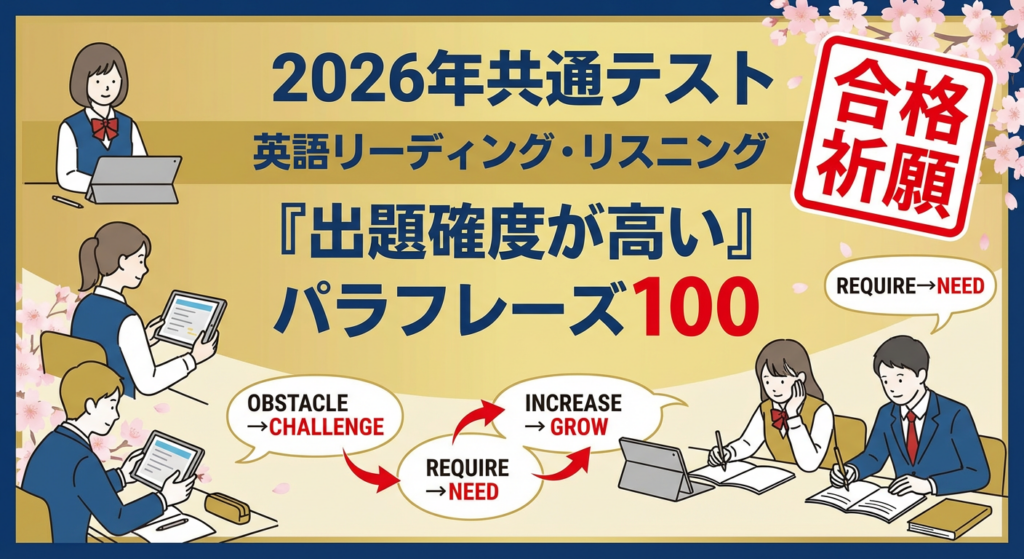
共通テストの英語リーディング・リスニングで、時間が足りない、内容が頭に入ってこない…そんな悩みを抱えていませんか?
実は、その原因の一つに「パラフレーズ(言い換え表現)」があります。問題文と選択肢で同じ意味が異なる言葉で表現される、この言い換え表現を攻略することが、高得点へのカギです。
今回は、2023年~2025年の共通テスト(本試験・追試験)を徹底分析し、リーディング・リスニング両分野で頻出のパラフレーズ表現100個を厳選しました。これをマスターすれば、あなたの英語力は飛躍的に向上するはず。さあ、ライバルに差をつける「言い換え力」を身につけましょう!
リーディング編
第1部:基本動詞の言い換え(1~10)
最も頻出される基本動詞の言い換えパターンです。「think」→「consider」「get」→「obtain」など、より形式的な動詞への言い換えが特徴です。共通テストでは、口語的な動詞がより学術的な表現に言い換えられることが多いため、これらのパターンを認識することが重要です。
| No. | パラフレーズ前 | パラフレーズ後 | 日本語例文 | 日本語訳 | ワンポイント |
|---|---|---|---|---|---|
| 1 | think | consider / believe | I think that this is the best option. → I consider this to be the best option. | これが最善の選択肢だと思う。→ これが最善の選択肢だと考える。 | 「think」よりも「consider」や「believe」の方が、より熟考した上での意見や信念を表す。 |
| 2 | get | obtain / acquire | You can get information from the website. → You can obtain information from the website. | ウェブサイトから情報を得ることができる。→ ウェブサイトから情報を入手することができる。 | 「get」よりも「obtain」や「acquire」の方が、努力して何かを手に入れるニュアンスが強い。 |
| 3 | say | state / claim | The witness said that he saw the suspect. → The witness stated that he saw the suspect. | 目撃者は容疑者を見たと述べた。→ 目撃者は容疑者を見たと証言した。 | 「say」よりも「state」や「claim」の方が、公式な場面や、主張を強調する場合に使われる。 |
| 4 | use | utilize / employ | We should use this new technology. → We should utilize this new technology. | 我々はこの新しい技術を使うべきだ。→ 我々はこの新しい技術を活用すべきだ。 | 「use」よりも「utilize」や「employ」の方が、効果的に、あるいは特定の目的のために用いる意味合いが強い。 |
| 5 | try | attempt / endeavor | I will try to solve the problem. → I will attempt to solve the problem. | その問題を解決しようと試みる。→ その問題を解決しようと試みる。 | 「try」よりも「attempt」や「endeavor」の方が、より困難なことへの挑戦や、多大な努力を伴う試みを表す。 |
| 6 | change | alter / modify | We need to change our plan. → We need to alter our plan. | 我々は計画を変更する必要がある。→ 我々は計画を修正する必要がある。 | 「change」よりも「alter」や「modify」の方が、部分的な変更や調整を指すことが多い。 |
| 7 | help | assist / aid | He helped me with my homework. → He assisted me with my homework. | 彼は私の宿題を手伝ってくれた。→ 彼は私の宿題を補助してくれた。 | 「help」よりも「assist」や「aid」の方が、よりフォーマルな文脈や、専門的な支援を表す。 |
| 8 | start | commence / initiate | The ceremony will start at 10 a.m. → The ceremony will commence at 10 a.m. | 式典は午前10時に始まる。→ 式典は午前10時に開始される。 | 「start」よりも「commence」や「initiate」の方が、公式な行事や、新しいプロジェクトの開始など、改まった場面で使われる。 |
| 9 | keep | maintain / preserve | We must keep the environment clean. → We must maintain a clean environment. | 我々は環境を清潔に保たなければならない。→ 我々は清潔な環境を維持しなければならない。 | 「keep」よりも「maintain」や「preserve」の方が、状態を維持するための努力や、価値あるものを保護するニュアンスが強い。 |
| 10 | show | indicate / demonstrate | The research shows that the new drug is effective. → The research indicates that the new drug is effective. | その研究は新薬が効果的であることを示している。→ その研究は新薬が効果的であることを示唆している。 | 「show」よりも「indicate」や「demonstrate」の方が、データや証拠に基づいて何かを指し示したり、論理的に証明したりする意味合いが強い。 |
第2部:形容詞・副詞の言い換え(11~20)
形容詞や副詞の言い換えは、文の評価や状態を表す重要な要素です。「important」→「crucial」「good」→「beneficial」など、より強い評価や、より具体的な意味を持つ表現への言い換えが特徴です。
| No. | パラフレーズ前 | パラフレーズ後 | 日本語例文 | 日本語訳 | ワンポイント |
|---|---|---|---|---|---|
| 11 | important | crucial / vital | It is important to follow the rules. → It is crucial to follow the rules. | ルールに従うことは重要だ。→ ルールに従うことは極めて重要だ。 | 「important」よりも「crucial」や「vital」の方が、「決定的な」「不可欠な」といった、より強い重要性を表す。 |
| 12 | good | beneficial / advantageous | This is a good opportunity for us. → This is a beneficial opportunity for us. | これは我々にとって良い機会だ。→ これは我々にとって有益な機会だ。 | 「good」よりも「beneficial」や「advantageous」の方が、具体的な利益や利点があることを示す。 |
| 13 | bad | detrimental / harmful | Smoking is bad for your health. → Smoking is detrimental to your health. | 喫煙は健康に悪い。→ 喫煙は健康に有害だ。 | 「bad」よりも「detrimental」や「harmful」の方が、具体的な損害や悪影響を及ぼすことを明確に示す。 |
| 14 | big | substantial / considerable | There is a big difference between the two. → There is a substantial difference between the two. | 両者には大きな違いがある。→ 両者には相当な違いがある。 | 「big」よりも「substantial」や「considerable」の方が、量や程度が大きいことを、より客観的・具体的に表す。 |
| 15 | difficult | challenging / demanding | The exam was very difficult. → The exam was very challenging. | その試験はとても難しかった。→ その試験はとてもやりがいがあった。 | 「difficult」が単に困難さを表すのに対し、「challenging」は困難だが乗り越える価値があるという前向きなニュアンスを含む。「demanding」は多くの努力や能力を要求されることを示す。 |
| 16 | enough | sufficient / adequate | We don’t have enough time. → We don’t have sufficient time. | 我々には十分な時間がない。→ 我々には十分な時間がない。 | 「enough」よりも「sufficient」や「adequate」の方が、必要とされる基準や量を満たしているか、という客観的な視点から「十分な」を表す。 |
| 17 | many | numerous / a multitude of | There are many reasons for this. → There are numerous reasons for this. | これには多くの理由がある。→ これには数多くの理由がある。 | 「many」よりも「numerous」や「a multitude of」の方が、数が非常に多いことを強調する、よりフォーマルな表現。 |
| 18 | old | ancient / long-standing | This is an old tradition. → This is an ancient tradition. | これは古い伝統だ。→ これは古代からの伝統だ。 | 「old」が単に古いことを表すのに対し、「ancient」は古代の、「long-standing」は長年にわたる、といった具体的な時間の長さを伴う。 |
| 19 | clear | apparent / evident | It is clear that he is lying. → It is apparent that he is lying. | 彼が嘘をついているのは明らかだ。→ 彼が嘘をついているのは明白だ。 | 「clear」よりも「apparent」や「evident」の方が、状況証拠などから見て、誰の目にも明らかである、というニュアンスが強い。 |
| 20 | really | genuinely / truly | I’m really sorry. → I’m genuinely sorry. | 本当にごめんなさい。→ 心からお詫び申し上げます。 | 「really」が口語的な強調であるのに対し、「genuinely」や「truly」は、心からの、偽りのない、といった誠実な気持ちを表す。 |
第3部:名詞の言い換え(21~30)
名詞の言い換えは、より抽象的で複雑です。「problem」→「issue」「result」→「outcome」など、より正式な表現や、より具体的な意味を持つ表現への言い換えが特徴です。
| No. | パラフレーズ前 | パラフレーズ後 | 日本語例文 | 日本語訳 | ワンポイント |
|---|---|---|---|---|---|
| 21 | problem | issue / challenge | We need to solve this problem. → We need to address this issue. | 我々はこの問題を解決する必要がある。→ 我々はこの問題に取り組む必要がある。 | 「problem」が解決すべき具体的な困難を指すのに対し、「issue」は議論すべき論点、「challenge」は乗り越えるべき課題、といったニュアンスを持つ。 |
| 22 | result | consequence / outcome | The result of the experiment was successful. → The outcome of the experiment was successful. | 実験の結果は成功だった。→ 実験の成果は成功だった。 | 「result」が一般的な結果を指すのに対し、「consequence」は特定の原因から生じる(しばしば好ましくない)結果、「outcome」は最終的な成果や結末を表す。 |
| 23 | reason | factor / cause | What is the reason for your decision? → What is the primary factor in your decision? | あなたの決定の理由は何ですか?→ あなたの決定における主な要因は何ですか? | 「reason」が行動の動機を指すのに対し、「factor」は結果に影響を与える要因、「cause」は直接的な原因を表す。 |
| 24 | way | method / approach | This is the best way to do it. → This is the most effective method. | これがそれを行う最善の方法だ。→ これが最も効果的な手法だ。 | 「way」が一般的な方法を指すのに対し、「method」は体系的な手法、「approach」は問題への取り組み方を表す。 |
| 25 | idea | concept / notion | I have an idea for a new product. → I have a concept for a new product. | 新製品のアイデアがある。→ 新製品の構想がある。 | 「idea」が一般的な思いつきを指すのに対し、「concept」はより具体的で体系的な構想、「notion」は漠然とした考えや観念を表す。 |
| 26 | part | component / element | This is an important part of the machine. → This is a crucial component of the machine. | これは機械の重要な部分だ。→ これは機械の不可欠な構成要素だ。 | 「part」が一般的な部分を指すのに対し、「component」は機械やシステムの構成要素、「element」は物事の基本的な要素を表す。 |
| 27 | effect | impact / influence | The new law will have a big effect on our lives. → The new law will have a significant impact on our lives. | 新しい法律は我々の生活に大きな影響を与えるだろう。→ 新しい法律は我々の生活に重大な影響を与えるだろう。 | 「effect」が一般的な効果・影響を指すのに対し、「impact」は強い衝撃を伴う影響、「influence」は間接的で徐々に及ぼす影響を表す。 |
| 28 | advantage | benefit / merit | The advantage of this system is its low cost. → The benefit of this system is its low cost. | このシステムの利点はコストが低いことだ。→ このシステムの恩恵はコストが低いことだ。 | 「advantage」が他との比較における有利な点を指すのに対し、「benefit」は個人や社会が受ける恩恵、「merit」は長所や価値を表す。 |
| 29 | disadvantage | drawback / shortcoming | The disadvantage of this plan is its complexity. → The drawback of this plan is its complexity. | この計画の欠点はその複雑さだ。→ この計画の難点はその複雑さだ。 | 「disadvantage」が不利な点を指すのに対し、「drawback」は計画などの難点、「shortcoming」は人や物の欠点を表す。 |
| 30 | people | individuals / the public | Many people think so. → Many individuals think so. | 多くの人々がそう考えている。→ 多くの個人がそう考えている。 | 「people」が不特定多数の人々を指すのに対し、「individuals」は一人ひとりの個人を、「the public」は一般大衆を指す。 |
第4部:句・節の言い換え(31~40)
句や節全体の言い換えは、共通テストで最も難易度が高いパターンです。構文が大きく変わることに注意が必要です。「because of」→「due to」「in order to」→「so as to」など、文法的な構造の変化を伴う言い換えが特徴です。
| No. | パラフレーズ前 | パラフレーズ後 | 日本語例文 | 日本語訳 | ワンポイント |
|---|---|---|---|---|---|
| 31 | because of | due to / owing to | The game was canceled because of the rain. → The game was canceled due to the rain. | 雨のために試合は中止になった。→ 雨が原因で試合は中止になった。 | 「because of」が口語的な原因・理由を表すのに対し、「due to」や「owing to」は、よりフォーマルな文脈で使われる。 |
| 32 | in order to | so as to / for the purpose of | He studied hard in order to pass the exam. → He studied hard so as to pass the exam. | 彼は試験に合格するために一生懸命勉強した。→ 彼は試験に合格するように一生懸命勉強した。 | 「in order to」が最も一般的。「so as to」はややフォーマル。「for the purpose of」は「~という目的で」と、目的をより強調する。 |
| 33 | even though | despite the fact that / although | Even though he is rich, he is not happy. → Despite the fact that he is rich, he is not happy. | 彼はお金持ちであるにもかかわらず、幸せではない。→ 彼がお金持ちであるという事実にもかかわらず、幸せではない。 | 「even though」や「although」が接続詞として文を導くのに対し、「despite」は前置詞のため、後ろに名詞(句)が続く。「despite the fact that」の形で接続詞のように使える。 |
| 34 | for example | for instance / to illustrate | I like sports, for example, soccer and baseball. → I like sports, for instance, soccer and baseball. | 私はスポーツが好きだ、例えばサッカーや野球など。→ 私はスポーツが好きだ、例えばサッカーや野球など。 | 「for example」と「for instance」はほぼ同義。「to illustrate」は「例を挙げて説明すると」というニュアンスで、より具体的な説明が続くことを示す。 |
| 35 | as a result | consequently / therefore | He didn’t study, and as a result, he failed the exam. → He didn’t study; consequently, he failed the exam. | 彼は勉強しなかった。その結果、試験に落ちた。→ 彼は勉強しなかった。その結果として、試験に落ちた。 | 「as a result」が一般的な結果を表すのに対し、「consequently」は論理的な帰結、「therefore」は結論を導く際に使われる。 |
| 36 | in addition | furthermore / moreover | In addition, I would like to say one more thing. → Furthermore, I would like to say one more thing. | 加えて、もう一つ言いたいことがある。→ さらに、もう一つ言いたいことがある。 | 「in addition」が単なる追加を表すのに対し、「furthermore」や「moreover」は、前の事柄をさらに補強する、より強い追加を表す。 |
| 37 | on the other hand | in contrast / conversely | This car is expensive. On the other hand, it is very reliable. → This car is expensive. In contrast, it is very reliable. | この車は高価だ。その一方で、とても信頼性が高い。→ この車は高価だ。対照的に、とても信頼性が高い。 | 「on the other hand」が対比を表すのに対し、「in contrast」は明確な対照、「conversely」は逆の関係を表す。 |
| 38 | in short | in brief / to sum up | In short, we have to cancel the project. → In brief, we have to cancel the project. | 要するに、我々はプロジェクトを中止しなければならない。→ 手短に言えば、我々はプロジェクトを中止しなければならない。 | 「in short」と「in brief」はほぼ同義。「to sum up」は、議論やプレゼンテーションの最後に、要点をまとめて締めくくる際に使われる。 |
| 39 | it is likely that | it is probable that / there is a high probability that | It is likely that he will win the election. → It is probable that he will win the election. | 彼が選挙に勝つ可能性は高い。→ 彼が選挙に勝つ公算は大きい。 | 「likely」よりも「probable」の方が、客観的な根拠に基づく確率が高いことを示す。「there is a high probability that」は、さらに確信度が高いことを表す。 |
| 40 | it is said that | it is believed that / it is widely accepted that | It is said that he is a genius. → It is believed that he is a genius. | 彼は天才だと言われている。→ 彼は天才だと信じられている。 | 「it is said that」が一般的な伝聞を表すのに対し、「it is believed that」は多くの人がそう信じていること、「it is widely accepted that」は広く受け入れられている通説であることを示す。 |
第5部:接続詞・接続副詞の言い換え(41~50)
接続詞や接続副詞の言い換えは、文と文の論理的な関係を表現する重要な要素です。「but」→「however」「so」→「thus」など、より形式的な表現への言い換えが特徴です。
| No. | パラフレーズ前 | パラフレーズ後 | 日本語例文 | 日本語訳 | ワンポイント |
|---|---|---|---|---|---|
| 41 | but | however / nevertheless | He is smart, but he is lazy. → He is smart; however, he is lazy. | 彼は賢いが、怠け者だ。→ 彼は賢い。しかしながら、怠け者だ。 | 「but」が口語的な逆接を表すのに対し、「however」や「nevertheless」は、よりフォーマルな文脈で使われる。「nevertheless」は「それにもかかわらず」という、より強い逆接の意を含む。 |
| 42 | so | thus / hence | He was tired, so he went to bed early. → He was tired; thus, he went to bed early. | 彼は疲れていたので、早く寝た。→ 彼は疲れていた。それゆえ、早く寝た。 | 「so」が口語的な因果関係を表すのに対し、「thus」は論理的な帰結、「hence」は「これが理由で」と、原因を強調する。 |
| 43 | and | as well as / in addition to | I like music and movies. → I like music as well as movies. | 私は音楽と映画が好きだ。→ 私は映画だけでなく音楽も好きだ。 | 「and」が単純な並列を表すのに対し、「as well as」は前の事柄を強調しつつ、後ろの事柄を付け加える。「in addition to」は「~に加えて」と、追加の要素を明確に示す。 |
| 44 | if | provided that / on condition that | You can go out if you finish your homework. → You can go out provided that you finish your homework. | 宿題を終えたら、外出してもよい。→ 宿題を終えるという条件で、外出してもよい。 | 「if」が一般的な条件を表すのに対し、「provided that」や「on condition that」は、特定の条件が満たされることを強く要求する。 |
| 45 | unless | except if / if not | I will go unless it rains. → I will go except if it rains. | 雨が降らない限り、私は行きます。→ 雨が降る場合を除いて、私は行きます。 | 「unless」は「if … not」と同じ意味。「except if」は「~の場合を除いて」と、例外を明確に示す。 |
| 46 | while | whereas / whilst | He is tall, while his brother is short. → He is tall, whereas his brother is short. | 彼は背が高いが、彼の弟は背が低い。→ 彼は背が高いのに対して、彼の弟は背が低い。 | 「while」が対比や時間的な同時性を表すのに対し、「whereas」は明確な対照・対比を示す。「whilst」は「while」のよりフォーマルな形。 |
| 47 | since | as / because | Since you are here, you can help me. → As you are here, you can help me. | あなたがここにいるのだから、手伝ってくれるね。→ あなたがここにいるので、手伝ってくれるね。 | 「since」と「as」は、相手がすでに知っている理由を述べる際に使われる。「because」は、相手が知らない新しい理由を述べる際に使われる。 |
| 48 | after | following / subsequent to | After the meeting, we had lunch. → Following the meeting, we had lunch. | 会議の後、我々は昼食をとった。→ 会議に続いて、我々は昼食をとった。 | 「after」が一般的な時間の前後関係を表すのに対し、「following」や「subsequent to」は、よりフォーマルな文脈で、ある出来事に続いて起こることを示す。 |
| 49 | before | prior to / in advance of | Please finish this before the deadline. → Please finish this prior to the deadline. | 締め切り前にこれを終えてください。→ 締め切りに先立ってこれを終えてください。 | 「before」が一般的な時間の前後関係を表すのに対し、「prior to」や「in advance of」は、よりフォーマルな文脈で、ある時点よりも前に、という意味を表す。 |
| 50 | about | regarding / concerning | I want to talk to you about something. → I want to talk to you regarding a certain matter. | あなたに話したいことがある。→ ある件に関して、あなたに話したいことがある。 | 「about」が口語的な「~について」を表すのに対し、「regarding」や「concerning」は、よりフォーマルな文脈で、特定の事柄に関連して、という意味を表す。 |
リスニング編
第1部:日常会話の基本表現(51~60)
日常会話で最も頻出する基本表現の言い換えです。「I think…」→「I believe…」「What’s up?」→「How’s it going?」など、より丁寧な表現への言い換えが特徴です。リスニング問題では、話者の意図を正確に理解することが重要です。
| No. | パラフレーズ前 | パラフレーズ後 | 日本語例文 | 日本語訳 | ワンポイント |
|---|---|---|---|---|---|
| 51 | I think… | I believe… / In my opinion… | I think we should go now. → I believe it’s time for us to leave. | もう行くべきだと思う。→ もう出発する時間だと信じています。 | 「I think」よりも「I believe」の方が確信度が高い。「In my opinion」は、自分の意見であることを明確にする丁寧な表現。 |
| 52 | I’m not sure. | I’m uncertain. / I have some doubts. | I’m not sure if he’s coming. → I’m uncertain about his arrival. | 彼が来るかどうかわからない。→ 彼の到着については不確かです。 | 「I’m not sure」よりも「I’m uncertain」の方がフォーマル。「I have some doubts」は、疑念を抱いているニュアンス。 |
| 53 | What’s up? | How’s it going? / What’s new? | Hey, what’s up? → Hi, how’s it going? | やあ、元気?→ こんにちは、調子はどう? | いずれも親しい間柄で使われる挨拶。「What’s new?」は、何か新しい出来事があったか尋ねる表現。 |
| 54 | No problem. | Don’t mention it. / My pleasure. | Thanks for your help. – No problem. → Thank you for your assistance. – Don’t mention it. | 手伝ってくれてありがとう。 – どういたしまして。→ ご協力ありがとうございます。 – どういたしまして。 | 「No problem」はカジュアルな返答。「Don’t mention it」や「My pleasure」は、より丁寧で、相手への配慮が感じられる。 |
| 55 | I’m tired. | I’m exhausted. / I’m worn out. | I’m so tired after work. → I’m completely exhausted from work. | 仕事の後でとても疲れた。→ 仕事で完全に疲れ果てた。 | 「tired」よりも「exhausted」や「worn out」の方が、極度に疲れている状態を表す。 |
| 56 | It’s expensive. | It’s costly. / It’s a bit pricey. | This watch is too expensive. → This watch is quite costly. | この腕時計は高すぎる。→ この腕時計はかなり高価だ。 | 「expensive」よりも「costly」の方がフォーマル。「a bit pricey」は、「少し値段が高い」という、やや婉曲的な表現。 |
| 57 | I have to go. | I must be going. / I should get going. | I have to go now. → I must be going now. | もう行かなくちゃ。→ もう行かなければなりません。 | 「I have to go」よりも「I must be going」や「I should get going」の方が、その場を去ることを丁寧に伝える表現。 |
| 58 | I don’t know. | I have no idea. / I’m not certain. | I don’t know the answer. → I have no idea what the answer is. | 答えがわからない。→ 答えが全くわからない。 | 「I don’t know」よりも「I have no idea」の方が、全く見当がつかないことを強調する。「I’m not certain」は、確信がないことを表す。 |
| 59 | See you later. | Talk to you later. / Catch you later. | See you later! → Talk to you later! | また後でね。→ また後で話そうね。 | 「See you later」が一般的な別れの挨拶であるのに対し、「Talk to you later」は電話やオンラインでの会話で使われることが多い。「Catch you later」は非常にカジュアルな表現。 |
| 60 | It’s easy. | It’s straightforward. / It’s a piece of cake. | This puzzle is easy. → This puzzle is straightforward. | このパズルは簡単だ。→ このパズルは単純明快だ。 | 「easy」よりも「straightforward」の方が、手順などが単純で分かりやすいことを示す。「a piece of cake」は「朝飯前だ」という意味の口語的なイディオム。 |
第2部:提案・依頼・許可(61~70)
提案、依頼、許可を求める表現の言い換えです。「Can you…?」→「Could you…?」「Let’s…」→「How about…?」など、より丁寧な表現への言い換えが特徴です。
| No. | パラフレーズ前 | パラフレーズ後 | 日本語例文 | 日本語訳 | ワンポイント |
|---|---|---|---|---|---|
| 61 | Can you…? | Could you…? / Would you mind…? | Can you help me? → Could you possibly help me? | 手伝ってくれる?→ もしよろしければ手伝っていただけませんか? | 「Can you…?」よりも「Could you…?」の方が丁寧。「Would you mind…?」は「~していただけませんか」と、相手の意向を伺う、さらに丁寧な依頼。 |
| 62 | Let’s… | How about…? / Shall we…? | Let’s go to the movies. → How about going to the movies? | 映画に行こうよ。→ 映画に行くのはどう? | 「Let’s…」が直接的な提案であるのに対し、「How about…?」は相手の意見を尋ねる形。「Shall we…?」は、よりフォーマルで、相手を丁重に誘う表現。 |
| 63 | You should… | I suggest… / It might be a good idea to… | You should see a doctor. → I suggest you see a doctor. | 医者に行った方がいいよ。→ 医者に行くことをお勧めします。 | 「You should…」が直接的な助言であるのに対し、「I suggest…」は提案という形をとる。「It might be a good idea to…」は、「~するのも良い考えかもしれません」という、控えめな助言。 |
| 64 | I want… | I would like… / I’m interested in… | I want a cup of coffee. → I would like a cup of coffee. | コーヒーが欲しい。→ コーヒーをいただけますか。 | 「I want…」が直接的な欲求を表すのに対し、「I would like…」は丁寧な要望。「I’m interested in…」は、何かに関心があることを示し、間接的に要望を伝える。 |
| 65 | Can I…? | May I…? / Is it alright if I…? | Can I use your phone? → May I use your phone? | 電話を借りてもいい?→ お電話をお借りしてもよろしいでしょうか? | 「Can I…?」が能力的な可能性を尋ねるのに対し、「May I…?」は許可を求める、より丁寧な表現。「Is it alright if I…?」は、相手の許可を得るための、さらに丁寧な言い方。 |
| 66 | You must… | It is necessary to… / You are required to… | You must finish this by tomorrow. → It is necessary to finish this by tomorrow. | 明日までにこれを終えなければならない。→ 明日までにこれを終える必要があります。 | 「You must…」が強い義務を表すのに対し、「It is necessary to…」は客観的な必要性、「You are required to…」は規則などによる要求を表す。 |
| 67 | Please… | I would appreciate it if you could… / Could you please…? | Please be quiet. → I would appreciate it if you could be quiet. | 静かにしてください。→ 静かにしていただけるとありがたいのですが。 | 「Please…」よりも「I would appreciate it if you could…」の方が、感謝の気持ちを伝えることで、依頼をより丁寧にしている。「Could you please…?」も丁寧な依頼の形。 |
| 68 | Why don’t we…? | What if we…? / Perhaps we could… | Why don’t we take a break? → What if we took a break? | 休憩しない?→ 休憩したらどうだろう? | 「Why don’t we…?」が提案の一般的な形であるのに対し、「What if we…?」は仮定の形で提案する。「Perhaps we could…」は、「もしかしたら~できるかもしれない」という、控えめな提案。 |
| 69 | I need… | I require… / It is essential that… | I need your help. → I require your assistance. | あなたの助けが必要です。→ あなたの支援を必要とします。 | 「I need…」が一般的な必要性を表すのに対し、「I require…」はよりフォーマルで、必須であることを示す。「It is essential that…」は、「~は不可欠だ」と、極めて重要であることを強調する。 |
| 70 | OK. | Certainly. / Of course. | Can you pass me the salt? – OK. → Could you pass me the salt? – Certainly. | 塩を取ってくれる? – いいよ。→ 塩を取っていただけますか? – かしこまりました。 | 「OK」がカジュアルな承諾であるのに対し、「Certainly」や「Of course」は、喜んで、もちろん、という積極的な承諾の気持ちを表す、より丁寧な返答。 |
第3部:感情・意見・感想(71~80)
感情や意見、感想を表現する言い換えです。「I like it.」→「I’m fond of it.」「I’m happy.」→「I’m delighted.」など、より強い感情表現や、より具体的な意見表現への言い換えが特徴です。
| No. | パラフレーズ前 | パラフレーズ後 | 日本語例文 | 日本語訳 | ワンポイント |
|---|---|---|---|---|---|
| 71 | I like it. | I’m fond of it. / I’m keen on it. | I like this song. → I’m fond of this song. | この歌が好きだ。→ この歌が気に入っている。 | 「I like it」よりも「I’m fond of it」の方が、愛情や愛着を持っているニュアンス。「I’m keen on it」は、熱中している、夢中になっている、という強い関心を示す。 |
| 72 | I don’t like it. | It’s not my cup of tea. / I’m not a big fan of it. | I don’t like horror movies. → Horror movies are not my cup of tea. | ホラー映画は好きじゃない。→ ホラー映画は私の好みではない。 | 「I don’t like it」が直接的な否定であるのに対し、「It’s not my cup of tea」は「私の好みではない」という、より婉曲的な表現。「I’m not a big fan of it」も、あまり好きではないことを穏やかに伝える。 |
| 73 | It’s interesting. | It’s fascinating. / It’s intriguing. | This book is interesting. → This book is fascinating. | この本は面白い。→ この本は魅力的だ。 | 「interesting」よりも「fascinating」の方が、非常に興味深く、心を奪われるような面白さを表す。「intriguing」は、好奇心をそそる、謎めいた面白さを示す。 |
| 74 | It’s boring. | It’s tedious. / It’s dull. | This movie is boring. → This movie is tedious. | この映画は退屈だ。→ この映画は単調で退屈だ。 | 「boring」が一般的な退屈さを表すのに対し、「tedious」は長くて単調な作業などに対する退屈さ、「dull」は面白みがなく、活気がない退屈さを表す。 |
| 75 | I’m happy. | I’m delighted. / I’m thrilled. | I’m happy to hear the news. → I’m delighted to hear the news. | その知らせを聞いて嬉しい。→ その知らせを聞いて大変嬉しい。 | 「happy」よりも「delighted」の方が、より大きな喜びを表す。「thrilled」は、興奮するような、わくわくするような喜びを表す。 |
| 76 | I’m sad. | I’m feeling down. / I’m heartbroken. | I’m sad about what happened. → I’m feeling down about what happened. | 起こったことについて悲しい。→ 起こったことについて気分が落ち込んでいる。 | 「sad」が一般的な悲しみを表すのに対し、「feeling down」は気分が落ち込んでいる状態、「heartbroken」は失恋などで心が張り裂けそうなほどの深い悲しみを表す。 |
| 77 | I agree. | I couldn’t agree more. / That’s a good point. | I agree with you. → I couldn’t agree more. | あなたに賛成です。→ 全く同感です。 | 「I agree」よりも「I couldn’t agree more」の方が、全面的に賛成していることを強調する。「That’s a good point」は、相手の意見の的確さを認めることで、同意を示す。 |
| 78 | I disagree. | I see your point, but… / I’m afraid I have a different opinion. | I disagree with you. → I see your point, but I have a different opinion. | あなたに反対です。→ あなたの言いたいことはわかりますが、私は違う意見です。 | 「I disagree」が直接的な反対であるのに対し、「I see your point, but…」は、相手の意見を一度受け入れた上で、自分の意見を述べる、より丁寧な反対の仕方。「I’m afraid I have a different opinion」も、控えめに反対意見を述べる表現。 |
| 79 | It’s beautiful. | It’s stunning. / It’s breathtaking. | The view is beautiful. → The view is stunning. | 景色が美しい。→ 景色が素晴らしい。 | 「beautiful」よりも「stunning」の方が、っとするほど美しい、という強い印象を表す。「breathtaking」は、息をのむほど美しい、という感動を表現する。 |
| 80 | It’s delicious. | It’s exquisite. / It’s mouth-watering. | This cake is delicious. → This cake is exquisite. | このケーキは美味しい。→ このケーキは絶品だ。 | 「delicious」が一般的な美味しさを表すのに対し、「exquisite」は、非常に洗練された、極上の美味しさを表す。「mouth-watering」は、よだれが出るほど美味しそう、という意味。 |
第4部:場所・時間・数量(81~90)
場所、時間、数量を表現する言い換えです。「here」→「at this location」「now」→「at the moment」など、より具体的で明確な表現への言い換えが特徴です。
| No. | パラフレーズ前 | パラフレーズ後 | 日本語例文 | 日本語訳 | ワンポイント |
|---|---|---|---|---|---|
| 81 | here | at this location / in this place | The meeting is here. → The meeting will be held at this location. | 会議はここです。→ 会議はこの場所で開かれます。 | 「here」よりも「at this location」や「in this place」の方が、場所をより明確に示す、フォーマルな表現。 |
| 82 | now | at the moment / currently | He is busy now. → He is busy at the moment. | 彼は今忙しい。→ 彼は現在忙しい。 | 「now」よりも「at the moment」や「currently」の方が、現時点での状況を強調する、ややフォーマルな表現。 |
| 83 | a lot of | a large number of / a great deal of | There are a lot of people here. → There is a large number of people here. | ここにはたくさんの人がいる。→ ここには多数の人がいる。 | 「a lot of」が口語的な「たくさんの」であるのに対し、「a large number of」は数えられる名詞に、「a great deal of」は数えられない名詞に使う、よりフォーマルな表現。 |
| 84 | a little | a small amount of / a bit of | I have a little money. → I have a small amount of money. | 私は少しお金を持っている。→ 私は少量のお金を持っている。 | 「a little」が口語的な「少しの」であるのに対し、「a small amount of」は数えられない名詞に、「a few」は数えられる名詞に使う。「a bit of」は口語的だが、様々な名詞に使える。 |
| 85 | soon | in the near future / shortly | I’ll be back soon. → I will return shortly. | すぐに戻ります。→ 間もなく戻ります。 | 「soon」よりも「in the near future」の方が、より漠然と「近い将来に」を表す。「shortly」は「間もなく」という、より短い時間を表す。 |
| 86 | always | consistently / invariably | He is always late. → He is consistently late. | 彼はいつも遅刻する。→ 彼は常に遅刻する。 | 「always」が「いつも」という頻度を表すのに対し、「consistently」は一貫して、「invariably」は例外なく、というニュアンスが強い。 |
| 87 | sometimes | occasionally / from time to time | I sometimes go for a walk. → I occasionally go for a walk. | 私は時々散歩に行く。→ 私は時折散歩に行く。 | 「sometimes」よりも「occasionally」の方が、頻度が低い。「from time to time」は「時々、折に触れて」という意味。 |
| 88 | never | under no circumstances / not at all | I will never forget you. → Under no circumstances will I forget you. | あなたのことは決して忘れない。→ どんな状況でもあなたのことは忘れません。 | 「never」よりも「under no circumstances」の方が、強い否定を強調する倒置構文で使われることが多い。「not at all」は「全く~ない」という、完全な否定。 |
| 89 | everywhere | in all places / throughout the area | I looked for my keys everywhere. → I searched for my keys throughout the area. | 私は鍵を至る所で探した。→ 私はその地域全体で鍵を探した。 | 「everywhere」よりも「in all places」や「throughout the area」の方が、範囲をより具体的に示す。 |
| 90 | about (approximately) | roughly / around | It takes about 10 minutes. → It takes roughly 10 minutes. | 約10分かかります。→ おおよそ10分かかります。 | 「about」が一般的な「約」であるのに対し、「approximately」はよりフォーマルで、正確な数値に近いことを示す。「roughly」や「around」は、より口語的な「おおよそ」。 |
第5部:アナウンス・指示(91~100)
駅や空港のアナウンス、指示や注意を表現する言い換えです。「Please wait.」→「Please hold on.」「Be careful.」→「Please be cautious.」など、より丁寧で正式な表現への言い換えが特徴です。
| No. | パラフレーズ前 | パラフレーズ後 | 日本語例文 | 日本語訳 | ワンポイント |
|---|---|---|---|---|---|
| 91 | Please wait. | Please hold on. / Please remain seated. | Please wait a moment. → Please hold on for a moment. | 少々お待ちください。→ 少々お待ちください。 | 「Please wait」が一般的な「待ってください」であるのに対し、「Please hold on」は電話などで使われることが多い。「Please remain seated」は、着席したままでいるように、という指示。 |
| 92 | Be careful. | Please be cautious. / Watch out! | Be careful when you cross the street. → Please be cautious when crossing the street. | 道を渡るときは気をつけて。→ 道を渡る際はご注意ください。 | 「Be careful」よりも「Please be cautious」の方が、より丁寧で、注意を促す度合いが強い。「Watch out!」は、危険が差し迫っていることを知らせる、緊急性の高い表現。 |
| 93 | Don’t forget. | Please remember to… / Make sure you… | Don’t forget to lock the door. → Please remember to lock the door. | ドアに鍵をかけるのを忘れないで。→ ドアに鍵をかけるのを忘れないでください。 | 「Don’t forget」が直接的な注意であるのに対し、「Please remember to…」は「~することを覚えておいてください」という、より丁寧な言い方。「Make sure you…」は、「必ず~するように」と、確認を促す表現。 |
| 94 | This way, please. | Please follow me. / Right this way. | This way, please. → Please follow me. | こちらへどうぞ。→ 私についてきてください。 | 「This way, please」が方向を示すのに対し、「Please follow me」は、自分についてくるように、という明確な指示。「Right this way」は、より口語的で、勢いのある案内。 |
| 95 | No entry. | Do not enter. / Access is restricted. | No entry. → Do not enter. | 立ち入り禁止。→ 立ち入らないでください。 | 「No entry」が標識などで使われる簡潔な表現であるのに対し、「Do not enter」はより直接的な禁止命令。「Access is restricted」は、立ち入りが制限されていることを、よりフォーマルに伝える。 |
| 96 | Silence, please. | Quiet, please. / Please refrain from talking. | Silence, please. The exam is about to start. → Quiet, please. The exam is about to start. | 静かに。試験が始まります。→ 静かにしてください。試験が始まります。 | 「Silence, please」よりも「Quiet, please」の方が、やや柔らかい表現。「Please refrain from talking」は、「おしゃべりはご遠慮ください」という、より丁寧な禁止。 |
| 97 | Line up here. | Please form a queue here. / Please get in line here. | Line up here. → Please form a queue here. | ここに並んでください。→ ここで列を作ってください。 | 「Line up here」が直接的な指示であるのに対し、「Please form a queue here」は、より丁寧な言い方。「queue」はイギリス英語でよく使われる。 |
| 98 | For sale. | Available for purchase. / Now on sale. | This house is for sale. → This house is available for purchase. | この家は売り物です。→ この家は購入可能です。 | 「For sale」が売り物であることを示すのに対し、「Available for purchase」は購入可能であることを、よりフォーマルに伝える。「Now on sale」は、現在販売中であることを強調する。 |
| 99 | Out of order. | Not in service. / Temporarily unavailable. | This machine is out of order. → This machine is not in service. | この機械は故障中です。→ この機械は現在使えません。 | 「Out of order」が故障中であることを示すのに対し、「Not in service」は、点検などで一時的に使えない場合にも使われる。「Temporarily unavailable」は、一時的に利用不可であることを、よりフォーマルに伝える。 |
| 100 | Keep out. | No trespassing. / Private property. | Keep out. → No trespassing. | 立ち入り禁止。→ 不法侵入禁止。 | 「Keep out」が一般的な立ち入り禁止を表すのに対し、「No trespassing」は、法的に立ち入りが禁止されていることを示す。「Private property」は、私有地であることを示し、立ち入りを制限する。 |