 ワークシート
 ぬりえ
 迷路
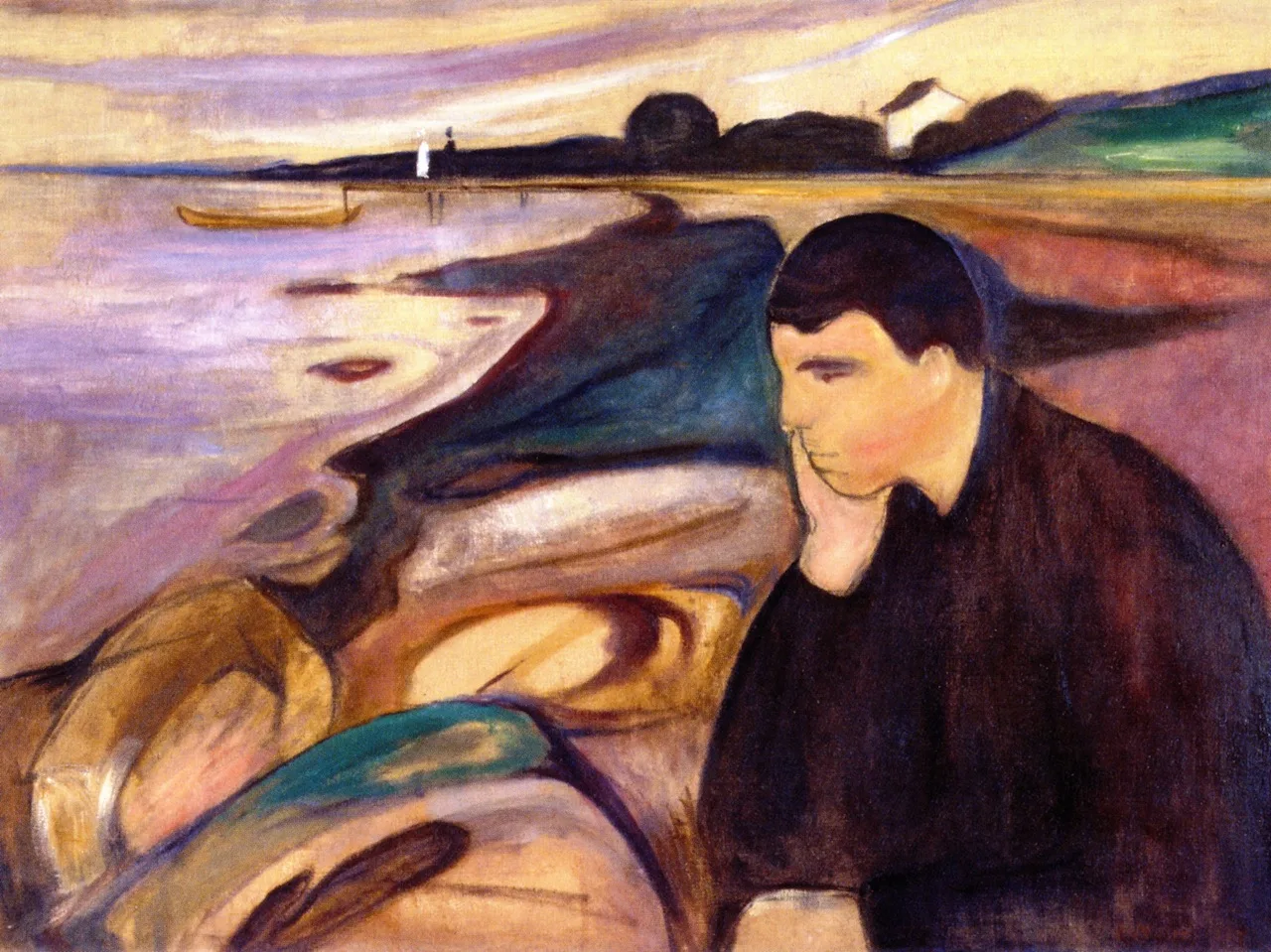
海辺でほおづえ。友だちの悲しい恋を描いた、ムンクの「ゆううつ」。Chin in hand by the sea: Munch's picture of a friend's sad love.
この作品のお話
Storyムンクが1894年に描いた絵です。右手前で、黒い服の男の人がほおづえをつき、うつむいています。左には夕暮れの海辺が広がり、岸の線がうねりながら奥へとのびています。遠くでは男女の2人が桟橋に立ち、その近くに黄色いボートがうかんでいます。題名の「メランコリー」は「ゆううつ・ふさぎこむ気分」という意味です。
Munch painted this picture in 1894. In the right foreground, a man in dark clothes rests his chin on his hand and looks down. On the left, a beach stretches away in the evening light, and the shoreline curves into the distance. Far away, a man and a woman stand on a pier, and a yellow boat floats nearby. 'Melancholy' means a sad, gloomy mood.
モデルはムンクの友人で、作家・批評家のヤッペ・ニルセンだとされています。彼はかなわない恋に苦しんでいて、ムンクはその姿を、オースゴールストランの海辺の景色と重ねて描きました。人の心の動きを、うねる岸辺の線や色で表すやり方は、のちに「表現主義」と呼ばれる絵の先がけになりました。
The model is thought to be Munch's friend Jappe Nilssen, a writer and critic. He was suffering from a hopeless love, and Munch painted him against the beach at Åsgårdstrand. Munch showed feelings through the curving shoreline and the colors. This way of painting led the way to what was later called Expressionism.
ムンクはこのテーマを何度も描いていて、オスロの国立美術館やベルゲンの美術館などにも別のバージョンがあります。この画像は1894年の版で、個人が持っています。ムンクは「生命のフリーズ」と名づけた一連の作品で、恋・不安・死などの気持ちをくり返し描きました。この絵もそのひとつです。
Munch painted this theme several times, and other versions are in the National Museum in Oslo and in a museum in Bergen. The picture here is the 1894 version in a private collection. In a series he called 'The Frieze of Life', Munch painted feelings such as love, anxiety and death again and again. This painting is part of that series.
男の人が海辺に座っています。手にあごをのせています。とても悲しそうです。ムンクの友人ヤッペ・ニルセンだと考えられています。遠くでは、2人が桟橋に立っています。
A man sits by the sea. He puts his chin on his hand. He looks very sad. He may be Munch's friend, Jappe Nilssen. Far away, two people stand on a pier.
英語のレベルは上の「やさしい/ふつう」で切りかえられます。
えっ!?な裏ネタ
Secretsほおづえの男性は、ムンクの友人ヤッペ・ニルセンとされています。ニルセンは、結婚している女性への、かなわない恋に苦しんでいました。ムンクは友人の心の痛みを、自分のことのように絵にしたのです。
The man with his chin in his hand is thought to be Munch's friend Jappe Nilssen. Nilssen was in love with a married woman, and he could not be with her. Munch painted his friend's heartache as if it were his own.
遠くの桟橋を歩く男女は、ニルセンが思いをよせていた女性と、その夫だと言われています。小さく描かれているのに、男性の心はずっとそちらに向いている。距離そのものが、さびしさを表しているのです。
The man and woman on the far pier are said to be the woman Nilssen loved and her husband. They are tiny, but his heart is turned toward them. The distance itself shows his loneliness.
頭を手でささえるポーズは、ヨーロッパの美術で昔から「ゆううつ」を表す形でした。有名なのはデューラーの版画『メレンコリアI』(1514年)です。ムンクも、何百年も続くこの伝統のポーズを使っています。
In European art, resting your head on your hand has long been the pose of melancholy. A famous example is Dürer's print 'Melencolia I' from 1514. Munch also used this pose with a history of hundreds of years.
1892年の版では、桟橋の上に男女のほか、オールを持つ3人目の人物が描かれています。1894年のこの版では遠くの男女だけになり、手前でひとり考えこむ男性が、いっそう目立って見えます。
In the 1892 version, a third figure carrying oars stands on the pier with the couple. In this 1894 version, only the distant couple remains, so the lonely man in the foreground stands out even more.
ここを見て!
Look Closer1ほおづえの男性The man with his chin in his hand
目をふせ、手にあごをのせた男性。顔の半分が画面の外まで迫るほど大きく描かれています。
He lowers his eyes and rests his chin on his hand. He is so big that he almost fills the right side.
2桟橋の2人Two people on the pier
白い服の女性と男性の小さな姿。男性の悩みの原因とされる2人です。
Tiny figures of a woman in white and a man. They are said to be the reason for his sadness.
3黄色いボートThe yellow boat
水辺にうかぶ黄色いボート。だれも乗っていないのが、さびしさを強めます。
A yellow boat on the water. It is empty, which makes the scene feel lonelier.
4うねる岸辺The curving shore
波のようにうねる岸の線。男性の心の動きを、景色の形で表しています。
The shoreline curves like a wave. The shape of the land shows the man's feelings.
英語で名画を語ろう
Talk about Art in EnglishThe man on the beach feels blue.
浜辺の男の人は気分がしずんでいます。
💡 英語の blue には「青い」のほかに「ゆううつな」の意味も。色と気持ちがつながる表現です。
英語で説明すると… Describe it
これは夕方の海辺の場面です。右には、黒っぽい服の男の人がほおづえをついて座っています。左では、岸が遠くへカーブしてのびています。遠くには、桟橋の上の2人と黄色いボートがあります。
This is a scene by the sea in the evening. On the right, a man in dark clothes is sitting with his chin in his hand. On the left, the shore curves into the distance. Far away, there are two people on a pier and a yellow boat.
考えてみよう Think & Talk
- この絵の色や線から、どんな気持ちを感じますか?How do the colors and lines make you feel?
- この男の人に話しかけられるとしたら、何と言いますか?If you could talk to this man, what would you say?
この作品の英単語
WordsThe painting shows a feeling of melancholy.
この絵はゆううつな気持ちを表しています。
He rests his chin on his hand.
彼は手にあごをのせています。
The shoreline curves into the distance.
岸の線が遠くへカーブしてのびています。
The empty boat looks lonely.
空っぽのボートはさびしそうに見えます。
ミニクイズ
QuizQ. 題名の「メランコリー」はどんな意味?What does the title 'Melancholy' mean?
気分がしずんでふさぎこむことです。男性のポーズや景色の色がそれを表しています。
It means a low, gloomy mood. The man's pose and the colors show it.
ウソ?ホント? 男の人のモデルは、ムンクの友人だとされている。The man is thought to be a friend of Munch.
作家・批評家のヤッペ・ニルセンだとされています。
He is thought to be the writer and critic Jappe Nilssen.
ウソ?ホント? 遠くの桟橋には、大きな汽船がとまっている。A big steamship is waiting at the far pier.
汽船はありません。桟橋には2人が立ち、その近くに小さな黄色いボートがうかんでいます。
There is no steamship. Two people stand on the pier, and a small yellow boat floats nearby.
 画像の出典とライセンス / Image credit
- PDEdvard Munch - Melancholy (1894).jpg(Wikimedia Commons)
ライセンス:Public domain(パブリックドメイン)/作者・撮影者の表記:Edvard Munch
この作品は、作者の死後長い年月がたち著作権の保護期間が終わった「パブリックドメイン」の作品です。画像は平面の作品を忠実に写したもので、新しい著作権は生じません(Wikimedia Commons の PD-Art の考え方)。 所蔵:個人蔵(Private collection)。画像は表示のために縮小・WebP 形式に変換しています。