 ワークシート
 ぬりえ
 迷路
真上から見下ろす不思議な視点。浮世絵に恋したアメリカ人画家の母子像。A strange view from above. A mother-and-child scene by an American who loved Japanese prints.
この作品のお話
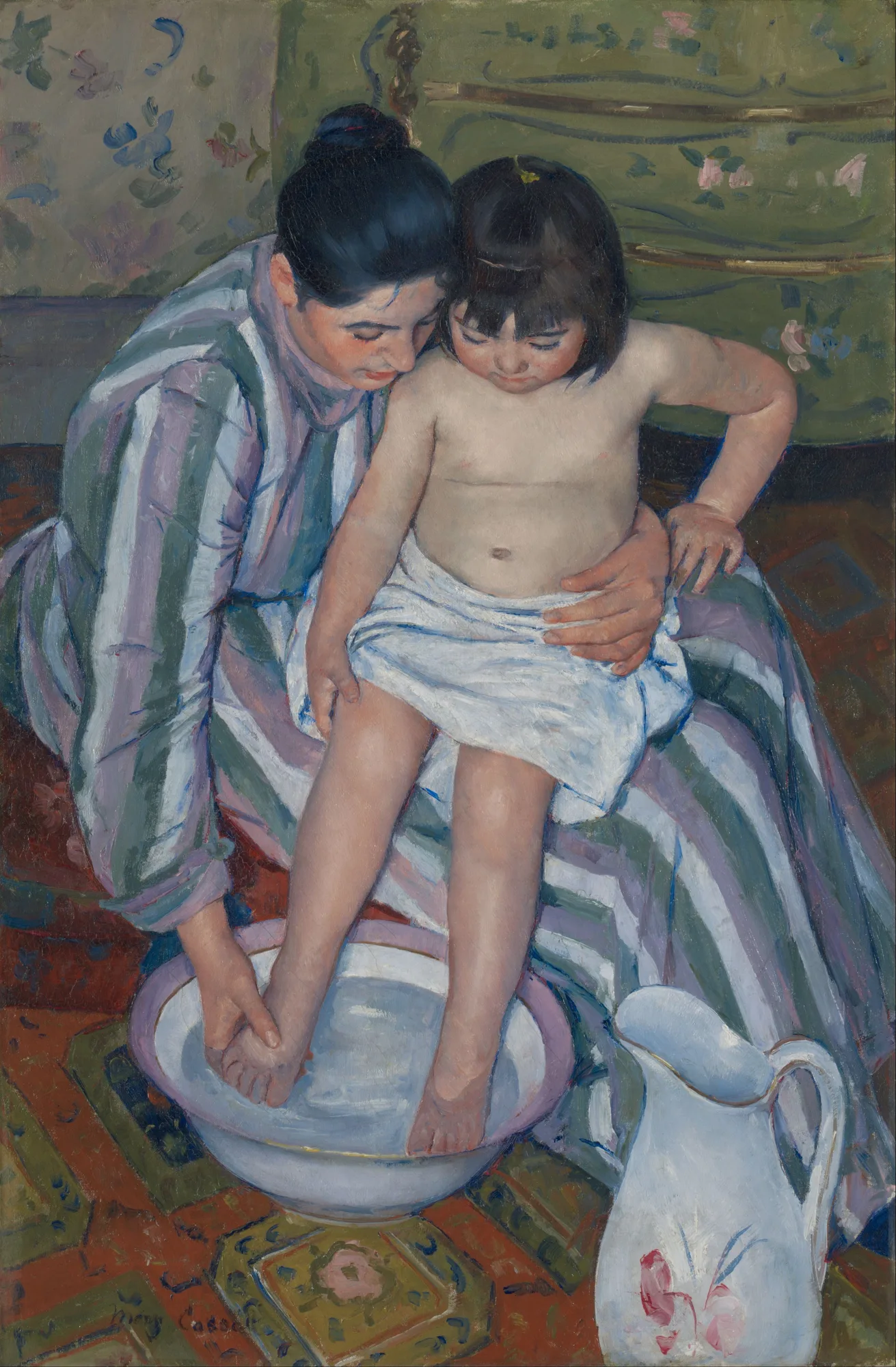
Story女の人がひざに小さな女の子をのせ、たらいのお湯で足を洗ってあげています。描いたのはアメリカ生まれの画家メアリー・カサット。1893年の作品で、今はシカゴ美術館にあります。二人は同じところを見下ろし、手と足が画面のまんなかで重なり合っています。
A woman holds a little girl on her lap and washes the girl's feet in a bowl of water. The American-born painter Mary Cassatt made this picture in 1893. It is now in the Art Institute of Chicago. The two look down at the same spot, and their hands and feet meet in the middle of the picture.
カサットはパリで活躍し、印象派の展覧会に参加したただ一人のアメリカ人画家でした。1890年、パリで日本の浮世絵の大きな展覧会を見て心を動かされます。この絵の、上から見下ろす視点、はっきりした輪郭、しま模様やじゅうたんの模様には、浮世絵から学んだことが表れています。
Cassatt worked in Paris and was the only American to show with the Impressionists. In 1890, she saw a large exhibition of Japanese prints in Paris and was deeply moved. In this painting, the view from above, the clear outlines and the bold patterns of stripes and carpet show what she learned from those prints.
シカゴ美術館は1910年にこの絵を買い入れました。カサットは、母と子のありふれた日常を、まるで宗教画の聖母子のように大切な姿として描きました。こうした作品は今もアメリカで深く愛され、カサットはアメリカを代表する女性画家として知られています。
The Art Institute of Chicago bought this painting in 1910. Cassatt painted an everyday moment between a woman and a child as something precious, almost like a Madonna and Child in religious art. Her works are still deeply loved in America, and she is known as one of the country's greatest women painters.
女の人が小さな女の子の足を洗っています。二人はいっしょに水を見下ろしています。描いたのはアメリカ出身のメアリー・カサット。彼女は日本の浮世絵が大好きでした。だから浮世絵のように、上から見た場面を描いたのです。
A woman is washing a little girl's feet. They look down at the water together. The painter is Mary Cassatt from America. She loved Japanese prints. So she painted the scene from above, like a Japanese print.
英語のレベルは上の「やさしい/ふつう」で切りかえられます。
えっ!?な裏ネタ
Secretsカサットは母と子の絵をたくさん描きましたが、モデルの多くは近所の人や、雇ったモデルだったと考えられています。しかもカサット自身は生涯結婚せず、子どももいませんでした。それでも、だれよりも温かい母子の絵を描き続けたのです。
Cassatt painted many mothers and children, but most of her models are thought to have been neighbors or hired models. Cassatt herself never married and had no children. Even so, she kept painting some of the warmest mother-and-child pictures ever made.
カサットは、友人のアメリカ人収集家ハヴマイヤー夫妻などに、ドガやモネの絵を買うようすすめました。そのコレクションの多くは、のちにニューヨークのメトロポリタン美術館に寄贈されます。アメリカの美術館に印象派の名作が多いのは、カサットのおかげでもあるのです。
Cassatt advised American collectors, such as her friends the Havemeyers, to buy works by Degas and Monet. Much of their collection was later given to the Metropolitan Museum of Art in New York. American museums are rich in Impressionist art partly thanks to Cassatt.
1890年の浮世絵展に感動したカサットは、翌年、日本の版画を思わせる10点ひと組のカラー版画を作りました。お風呂や手紙を書く女性など、日常の場面を、すっきりした線と平らな色で表しています。この絵は、その2年後に描かれました。
After the 1890 show of Japanese prints, Cassatt made a set of ten color prints the next year. They show daily scenes, like a bath or a woman writing a letter, with clean lines and flat colors. This painting came two years later.
1877年、カサットはドガから印象派の仲間に加わるよう誘われました。のちに彼女は「喜んで引き受けた。ようやく生き始めた」という意味の言葉を残しています。決まりきった美術がきらいだったカサットにとって、印象派は自由に描ける場所でした。
In 1877, Degas invited Cassatt to join the Impressionists. She later wrote that she accepted with joy and that she 'began to live.' She disliked old-fashioned, rule-bound art, and the Impressionists gave her the freedom to paint her own way.
ここを見て!
Look Closer1見下ろす二つの顔Two faces looking down
女の人と女の子が、そろって足元を見ています。視線が同じ方向を向くことで、二人の心のつながりが伝わります。
The woman and the girl both look down at the girl's feet. Their eyes point the same way, which shows how close they are.
2たらいの水The bowl of water
上から見下ろしているので、たらいが楕円形に大きく見えます。水の中の足までうっすら見えます。
Because we look from above, the bowl looks like a big oval. We can even see the feet through the water.
3花柄の水差しThe flowered pitcher
画面のはしで切れている水差し。こうした大胆な切り取り方も、浮世絵の影響といわれます。
The pitcher is cut off by the edge of the picture. Bold cropping like this is often linked to Japanese prints.
4しま模様の服The striped dress
緑とむらさきの太いしま模様。じゅうたんの模様と合わさって、画面がにぎやかで平らな感じになります。
Bold green and purple stripes. Together with the carpet pattern, they make the picture lively and flat, like a print.
英語で名画を語ろう
Talk about Art in EnglishCassatt shows the mother and child from above.
カサットは母と子を上から見下ろすように描いています。
💡 見下ろす視点は from above、見上げる視点は from below。構図を説明するときの基本表現です。
英語で説明すると… Describe it
この絵では、女の人が小さな女の子をひざにのせて座っています。女の人は緑とむらさきのしま模様の服を着ています。二人は白いたらいの水を見下ろしています。右には、花柄の白い水差しがあります。
In this picture, a woman is sitting with a little girl on her lap. The woman is wearing a dress with green and purple stripes. They are looking down at a white bowl of water. On the right, there is a white pitcher decorated with flowers.
考えてみよう Think & Talk
- カサットはなぜ、この場面を上から見下ろすように描いたのだと思いますか?Why do you think Cassatt painted the scene from above?
- 女の子は今、どんな気持ちだと思いますか?How do you think the girl feels right now?
この作品の英単語
WordsThe girl puts her feet in a basin of water.
女の子は、水の入ったたらいに足を入れています。
A white pitcher stands on the carpet.
白い水差しがじゅうたんの上に置いてあります。
The woman washes the child's feet.
女の人が子どもの足を洗っています。
She is wearing a striped dress.
彼女はしま模様の服を着ています。
ミニクイズ
QuizQ. カサットがこの絵の構図で強く影響を受けたものは?What strongly influenced the design of this painting?
1890年にパリで見た浮世絵展から、上からの視点や大胆な模様を学びました。
From a show of Japanese prints in Paris in 1890, she learned to use views from above and bold patterns.
ウソ?ホント? カサットは印象派の展覧会に参加したアメリカ人画家だ。Cassatt was an American painter who showed with the Impressionists.
ドガに誘われ、1879年から印象派展に出品しました。
Degas invited her, and she showed at the Impressionist exhibitions from 1879.
ウソ?ホント? カサットには5人の子どもがいて、この女の子は末っ子だ。Cassatt had five children, and this girl is the youngest.
カサットは生涯結婚せず、子どももいませんでした。
Cassatt never married and had no children.
 画像の出典とライセンス / Image credit
- PDMary Cassatt - The Child's Bath - Google Art Project.jpg(Wikimedia Commons)
ライセンス:Public domain(パブリックドメイン)/作者・撮影者の表記:Mary Cassatt/提供元:Google Arts & Culture: Home page – Image
この作品は、作者の死後長い年月がたち著作権の保護期間が終わった「パブリックドメイン」の作品です。画像は平面の作品を忠実に写したもので、新しい著作権は生じません(Wikimedia Commons の PD-Art の考え方)。 所蔵:シカゴ美術館(The Art Institute of Chicago)。画像は表示のために縮小・WebP 形式に変換しています。