Kinosaki Onsen
a hot spring town in northern Hyogo known for its seven public bathhouses
城崎温泉(きのさきおんせん)
In one line
The shortest answer that works
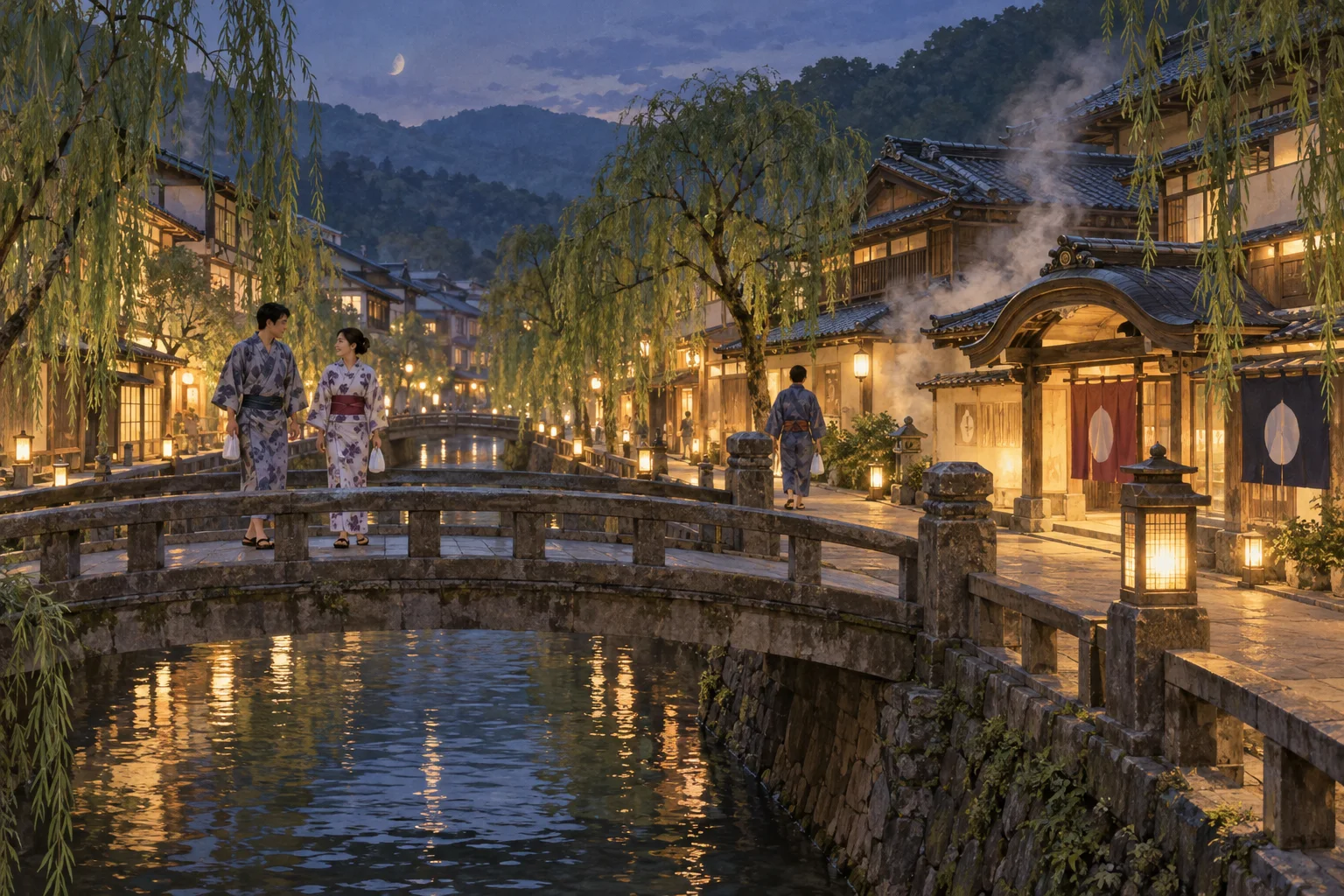
Kinosaki Onsen is a hot spring town where guests walk between seven public bathhouses in yukata.
城崎温泉は、泊まり客が浴衣で七つの外湯を歩いて回る温泉街です。
In 30 seconds
The standard explanation
Kinosaki Onsen is a hot spring town in the north of Hyogo Prefecture, near the Sea of Japan. Its best-known feature is its seven public bathhouses, called soto-yu, spread along a small river lined with willow trees. Guests put on the yukata, or cotton robe, from their inn and walk from bath to bath in wooden geta. The town has drawn writers and travelers for centuries.
城崎温泉は、兵庫県の北部、日本海の近くにある温泉街です。いちばんの特徴は、柳並木の小さな川沿いに点在する「外湯」と呼ばれる七つの共同浴場です。泊まり客は宿の浴衣に着替え、木の下駄で湯から湯へと歩いて回ります。この町には何百年も前から、作家や旅人が訪れてきました。
As a short speech
A full paragraph you can read aloud
Kinosaki Onsen is a small hot spring town in the north of Hyogo Prefecture, close to the Sea of Japan. What makes it different is that the whole town works like one big inn.
Instead of staying inside their hotel, guests change into yukata and stroll along a river lined with willow trees, visiting seven public bathhouses called soto-yu. The sound of wooden geta in the evening is part of the experience.
According to local legend, a Buddhist monk opened one of the springs in 720. The writer Shiga Naoya stayed here in 1913, and a short story he set here is still read in Japanese schools. In winter, many people come for the crab. I think it is the best place to feel what a real onsen town is like.
城崎温泉は、兵庫県の北部、日本海の近くにある小さな温泉街です。ほかと違うのは、町全体が一つの大きな旅館のように成り立っていることです。
泊まり客は宿にこもらず、浴衣に着替えて柳並木の川沿いを歩き、「外湯」と呼ばれる七つの共同浴場を回ります。夕方に響く下駄の音も、楽しみの一つです。地元の言い伝えでは、720年に一人の僧が湯の一つを開いたとされます。
作家の志賀直哉は1913年にここに滞在し、城崎を舞台にした短編は今も日本の学校で読まれています。冬には、カニを目当てに多くの人が訪れます。温泉街らしさを味わうには、いちばんの場所だと思います。
Questions people actually ask
And how to answer them.
Do I have to leave my inn to take a bath?
No, most inns have their own baths too. But walking to the public bathhouses is the main attraction, and many inns give their guests a pass that covers all seven.
いいえ、たいていの宿には自前のお風呂もあります。ただ、外湯まで歩いて行くのがいちばんの楽しみで、七つすべてに入れる券を泊まり客に渡す宿も多くあります。
Can I really walk around town in the inn's yukata?
Yes. In Kinosaki it is normal and even expected. Just put a jacket over it on cold nights, and check which bathhouses are closed that day, because each one has its own day off.
はい。城崎ではそれが普通で、むしろ歓迎されます。寒い夜は上に羽織るものを着て、その日休みの外湯がないか確かめてください。外湯はそれぞれ定休日が違います。
Why is the town famous in Japanese literature?
Shiga Naoya came here in 1913 to recover after being hit by a train in Tokyo. The short story he wrote about his stay, published in 1917, often appears in Japanese high school textbooks.
志賀直哉は1913年、東京で電車にはねられたけがの養生のためにここを訪れました。その滞在を書いた短編は1917年に発表され、高校の国語の教科書によく載っています。
Phrases you can use
- Let's go around the public baths in our yukata.浴衣で外湯めぐりをしましょう。
- Each bathhouse has a different kind of bath.外湯ごとにお風呂の造りが違います。
- Your inn may give you a pass for the public baths.宿で外湯の券がもらえるかもしれませんよ。
- Wear a jacket over your yukata. It gets cold at night.浴衣の上に羽織を着てください。夜は冷えます。
- The town gets especially busy in crab season.カニの季節は、町がとくににぎわいます。
Words you need
- public bathhouse共同浴場・外湯
- hot spring town温泉街
- bath-hopping湯めぐり
- willow tree柳
- wooden clogs下駄
Watch
From YouTubeBackground (Japanese)
地元に伝わる話では、奈良時代の720年、道智上人が千日の修行を終えたのちに湯が湧いたとされ、2020年には開湯1300年の催しが行われた。それより古く、傷ついたコウノトリが湯につかっていたことから湯が見つかったという「鴻の湯」の伝説もある。1925年の北但馬地震では町がほぼ壊滅し、今の町並みの多くはその後の復興で形づくられた。志賀直哉は1913年、山手線の電車にはねられたけがの養生でここに滞在し、その体験をもとに1917年、短編「城の崎にて」を発表した。