kazokusou
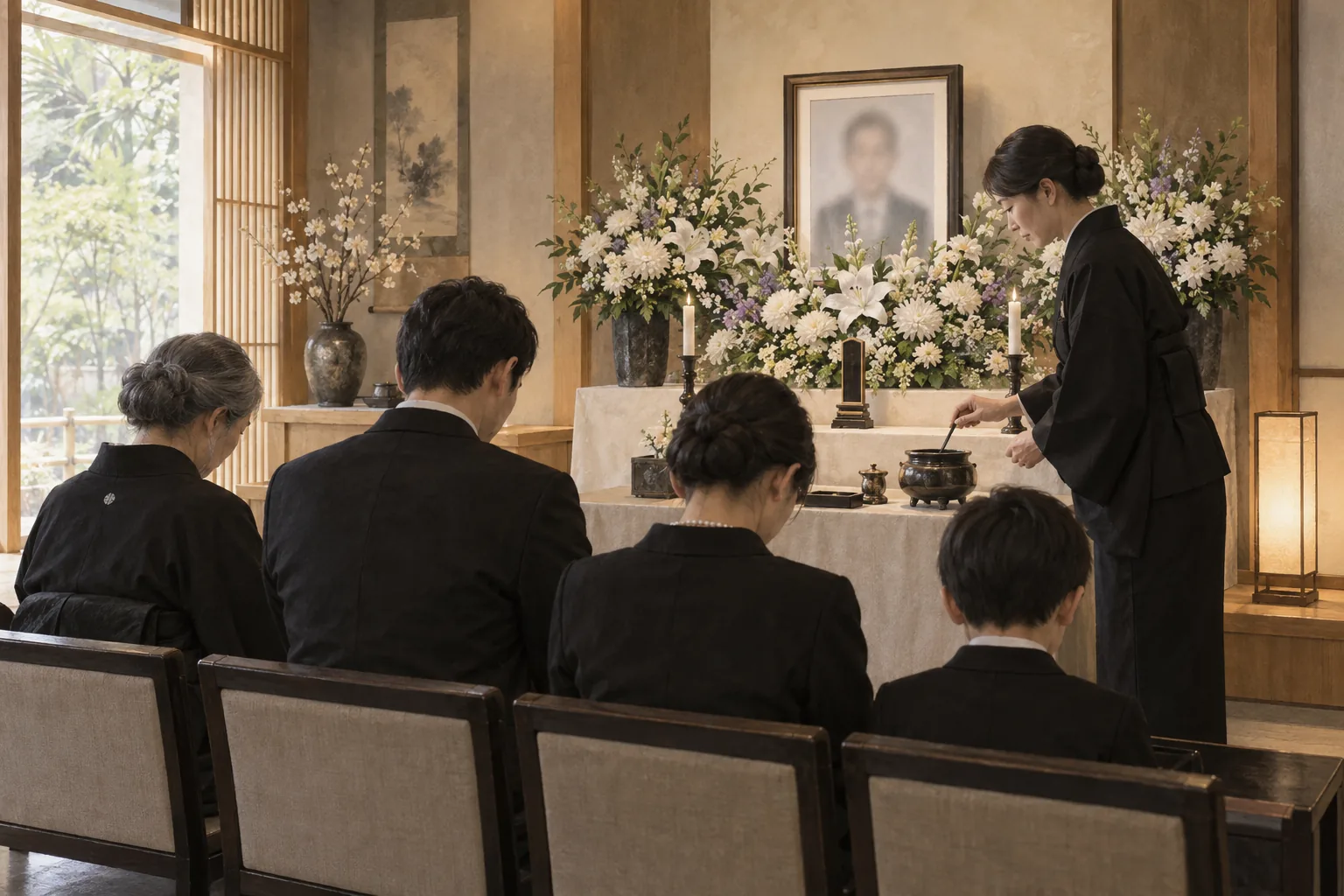
a funeral limited to close family and a few relatives
家族葬(かぞくそう)
In one line
The shortest answer that works
Kazokusou is a small funeral limited to close family and a few relatives, now Japan's most common funeral style.
家族葬とは、近い親族だけで行う小規模な葬儀で、今では日本で最も一般的な形になっています。
In 30 seconds
The standard explanation
A kazokusou keeps the guest list to immediate family and, at most, a handful of close relatives, deliberately excluding coworkers, neighbors and distant acquaintances who would attend a traditional large funeral. It grew out of a wish to avoid the exhausting round of greeting hundreds of condolence-callers, and out of rising funeral costs. The family often informs the wider circle only after the funeral is over, with a printed notice asking that flowers and condolence money not be sent.
家族葬は、招く人を近親者と、多くてもごく親しい親族にとどめ、同僚や近所の人、あまり付き合いのない知人はあえて呼ばない葬儀です。何百人もの弔問客に挨拶を返す負担を避けたいという思いや、葬儀費用の高さが背景にあります。多くの場合、遺族は広い範囲の関係者には葬儀が終わってから知らせ、香典や供花を辞退する旨を書き添えます。
As a short speech
A full paragraph you can read aloud
For decades the standard Japanese funeral was a large, public affair: a wake and a funeral open to coworkers, neighborhood associations and distant relatives, with a receiving line where the family bowed and thanked hundreds of visitors one by one over two exhausting evenings. Kazokusou emerged as a deliberate alternative, limiting attendance to immediate family and perhaps a dozen close relatives, with everyone else simply informed afterward through a printed notice that also asks, politely but firmly, that flowers and condolence money be declined.
Funeral industry surveys have tracked kazokusou rising from a minority option to the most commonly chosen funeral format in Japan over the last two decades, driven partly by smaller families, an aging population where the deceased has fewer surviving close contacts, and a wish to control the very real cost of a full funeral. It is not the same as a funeral with no ceremony at all, called chokusou, where there is no service before cremation; kazokusou still has a wake and a funeral rite, just a small one.
何十年ものあいだ、日本の標準的な葬儀は大がかりで公にひらかれたものでした。通夜と葬儀には同僚や町内会、遠い親戚までもが訪れ、遺族は二晩にわたって何百人もの弔問客一人ひとりに頭を下げて礼を述べる、体力を消耗する場でした。
家族葬は、これに代わる選択として意図的に生まれたもので、参列者を近親者とせいぜい十数人の近い親族にとどめ、それ以外には葬儀のあとで印刷された挨拶状によって知らせるだけにします。その挨拶状には、香典や供花を辞退する旨も、丁寧ながらはっきりと書き添えられます。
葬儀業界の調査では、この二十年ほどで家族葬は少数派の選択肢から、日本で最も多く選ばれる葬儀の形へと変わってきたことが確認できます。背景には、家族の縮小、故人の身近な交友関係が高齢で減っていること、そして葬儀にかかる実際の費用を抑えたいという思いがあります。家族葬は、通夜も葬儀の儀式も一切行わない直葬とは別のもので、家族葬にも通夜と葬儀はありますが、それが小規模だという点が異なります。
Questions people actually ask
And how to answer them.
Is kazokusou cheaper than a regular funeral?
Usually, since fewer guests means less catering, fewer return gifts, and a smaller hall, though a family can still spend a great deal on a small funeral. Cost reduction is one motive, not a guarantee.
ふつうは安くなります。参列者が少なければ料理や返礼品、会場も小さくて済むからです。ただし小さな葬儀に多くの費用をかける家庭もあり、費用を抑えられることは動機の一つであって、必ずそうなるわけではありません。
If I wasn't invited, is it rude to visit afterward?
It's better to follow what the family's notice says. Many kazokusou announcements explicitly ask that visitors, flowers and condolence money be declined, and respecting that request is what is expected.
遺族からの知らせに従うのがよいでしょう。家族葬の挨拶状の多くは、弔問や供花、香典を辞退する旨をはっきりと書いており、それを尊重することが望まれます。
Is kazokusou the same as having no funeral at all?
No. A wake and a funeral rite are still held, just with a small guest list. A funeral with no ceremony at all before cremation is a separate, less common option called chokusou.
違います。通夜と葬儀の儀式は行われ、参列者が少ないだけです。火葬の前に何の儀式も行わない、より少数派の形は直葬と呼ばれ、家族葬とは区別されます。
Phrases you can use
- We kept it to a small family funeral.家族葬という小さな形にしました。
- The notice said flowers were declined.挨拶状には供花を辞退すると書かれていました。
- Only close relatives were invited.近い親族だけが招かれました。
- We were informed only after the funeral.葬儀が終わってから知らされました。
- It's become the most common style now.今では最も一般的な形になっています。
Words you need
- family-only funeral家族葬
- wake通夜
- condolence money香典
- funeral with no ceremony直葬
- printed notice挨拶状
Watch
From YouTubeBackground (Japanese)
家族葬は、参列者を近親者と少数の親族にとどめる葬儀で、同僚や近所付き合いのある人、遠い知人は招かず、多くの場合あとから挨拶状で知らせるにとどめる。核家族化と高齢化により故人の交友関係が狭まったこと、香典返しや会場費など葬儀費用を抑えたいという事情が背景にあるとされる。葬儀業界の調査では、この二十年ほどで選ばれる割合が大きく増え、今では最も多く選ばれる形式になっているとされる。通夜・告別式の儀式そのものを行わない直葬とは異なり、家族葬にも儀式はあり、規模だけが小さい点が特徴である。