janken
rock-paper-scissors, used by adults to decide almost anything
じゃんけん(じゃんけん)
In one line
The shortest answer that works
Janken is rock-paper-scissors, and adults in Japan use it to settle things seriously.
じゃんけんはグー・チョキ・パーの遊びで、日本では大人も本気で使います。
In 30 seconds
The standard explanation
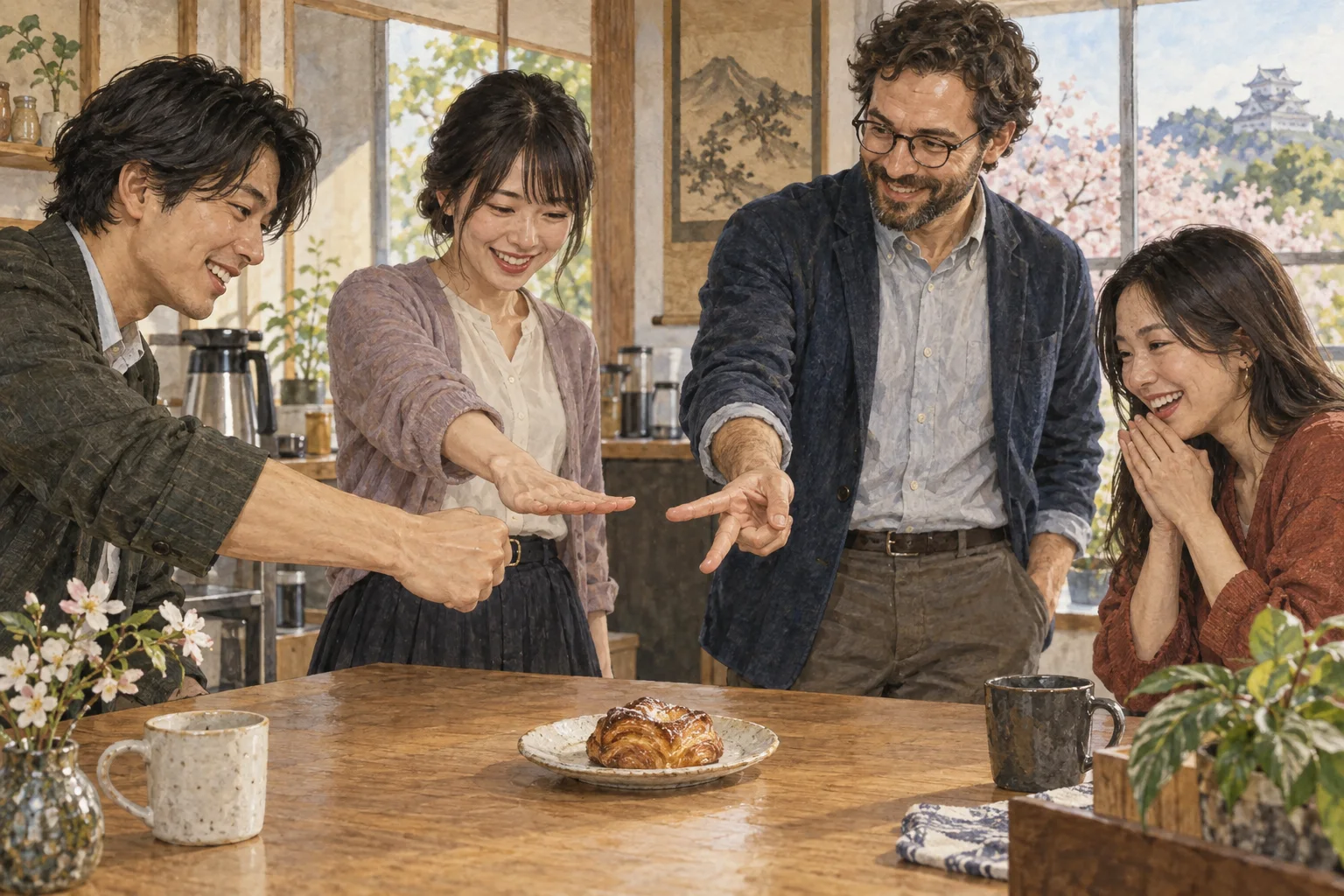
Janken is the same game as rock-paper-scissors: rock beats scissors, scissors beats paper, paper beats rock. What surprises visitors is how it is used. Adults decide who goes first, who takes an unpopular duty and sometimes who pays, and the result is accepted without argument because it is visibly fair.
じゃんけんは、石・はさみ・紙の遊びと同じです。グーはチョキに勝ち、チョキはパーに勝ち、パーはグーに勝つ。訪れた人が驚くのは、その使われ方です。大人が、順番、やりたくない当番、ときには支払いを決めます。誰の目にも公平だから、結果に文句が出ません。
As a short speech
A full paragraph you can read aloud
Janken is rock-paper-scissors, and the rules are the ones you know. What is worth explaining is its standing. In Japan it is not only a children's game: adults use it to decide who speaks first in a meeting, who takes the shift nobody wants, which team starts, and occasionally who pays for dinner.
It settles things that would otherwise require someone to pull rank or to argue, and because the outcome is obviously random, nobody loses face by losing. The call is jan-ken-pon, with the hand shown on pon. If it is a draw, everyone says aiko desho and throws again, repeating as long as it takes.
Schools and sports teams use it to pick sides, and television shows build whole segments on it. If you are in a group and something has to be decided quickly, putting out your fist and saying jan-ken-pon will be understood instantly and will probably be welcomed.
じゃんけんは石・はさみ・紙で、決まりはご存じのとおりです。説明する値打ちがあるのは、その位置づけのほうです。日本では子どもの遊びにとどまりません。大人が、会議で誰から話すか、誰もやりたくない当番を誰が引き受けるか、どちらのチームが先か、ときには誰が食事代を持つかを、これで決めます。
本来なら立場の上下や言い合いが要る場面を、これが片づけます。結果が明らかに運なので、負けても面子を失いません。掛け声は「じゃん・けん・ぽん」で、手は「ぽん」で出します。同じなら「あいこでしょ」と言い、決まるまで繰り返します。
学校や部活でも組分けに使い、テレビ番組はこれで企画をまるごと作ります。何かを手早く決めたいとき、拳を出して「じゃんけんぽん」と言えば、すぐ通じますし、たぶん喜ばれます。
Questions people actually ask
And how to answer them.
Is it really used by adults?
Constantly. Committees use it to assign roles, colleagues use it for the last piece of food, and a pop idol group has even held televised janken tournaments. It is treated as a legitimate method, not a joke.
しょっちゅう使います。役員を決める、最後の一つを誰が食べるか。アイドルグループがじゃんけん大会をテレビで中継したこともあります。冗談ではなく、まっとうな決め方として扱われます。
What do you say?
Jan-ken-pon, throwing on pon. For a draw, aiko desho and throw again. Many people start with saisho wa guu, meaning first comes rock, to synchronize the timing.
「じゃんけんぽん」で、「ぽん」で出します。あいこなら「あいこでしょ」。調子を合わせるために「最初はグー」から始める人も多くいます。
Where does it come from?
From earlier Japanese hand games that came through China, and the three-sign version is thought to have taken its current form in the nineteenth century. It spread worldwide from Japan in the twentieth century.
中国から伝わった拳遊びの流れをくむ日本の遊びで、いまの三つの形になったのは19世紀とされます。20世紀に日本から世界へ広がりました。
A common misunderstanding
MYTHRock-paper-scissors is a Western children's game that reached Japan.
FACTThe three-sign version took its modern form in Japan and spread outward from there in the twentieth century, which is why the Japanese name is used in some languages.
Phrases you can use
- Let's settle it with janken.じゃんけんで決めましょう。
- Jan-ken-pon — show your hand on pon.じゃんけんぽん。「ぽん」で出します。
- If it's a draw, we go again.あいこなら、もう一度です。
- Adults use it too, seriously.大人も本気で使います。
- Nobody argues with the result.結果に文句を言う人はいません。
Words you need
- rock, scissors, paperグー・チョキ・パー
- a draw, a tieあいこ
- to decide by lotくじで決める
- duty, turn当番
- fair公平な
Watch
From YouTubeBackground (Japanese)
じゃんけんは、中国から伝わった拳遊びの流れをくむ日本の遊びとされ、三すくみの形に整ったのは19世紀とみられる。「最初はグー」は昭和の終わりにテレビ番組から広まった掛け声で、それ以前は全国的なものではなかった。地域によって掛け声は大きく異なり、「いんじゃんほい」「ちっけった」などの言い方がある。学校や職場でも、順番や役割を決める場面でふつうに用いられる。英語では rock-paper-scissors と呼ぶが、janken という語をそのまま使う言語もある。