butsudan
the Buddhist altar in a Japanese home
仏壇(ぶつだん)
In one line
The shortest answer that works
A butsudan is a cabinet-sized Buddhist altar in the home where the family's ancestors are honored.
仏壇とは、家の中に置く戸棚ほどの仏教の祭壇で、先祖を祀る場所です。
In 30 seconds
The standard explanation
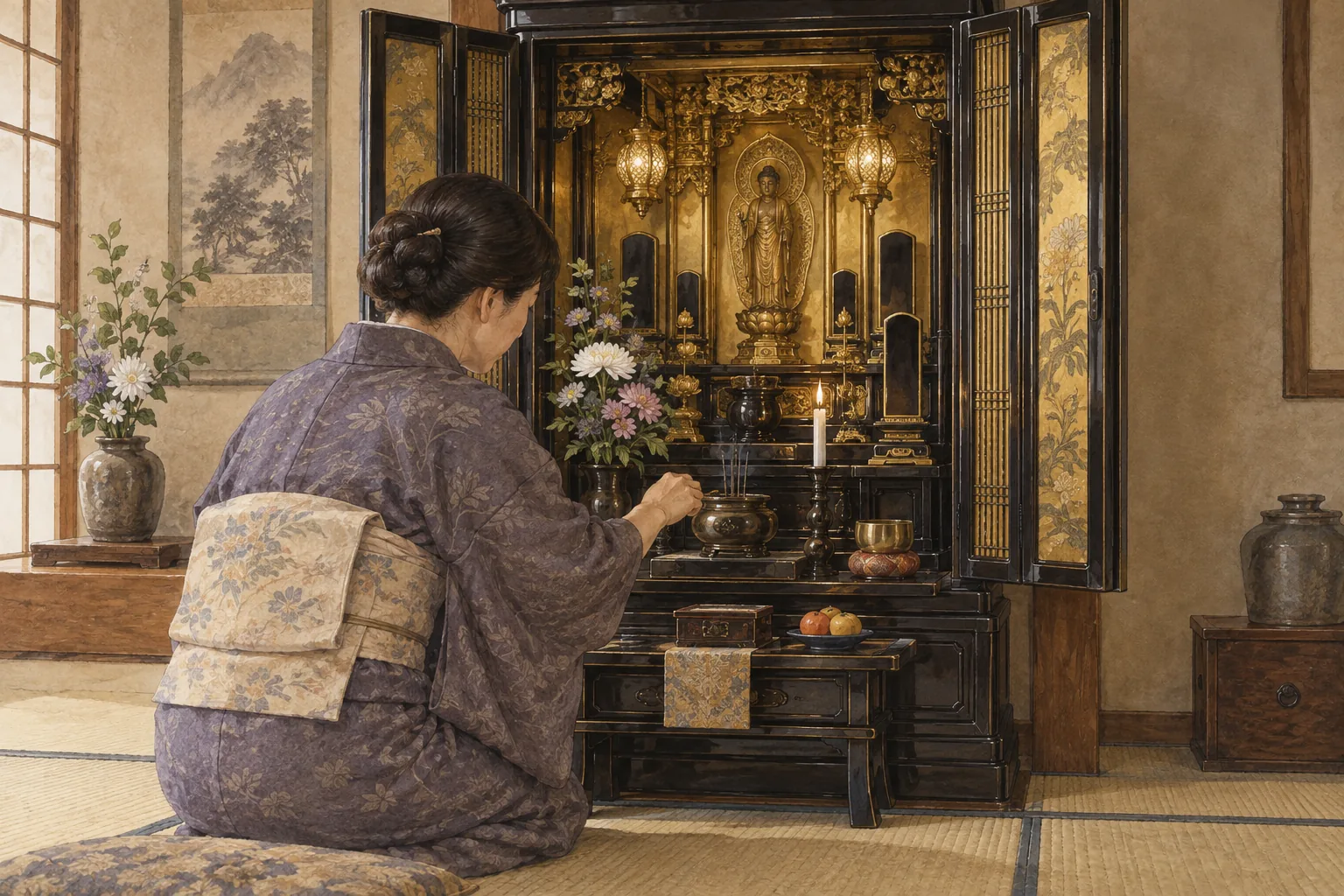
Many Japanese homes have a butsudan, a lacquered wooden cabinet holding a Buddhist image and memorial tablets with the names of the family's dead. In many such homes, someone opens it in the morning, offers rice, water and incense, ring a small bell and put their hands together. It is where the household's relationship with its ancestors is maintained day to day.
日本の多くの家には仏壇があります。漆塗りの木の厨子で、仏像や掛け軸と、亡くなった家族の名を記した位牌を納めます。そうした家の多くでは、朝に扉を開け、ご飯・水・線香を供え、りんを鳴らして手を合わせます。家と先祖との関係を日々保つ場所です。
As a short speech
A full paragraph you can read aloud
A butsudan is a Buddhist altar kept inside the home, usually a lacquered wooden cabinet with doors, standing in a corner of a tatami room. Inside there is an image of the Buddha of the family's sect, and in front of it the memorial tablets, thin lacquered boards carrying the posthumous names of the family's dead.
The daily routine is simple. In the morning someone opens the doors, puts out a small cup of water and a little of the rice that has just been cooked, lights incense, rings a small bowl-shaped bell, and puts their hands together.
If somebody brings a gift of sweets to the house, it often goes to the butsudan first and is eaten afterwards. When something significant happens, you tell it there. It is less like a shrine to visit than like keeping a place at the table, and the person who tends it is often one of the older members of the household.
仏壇は家の中に置く仏教の祭壇で、たいていは扉のついた漆塗りの木の厨子です。和室の一角に据えられます。中にはその家の宗派の本尊があり、その前に位牌が並びます。
亡くなった家族の戒名を記した細い漆塗りの板です。日々の作法は簡単です。朝、誰かが扉を開け、水を小さな器に入れ、炊きたてのご飯を少し供え、線香をあげ、りんを鳴らして手を合わせます。
菓子の頂き物があれば、まず仏壇に供え、それから食べます。大きな出来事があれば、そこに報告します。訪ねていく社というより、食卓に一席を空けておくことに近く、世話をするのは家の年長の人であることが多いです。
Questions people actually ask
And how to answer them.
What are the wooden tablets?
Ihai, memorial tablets. Each carries the posthumous Buddhist name given to a family member at their funeral, along with the date of death. They stand in for the person.
位牌です。それぞれに、葬儀で授かった戒名と没年月日が記されています。その人の代わりとしてそこにあります。
What do I do if I'm shown one as a guest?
Kneel or stand in front of it, light one stick of incense if invited, ring the bell once, and put your hands together briefly. A short bow afterwards to the family is normal.
前に座るか立ち、すすめられたら線香を一本あげ、りんを一度鳴らし、短く手を合わせます。そのあとご家族に軽く一礼するのが普通です。
Do young people still have them?
Less often. Many apartments have no tatami room, families are smaller, and the traditional cabinet is large and expensive. Compact modern designs that look like furniture have become common.
減っています。和室のないマンションも多く、家族も小さくなり、伝統的な仏壇は大きく高価です。家具のように見える小型の現代的な仏壇が広まっています。
Phrases you can use
- We offer rice and water every morning.毎朝、ご飯と水を供えます。
- Light one stick of incense and ring the bell once.線香を一本あげて、りんを一度鳴らします。
- Gifts of food go to the altar first.頂き物は、まず仏壇に供えます。
- The tablets have the names of family members who died.位牌には、亡くなった家族の名前が記されています。
- Modern ones look more like ordinary furniture.最近のものは普通の家具のような見た目です。
Words you need
- altar仏壇、祭壇
- memorial tablet位牌
- incense stick線香
- ancestor先祖
- household家、世帯
Watch
From YouTubeBackground (Japanese)
仏壇が一般家庭に広まったのは江戸時代の寺請制度によるところが大きい。すべての家がいずれかの寺の檀家となることが求められ、家ごとに仏壇を持つ慣習が定着した。仏壇の中央に祀る本尊は宗派によって異なり、浄土真宗は阿弥陀如来、曹洞宗は釈迦如来などとされる。なお浄土真宗では位牌を用いず、過去帳や法名軸を使うのが本来の形である。神道の家では仏壇のかわりに「神棚」を祀り、両方を置く家庭も多い。近年は住宅事情に合わせた小型の「モダン仏壇」や、手元供養と呼ばれる小さな容器に遺骨の一部を納める形も増えている。