kamidana
the household Shinto altar
神棚(かみだな)
In one line
The shortest answer that works
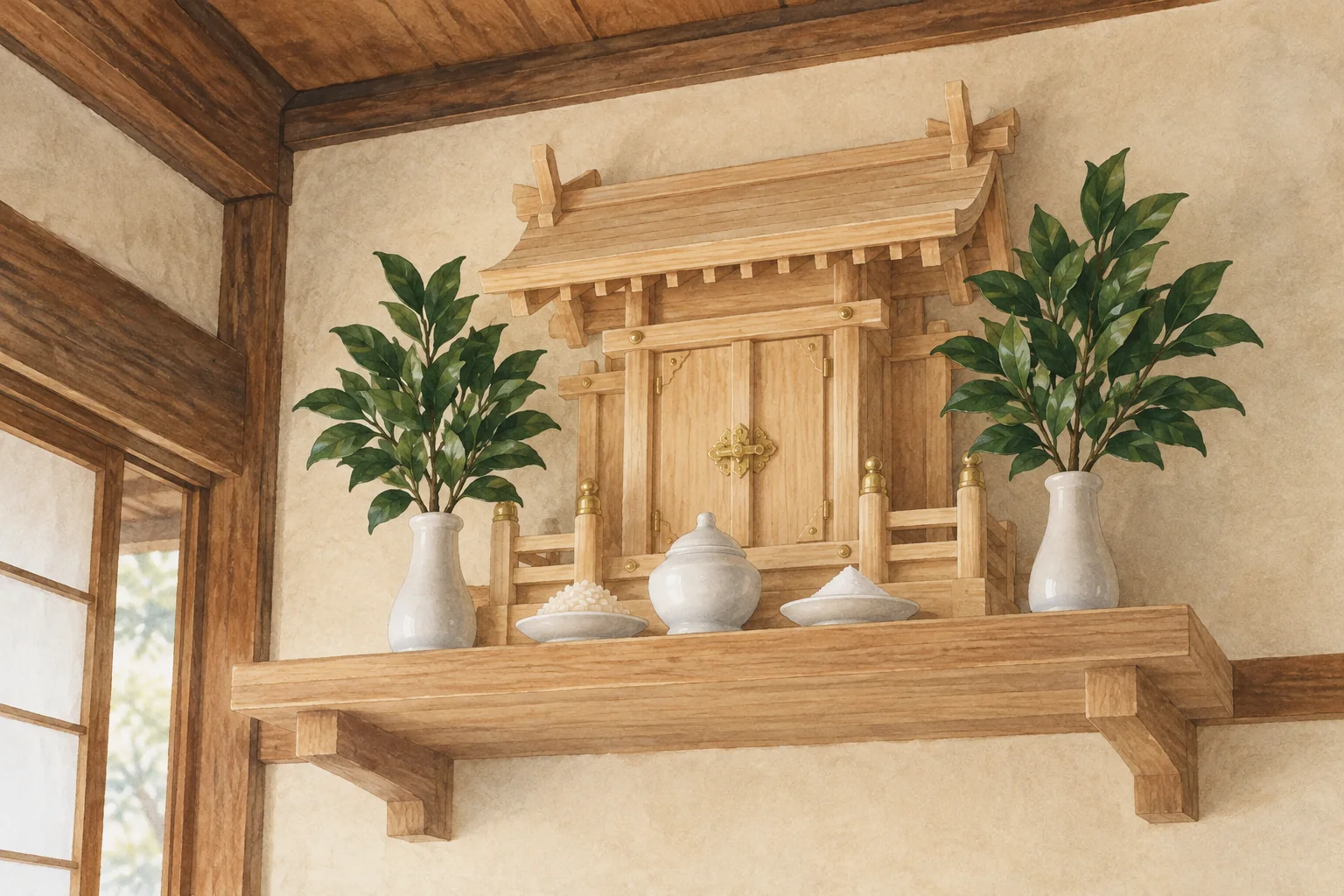
A kamidana is a small Shinto shelf in a home or shop, holding a shrine's paper talisman.
神棚とは、家や店に設けた神道の小さな棚で、神社の御札を納めます。
In 30 seconds
The standard explanation
A kamidana is a small wooden shelf set high on a wall, holding a paper talisman received from a shrine, with offerings of rice, salt, water and sake in front of it. Many Japanese households also keep a Buddhist altar for the family's dead, and the two are separate things that coexist without conflict.
神棚とは、壁の高い位置に設けた木の小さな棚で、神社で受けた御札を納め、その前に米、塩、水、酒を供えます。日本の家庭の多くは、先祖のための仏壇も別に持っていて、二つは矛盾なく併存する別のものです。
As a short speech
A full paragraph you can read aloud
A kamidana is a household Shinto altar, a small wooden shelf mounted high on a wall in a home, a shop or an office. Inside it is a paper talisman received from a shrine, usually one from the Grand Shrine of Ise and one from the local guardian shrine.
In front stand small vessels of rice, salt, water and sometimes sake, replaced regularly, and a sprig of evergreen. There are conventions: it should be above eye level so you do not look down on it, facing south or east if possible, and not directly under a toilet or a walkway on the floor above.
Many Japanese homes also have a Buddhist altar for the family's dead, and having both is completely ordinary. Broadly speaking, Shinto handles the living, the new year, the new house and the new business; Buddhism handles the dead. New kamidana are rarer in apartments now, but you will still see one above the till in a small shop or a restaurant.
神棚は家庭の神道の祭壇で、家や店、事務所の壁の高い位置に取り付ける木の小さな棚です。中には神社で受けた御札を納め、ふつうは伊勢の神宮の御札と、その土地の氏神の御札を並べます。前には米、塩、水、ときに酒を入れた小さな器を置いて定期的に取り替え、榊を立てます。
決まりがあります。見下ろさずにすむよう目線より高くすること、できれば南か東を向けること、上の階の便所や通路の真下を避けること。日本の家庭の多くは先祖のための仏壇も持っていて、両方あることはまったくふつうです。
大まかに言えば、神道は生きている側、年の初め、新しい家、新しい商売を扱い、仏教は亡くなった側を扱います。集合住宅で新しく神棚を設ける例は減りましたが、小さな店や飲食店のレジの上には今も見かけます。
Questions people actually ask
And how to answer them.
Isn't it strange to have a Shinto shelf and a Buddhist altar in the same house?
Not in Japan. The two are understood to cover different things rather than to compete, and many families use both without thinking of it as holding two religions. This is one reason the membership figures reported by religious groups in Japan add up to well over the population.
日本では奇妙ではありません。二つは競い合うものではなく、扱う領域が違うと理解されていて、多くの家は二つの宗教を持っているとは考えずに両方を使っています。宗教団体が届け出る信者数の合計が人口を大きく上回るのも、これが理由の一つです。
What do you do with last year's talisman?
You return it to a shrine, usually at New Year, where old talismans and decorations are collected and burned in a ritual fire. You do not put it out with the household trash, and many shrines have a marked box for returns all year round.
神社に返します。たいていは正月で、古い御札や飾りを集めて焚き上げる行事があります。家庭のごみには出しません。多くの神社には、年間を通じて古札を納める箱が置かれています。
Phrases you can use
- It holds a talisman from a shrine.神社の御札を納めています。
- It has to be above eye level.目線より高い位置に設けます。
- Many homes have a Buddhist altar too.仏壇も置いている家が多いです。
- Old talismans go back to the shrine.古い御札は神社に返します。
Words you need
- household altar神棚
- talisman御札
- offeringお供え
- evergreen sprig榊
Watch
From YouTubeBackground (Japanese)
神棚に納める御札は、伊勢の神宮の神宮大麻、氏神の御札、崇敬する神社の御札の三枚を並べる形が広く行われています。供え物は米、塩、水が基本で、榊は月に二回、一日と十五日に取り替える習わしがあります。相撲の土俵や工事の起工式など、家の外でも同じ考え方の祭祀が行われます。集合住宅では棚を取り付けられないため、壁に貼る簡易なものや、家具の上に置く形も売られています。