hanamatsuri
the Buddha's birthday
花祭り(はなまつり)
In one line
The shortest answer that works
Hanamatsuri, the flower festival, is the April 8th celebration of the Buddha's birthday, with sweet tea poured over a statue.
花祭りとは、四月八日に寺で小さな像に甘茶をかけて釈迦の誕生を祝う行事です。
In 30 seconds
The standard explanation
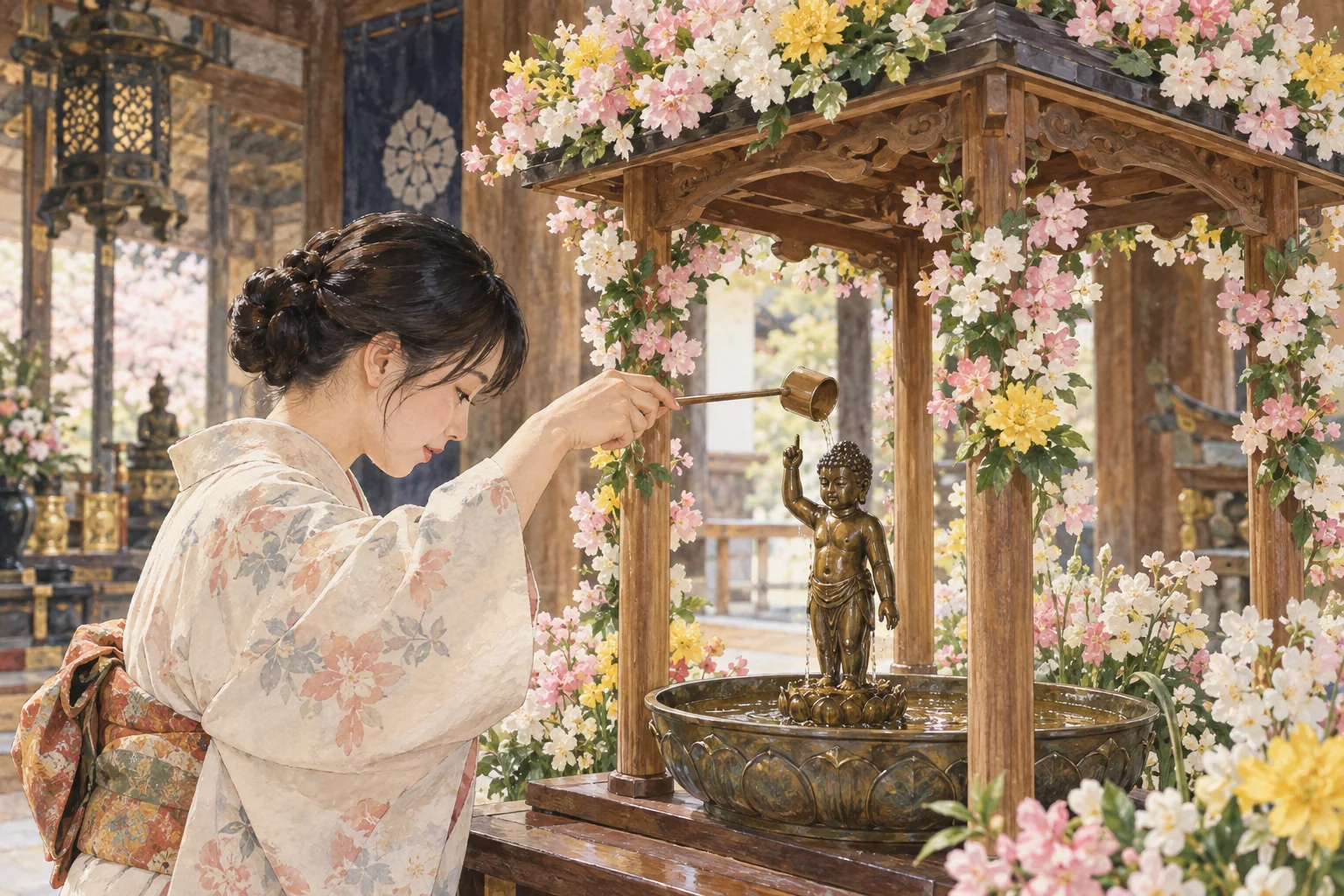
Hanamatsuri, on April 8th, marks the birth of the historical Buddha. Temples set out a small flower-covered shrine holding a statue of the infant Buddha, and visitors ladle sweet hydrangea tea over it. Kindergartens attached to temples often hold the event, and it is far quieter than the New Year or Obon.
花祭りは四月八日で、釈迦の誕生を祝う日です。寺は花で飾った小さな堂に誕生仏を安置し、訪れた人が甘茶を柄杓ですくってかけます。寺に併設された幼稚園で行われることも多く、正月やお盆に比べるとずっと静かな行事です。
As a short speech
A full paragraph you can read aloud
Hanamatsuri, the flower festival, is the Japanese observance of the Buddha's birthday, held on April 8th. Temples set up a small open shrine roofed with flowers, called a hanamido, and inside stands a statue of the infant Buddha with one hand raised. Visitors take a bamboo ladle and pour sweet tea over the statue, an act that refers to the legend that sweet rain fell at his birth.
The tea is amacha, brewed from a variety of hydrangea leaf, naturally sweet without sugar, and it is often served to drink as well. Compared with the New Year or Obon this is a modest event, known mainly to temple families and to children at Buddhist kindergartens, and many Japanese people would struggle to name the date.
The name refers to the flowers on the little shrine, which recall the garden where the Buddha is said to have been born, and since the date often falls in cherry blossom season, a temple courtyard with blossom overhead is a pleasant place to encounter it.
花祭りは、四月八日に行われる釈迦の誕生を祝う日本の行事です。寺は花で屋根を葺いた小さな堂、花御堂を設け、その中に片手を上げた誕生仏を安置します。訪れた人は竹の柄杓で甘茶を像にかけます。釈迦の誕生のときに甘い雨が降ったという伝えにちなむ所作です。
甘茶はアマチャの葉から煎じたもので、砂糖を加えなくても甘く、飲むためにも出されます。正月やお盆に比べれば控えめな行事で、主に寺の関係者と、仏教系の幼稚園に通う子どもたちに知られています。
日付を言える日本人は多くありません。名は花御堂を飾る花にちなみ、釈迦が生まれたとされる花園になぞらえたものです。多くの地域で桜の時季と重なるので、花の下の寺の境内でこれに出会うのは、気持ちのよいものです。
Questions people actually ask
And how to answer them.
Can anyone take part?
Yes. Temples holding it welcome passers-by, and pouring the tea takes a moment. There is no charge, though a small offering box is usually there.
できます。行っている寺は通りがかりの人も迎えますし、甘茶をかけるのは一瞬です。料金はありませんが、たいてい賽銭箱が置かれています。
What is the sweet tea?
Amacha, made from the leaves of a hydrangea variety, which are naturally sweet when dried and brewed. It should be drunk in normal amounts; strong brews have caused problems in the past.
甘茶です。アマチャという紫陽花の仲間の葉から作り、乾かして煎じると自然に甘くなります。ふつうの濃さで飲むもので、濃く煎じすぎたものが問題になったことがあります。
Why is it not a bigger event?
In everyday Japanese life, Buddhism has largely centered on funerals and ancestral rites rather than the founder's biography, so the birthday never became a public holiday or a family occasion in the way Obon did.
日本の暮らしの中の仏教は、開祖の生涯よりも、おもに葬儀と先祖の供養を中心に営まれてきました。そのため誕生の日は、お盆のように祝日や家の行事にはなりませんでした。
Phrases you can use
- Today is the Buddha's birthday.今日はお釈迦様の誕生日です。
- Pour the sweet tea over the statue.像に甘茶をかけてください。
- The little shrine is covered in flowers.花御堂は花で覆われています。
- Would you like to try the tea?甘茶を召し上がりますか。
- The children take part too.子どもたちも参加します。
Words you need
- the Buddha's birthday灌仏会
- sweet hydrangea tea甘茶
- flower-covered shrine花御堂
- infant Buddha statue誕生仏
- ladle柄杓
Watch
From YouTubeBackground (Japanese)
花祭りは正式には灌仏会、あるいは仏生会と呼ばれます。四月八日に行うのが一般的ですが、旧暦に合わせて五月に行う寺もあります。誕生仏が右手を上げた姿をしているのは、生まれてすぐ七歩歩んで言葉を発したという伝えによります。甘茶はアジサイの仲間のアマチャの葉を乾燥させて煎じたもので、飲むほか、かけた甘茶を持ち帰って墨をすり、虫よけの札を書く風習が伝わる地域もあります。