Gion Matsuri
the month-long Kyoto festival that began as a rite against plague
祇園祭(ぎおんまつり)
In one line
The shortest answer that works
Gion Matsuri is a Kyoto festival that runs through July and began in 869 as a rite against plague.
祇園祭は7月いっぱい続く京都の祭りで、869年に疫病を鎮める祈りとして始まりました。
In 30 seconds
The standard explanation
Gion Matsuri fills the whole of July in Kyoto, with the two float processions on the 17th and the 24th as its high points. It is said to have begun in 869, when plague spread and sixty-six halberds, one for each province, were set up and a portable shrine was carried to pray for it to end. The floats grew elaborate from the fifteenth century onward.
祇園祭は京都の7月をまるごと使う祭りで、17日と24日の二度の山鉾巡行が山場です。始まりは869年とされ、疫病が広がったとき、当時の国の数にちなんで66本の矛を立て、神輿を送って終息を祈ったことでした。山鉾が豪華になるのは15世紀以降です。
As a short speech
A full paragraph you can read aloud
Gion Matsuri is often described as one of Japan's three great festivals, and what makes it worth explaining is the reason it exists. According to tradition, in 869 an epidemic spread through the capital, and a rite was held in which sixty-six halberds were set up, one for each province of the country, and a portable shrine was carried to a garden to ask that the sickness be driven out.
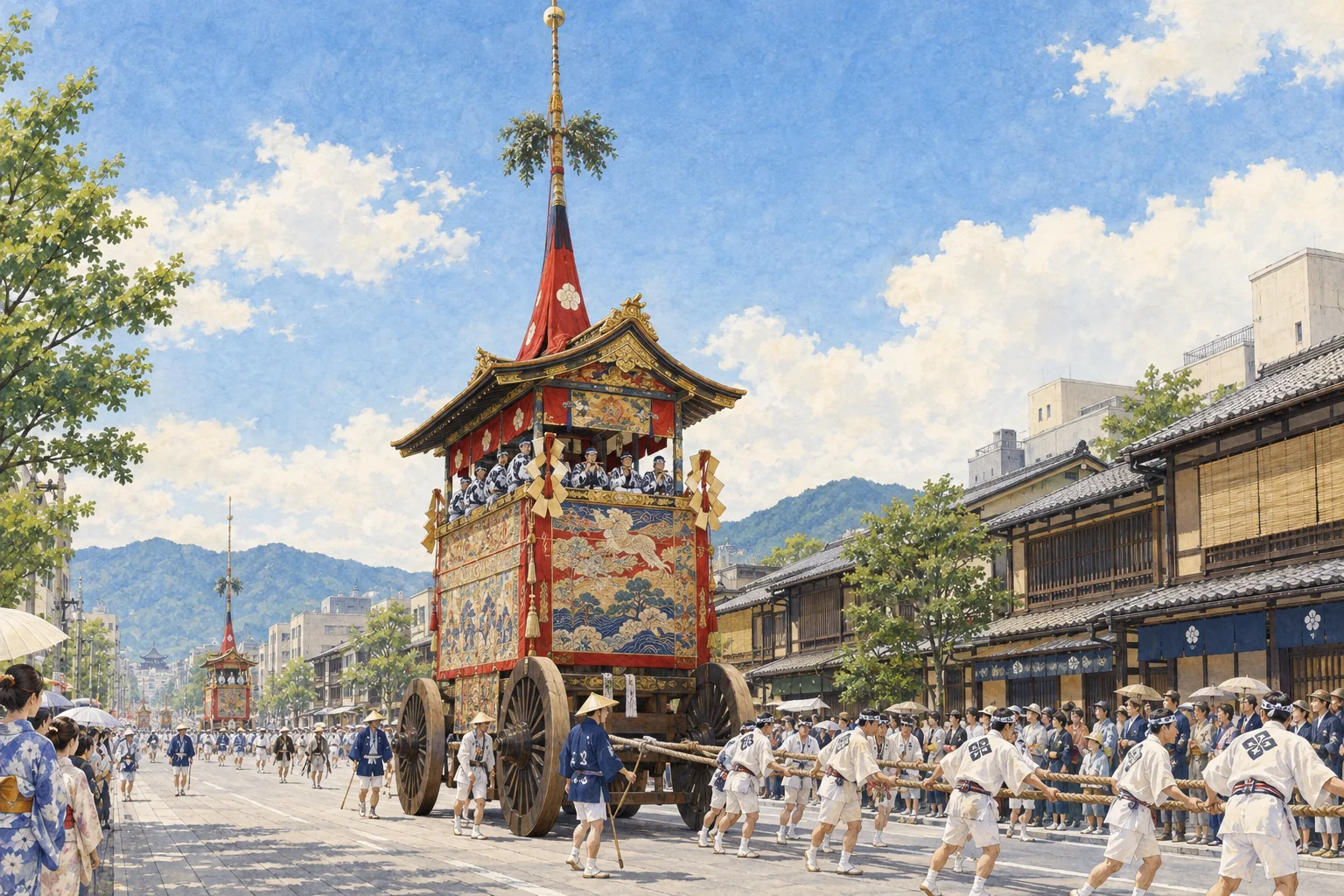
That rite became annual, and over the centuries the halberds turned into the floats you see now: wooden structures up to twenty-five meters tall and weighing up to around twelve tons, hung with textiles including imported Persian and Belgian tapestries, pulled through the streets by teams on ropes with no nails holding the frame together.
Two processions run, on the seventeenth and the twenty-fourth. The evenings before are called yoiyama, when the streets close, the floats are lit, and old merchant houses open to show their treasures. It was listed by UNESCO in 2009.
祇園祭は日本三大祭の一つとよく紹介されますが、説明する価値があるのは、なぜ存在するかのほうです。伝承によれば、869年、都に疫病が広がり、当時の国の数にちなんだ66本の矛を立て、神輿を神泉苑へ送って、病が退くよう祈る儀礼が行われました。
これが年ごとの行事になり、何世紀もかけて、矛はいま見る山鉾に育ちます。大きなものは高さ25メートル、重さ12トンにおよぶ木の構造物で、ペルシャやベルギーから渡った織物を掛け、綱を引く人たちが通りを進ませる。
骨組みは釘を使わず縄で締めてあります。巡行は17日と24日の二度。その前の晩は宵山と呼ばれ、通りが歩行者に開かれ、山鉾に灯がともり、古い商家が家の宝を見せます。2009年にユネスコの無形文化遺産に記載されました。
Questions people actually ask
And how to answer them.
Why is it a whole month?
The processions are the visible part, but the festival includes the assembly of the floats, rites at the shrine, the carrying of the portable shrines and their return. Each stage has its date, and together they fill July.
巡行は見える部分にすぎません。山鉾を組み立て、社で神事を行い、神輿を送り、また戻す。それぞれに日が決まっていて、合わせて7月が埋まります。
Can anyone watch or join?
Watching is free along the route and the evenings before are open to everyone. Pulling a float is usually for the neighborhood associations, though some accept outside volunteers, and a few floats have long not allowed women aboard, which is debated locally.
沿道で見るのは無料で、前夜の宵山は誰でも歩けます。山鉾を引くのは町内の保存会が中心ですが、外からの参加を受け入れる鉾もあります。いくつかの鉾は長く女性を乗せてこなかった慣行があり、地元でも議論になっています。
Are there other festivals like it?
Kyoto alone has three great festivals: Aoi in May, Gion in July and Jidai in October. Nationally, Gion is usually grouped with Tenjin in Osaka and Kanda in Tokyo as the three great festivals of Japan.
京都だけでも三大祭があります。5月の葵祭、7月の祇園祭、10月の時代祭です。全国では、大阪の天神祭、東京の神田祭と並べて日本三大祭と呼ばれます。
Phrases you can use
- It began in 869 as a rite against plague.869年、疫病を鎮める祈りとして始まりました。
- Sixty-six halberds were set up, one per province.当時の国の数にちなんで66本の矛を立てました。
- The largest floats weigh around twelve tons.大きな鉾は12トンほどあります。
- No nails — the frames are tied with rope.釘は使わず、縄で締めてあります。
- The evenings before the procession are called yoiyama.巡行の前の晩を宵山といいます。
Words you need
- festival float山鉾
- epidemic, plague疫病
- portable shrine神輿
- procession巡行
- neighborhood association町内会・保存会
Watch
From YouTubeBackground (Japanese)
貞観11年(869年)、疫病の流行を受け、当時の国の数である66本の矛を立て、神泉苑に神輿を送った御霊会が起源とされる。山鉾が現在のように大型化し華美になったのは室町時代以降で、応仁の乱で中断したのち復興した。前祭の巡行は7月17日に23基、後祭は7月24日に11基が出る。山鉾の組み立ては釘を使わず縄で締める「縄がらみ」による。平成21年(2009年)に「京都祇園祭の山鉾行事」としてユネスコ無形文化遺産に記載され、2016年に「山・鉾・屋台行事」として統合された。