choyo
the chrysanthemum festival of the ninth month
重陽の節句(ちょうようのせっく)
In one line
The shortest answer that works
Choyo, on the ninth of the ninth month, is the chrysanthemum festival, the least observed of the five seasonal festivals.
重陽とは九月九日の菊の節句で、五節句の中で最も廃れたものです。
In 30 seconds
The standard explanation
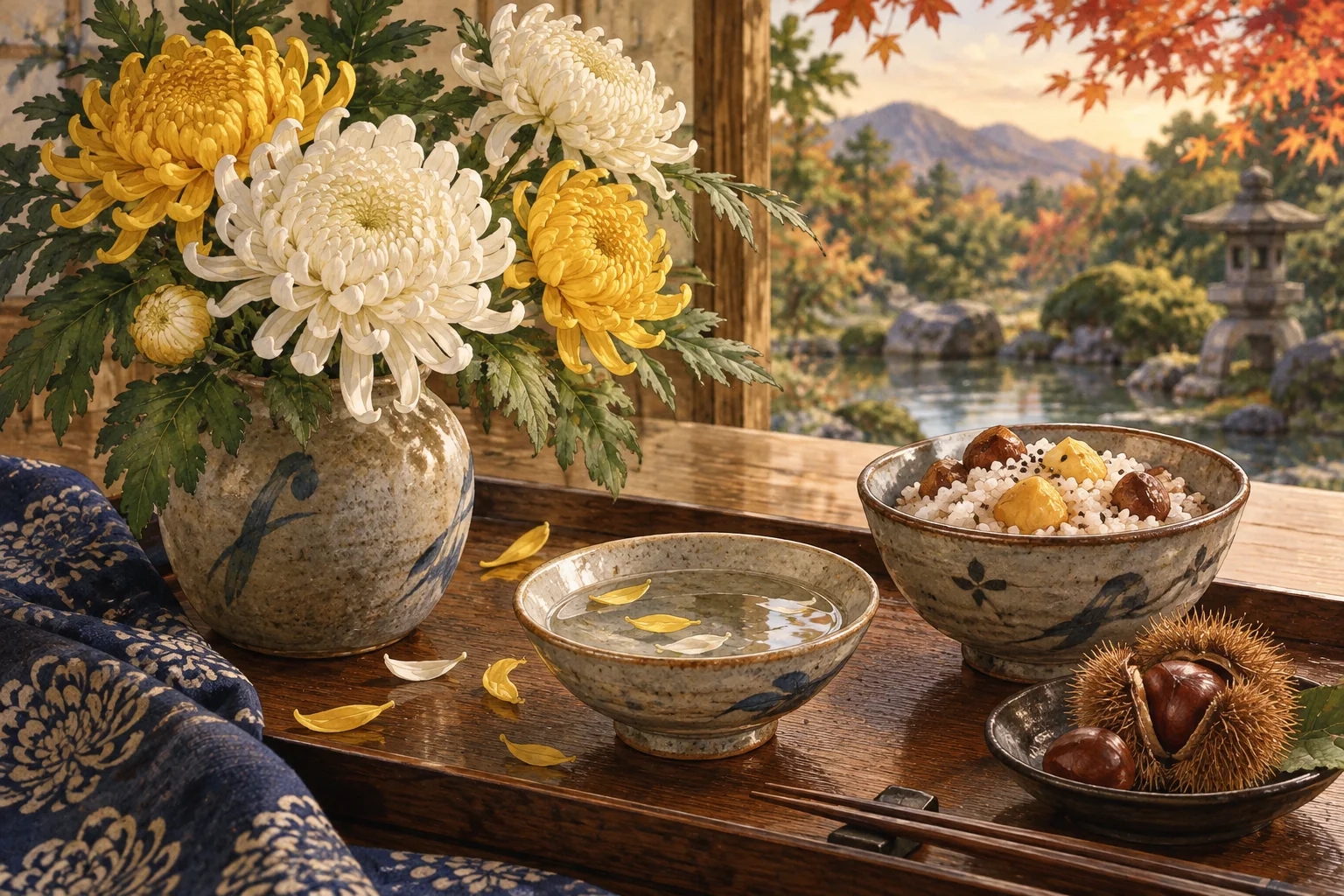
Choyo falls on the ninth day of the ninth month, where the most auspicious odd number is doubled. The plant of the day is the chrysanthemum, associated with long life. Customs included floating a petal in sake, laying cotton over a flower overnight and wiping the face with the dew-soaked cotton, and eating chestnut rice. On the old lunar calendar the timing matched the flowers; on the new calendar it does not, and the festival faded.
重陽は九月九日、最も縁起のよい奇数が重なる日です。この日の植物は菊で、長寿と結びついています。習わしには、菊の花びらを浮かべた酒、花に綿をかぶせて夜露を含ませ、その綿で顔を拭う「菊の着せ綿」、栗ご飯を食べることなどがありました。旧暦では菊の季節と合っていましたが、新暦では合わず、この節句は廃れました。
As a short speech
A full paragraph you can read aloud
Of Japan's five seasonal festivals, four are household names and one is not. Choyo falls on the ninth day of the ninth month, and its name refers to the doubling of nine, which in the old system was the most yang, the most auspicious, of the odd numbers. The plant attached to it is the chrysanthemum, which in China and Japan is a symbol of long life.
The court customs were elegant: a petal floated on sake, poems on the theme of longevity, and a practice in which raw cotton was laid over a chrysanthemum overnight to absorb the dew, then used the next morning to wipe the face. Chestnuts are eaten, so some regions call it the chestnut festival.
The reason you will rarely see it is the calendar. On the old lunar calendar the ninth of the ninth fell in what is now October, when chrysanthemums bloom. The switch to the solar calendar moved the date a month early, out of season, and without a children's element to carry it, the day quietly faded.
日本の五節句のうち、四つは誰もが知っていて、一つはそうではありません。重陽は九月九日に当たり、その名は九が重なることを指します。古い考え方で九は最も陽の、最も縁起のよい奇数でした。結びつく植物は菊で、中国でも日本でも長寿の象徴です。
宮中の習わしは優雅なものでした。菊の花びらを浮かべた酒、長寿を題にした歌、そして菊の着せ綿です。前の晩に菊へ真綿をかぶせて夜露を移し、翌朝その綿で顔を拭いました。栗を食べるので、栗の節句と呼ぶ地域もあります。
めったに見かけない理由は暦にあります。旧暦の九月九日は今の十月にあたり、菊の咲く季節でした。太陽暦への切り替えでこの日付は一か月早まって季節から外れ、行事を支える子どもの要素もなかったため、この日は静かに消えていきました。
Questions people actually ask
And how to answer them.
Why is nine the most auspicious number?
In the old Chinese system odd numbers were yang and auspicious, and nine is the largest single-digit odd number. The ninth day of the ninth month doubles it, which made the date powerful, and in that view a doubled auspicious number was also a point of instability needing a ritual.
古い中国の考え方では奇数は陽で縁起がよく、九は一桁の奇数で最大です。九月九日はそれが重なるので力のある日となり、同時に、縁起のよい数が重なる日は不安定でもあり、儀礼が要るとされました。
Does anyone still observe it?
Some shrines and temples hold chrysanthemum rites, a few old families keep the cotton custom, and chrysanthemum exhibitions in autumn are related in spirit. Restaurants occasionally serve chrysanthemum sake on the day. As a household event it has essentially disappeared.
一部の社寺が菊にまつわる神事や法要を行い、古い家で着せ綿の習わしを続ける例があり、秋の菊の展覧会も気持ちの上では地続きです。料理店がその日に菊酒を出すこともあります。家庭の行事としては、ほぼ姿を消しました。
Phrases you can use
- It's the ninth day of the ninth month.九月九日の節句です。
- The chrysanthemum stands for long life.菊は長寿を表します。
- A petal is floated on the sake.酒に花びらを浮かべます。
- It's the one festival that didn't survive.唯一、残らなかった節句です。
- The old calendar put it a month later.旧暦では一か月あとでした。
Words you need
- chrysanthemum菊
- longevity長寿
- auspicious縁起のよい
- lunar calendar旧暦
- chestnut栗
Watch
From YouTubeBackground (Japanese)
重陽は五節句の一つで、陽の数である九が重なることからこの名があります。菊の節句とも呼ばれ、菊の花びらを浮かべた菊酒を飲み、長寿を願う習わしが宮中から広まりました。前夜に菊へ真綿をかぶせて露と香りを移し、翌朝それで身体を拭う「菊の着せ綿」は、平安時代の記録にも見られます。栗ご飯を食べることから「栗の節句」と呼ぶ地域もあります。旧暦の九月九日は新暦ではおおむね十月にあたり、菊の見ごろと重なっていましたが、明治の改暦で新暦の九月九日に行うようになると季節と合わなくなりました。子どもの行事という支えがなかったことと合わせて、五節句の中で最も衰えた行事になったと説明されます。現在も一部の社寺では重陽の神事や菊供養が続けられています。