

 ワークシート
 ぬりえ
 迷路
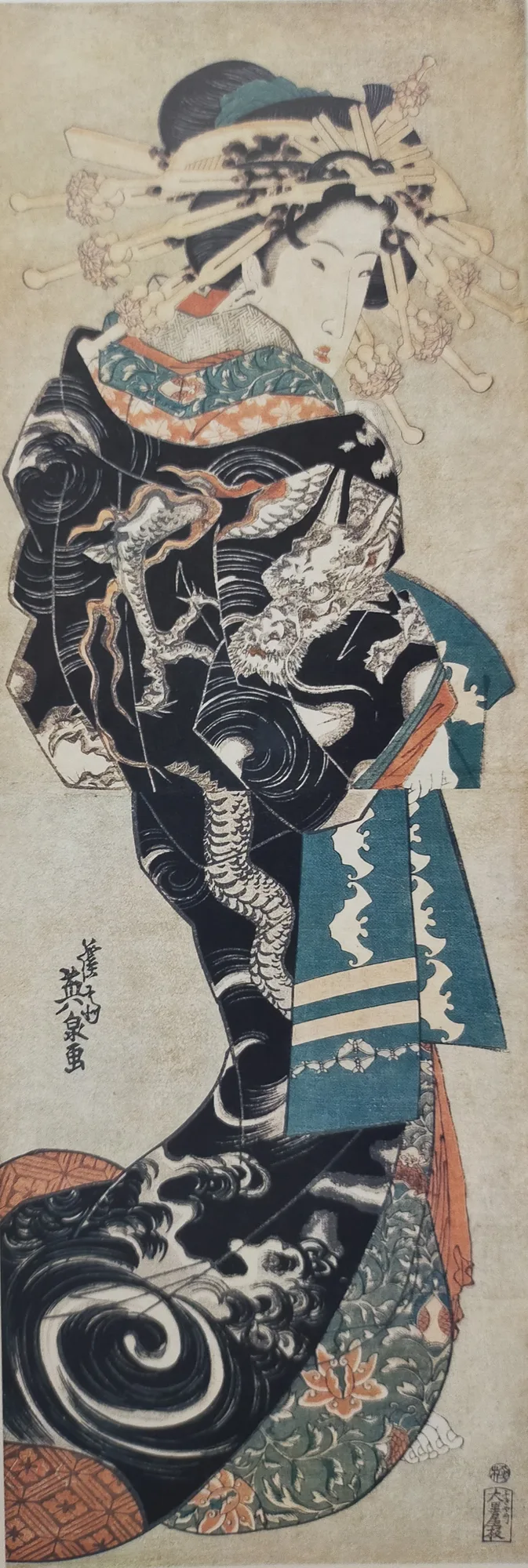
着物に竜がうねる!ゴッホが写して油絵にした、江戸のファッションリーダー。A dragon twists across her robe! Van Gogh copied this Edo fashion icon in oil paint.
この作品のお話
Storyたくさんのかんざしとくしで髪をかざった女性が、ふり返るように立っています。黒い打掛(うちかけ)には、雲の中をうねる竜。すそは渦巻く波のような大胆な模様です。江戸の吉原の、位の高い遊女「花魁(おいらん)」を描いた、渓斎英泉の浮世絵で、二枚の紙をたてにつないだ細長い大きな作品です。
A woman with many hairpins and combs in her hair stands and looks back. Her black outer robe shows a dragon twisting through clouds. The hem has bold swirls like waves. This print by Keisai Eisen shows an oiran, a high-ranking courtesan in Edo's Yoshiwara district. It is a tall, narrow work made of two sheets joined top to bottom.
花魁は、和歌や書、楽器などの教養も身につけた、江戸のあこがれの存在で、その髪型や着物は流行の最先端でした。英泉は1830年代ごろ、少し気だるげで色っぽい独特の美人画で人気を集めました。この作品でも、首をかしげたポーズと、強い竜の模様の組み合わせが目をひきます。
Oiran studied poetry, calligraphy and music, and many people in Edo admired them. Their hairstyles and clothes set the latest fashions. In the 1830s, Eisen became popular for his own style of beautiful women, a little languid and charming. Here, her tilted head and the powerful dragon pattern make a striking pair.
1886年、パリの雑誌『パリ・イリュストレ』の日本特集号の表紙に、この絵が左右反転して載りました。それを見たゴッホは絵を写しとって拡大し、1887年に油絵「花魁(渓斎英泉による)」を描きました。今はアムステルダムのファン・ゴッホ美術館にあります。画像の摺りは千葉市美術館のものです。
In 1886, this picture appeared, flipped left to right, on the cover of a Japan special issue of the Paris magazine Paris Illustré. Van Gogh traced it, enlarged it, and in 1887 painted 'Courtesan (after Eisen)' in oil. It is now in the Van Gogh Museum in Amsterdam. The print in this image belongs to the Chiba City Museum of Art.
この女性は「花魁」です。昔の江戸のファッションスターでした。黒い打掛には大きな竜がいます。髪にはたくさんのかんざしをさしています。ゴッホは雑誌でこの絵を見て、自分でまねして描きました。
This woman is an oiran. She was a fashion star in old Edo. Her black robe has a big dragon. She has many pins in her hair. Van Gogh saw this picture in a magazine and painted his own copy.
英語のレベルは上の「やさしい/ふつう」で切りかえられます。
えっ!?な裏ネタ
Secrets雑誌の表紙には、英泉の絵が左右反転して載っていました。ゴッホはその表紙をもとに描いたので、ゴッホの花魁は英泉の原画とは逆向きです。ゴッホが表紙をなぞった写しの紙も残っています。
The magazine cover reproduced Eisen's figure in reverse. Van Gogh worked from that cover, so his oiran faces the opposite way from Eisen's original. The paper on which he traced the cover still exists.
ゴッホの油絵では、花魁のまわりに池や竹、カエル、ツルなどが描き足されています。これらは別の浮世絵から借りてきたモチーフだと考えられています。ゴッホなりの「日本」を組み立てたのです。
In Van Gogh's painting, a pond, bamboo, frogs and cranes surround the oiran. These are thought to come from other Japanese prints. Van Gogh built his own idea of 'Japan'.
すその下から、はだしの足先がのぞいています。花魁は冬でも足袋をはかず、はだしで高いげたをはくのが「粋(いき)」とされたと言われます。足元までおしゃれの決まりがあったのです。
A bare foot peeks out from under the hem. It is said that oiran did not wear socks even in winter. Going barefoot in tall clogs was thought to be stylish. Even feet had fashion rules.
英泉は美人画だけでなく風景画も描きました。中山道の宿場を描く「木曽街道六十九次」は英泉が描き始め、途中から歌川広重が引きついで完成させたシリーズです。一つのシリーズに二人の名手の絵がならんでいます。
Eisen painted landscapes too. The series 'Sixty-nine Stations of the Kisokaidō' was started by Eisen. Utagawa Hiroshige took over partway and finished it. One series holds the work of two masters.
ここを見て!
Look Closer1かんざしとくしHairpins and combs
放射状にさした何本ものかんざしと、べっこう色のくし。花魁の位の高さを示す豪華な髪かざりです。
Many hairpins spread out like rays, with amber-colored combs. These rich ornaments show her high rank.
2雲の中の竜Dragon in the clouds
黒い打掛に、雲をまといながらうねる竜。力強い模様が、やさしい顔と対照的です。
A dragon twists through clouds on the black robe. The powerful pattern contrasts with her gentle face.
3渦巻くすそSwirling hem
すそには大きな渦の模様。重たい打掛が床に広がる様子を、大胆な形で表しています。
The hem has a huge swirl pattern. It boldly shows the heavy robe spreading on the floor.
4はだしの足先A bare foot
すその下からのぞくはだしの足。花魁は冬でもはだしが粋とされたと言われます。
A bare foot peeks out. Oiran were said to go barefoot even in winter for style.
英語で名画を語ろう
Talk about Art in EnglishThe oiran is wearing a black robe with a dragon on it.
花魁は、竜の模様の黒い打掛を着ています。
💡 服だけでなく、髪かざりやアクセサリーにも wear を使えます。
英語で説明すると… Describe it
これは女性を描いた縦長の絵です。彼女は大きな竜の模様の黒い打掛を着ています。髪にはたくさんの長いかんざしがあります。彼女は肩ごしにふり返っています。下のほうでは、打掛に大きな渦の模様があります。
This is a tall picture of a woman. She is wearing a black robe with a big dragon. There are many long pins in her hair. She is looking back over her shoulder. At the bottom, her robe has big swirls.
考えてみよう Think & Talk
- 打掛の模様に、なぜ竜が選ばれたのだと思いますか?Why do you think a dragon was chosen for her robe?
- ゴッホは日本に行ったことがありません。日本をどんな国だと想像していたと思いますか?Van Gogh never visited Japan. How do you think he imagined it?
この作品の英単語
WordsHer black robe has a dragon on it.
彼女の黒い打掛には竜が描かれています。
A dragon flies through the clouds.
竜が雲の中を飛んでいます。
The oiran looks elegant and proud.
花魁は優雅で誇り高く見えます。
Van Gogh traced the picture from a magazine.
ゴッホは雑誌の絵をなぞって写しました。
ミニクイズ
QuizQ. ゴッホはこの絵を、何を見て知った?How did Van Gogh first see this picture?
1886年の『パリ・イリュストレ』日本特集号の表紙に載りました。ゴッホは日本に行ったことはありません。
It was on the cover of Paris Illustré in 1886. Van Gogh never went to Japan.
ウソ?ホント? ゴッホの油絵の花魁は、英泉の原画と同じ向きである。Van Gogh's oiran faces the same way as Eisen's original.
雑誌で左右反転していたので、ゴッホの絵は逆向きです。
The magazine printed it flipped, so Van Gogh's faces the other way.
ウソ?ホント? この作品は、二枚の紙をたてにつないだ浮世絵である。This work is made of two sheets joined top to bottom.
大判の紙を二枚たてにつないだ、細長い作品です。
Two large sheets are joined to make a tall, narrow picture.
 画像の出典とライセンス / Image credit
- PDUnryuuchikakeno-oiran.jpg(Wikimedia Commons)
ライセンス:Public domain(パブリックドメイン)/作者・撮影者の表記:渓斎英泉(1791ー1848)/提供元:千葉市美術館『浮世絵師 渓斎英泉』(2012)より
この作品は、作者の死後長い年月がたち著作権の保護期間が終わった「パブリックドメイン」の作品です。画像は平面の作品を忠実に写したもので、新しい著作権は生じません(Wikimedia Commons の PD-Art の考え方)。 所蔵:千葉市美術館(画像の摺り)(Chiba City Museum of Art (this impression))。画像は表示のために縮小・WebP 形式に変換しています。
