 ワークシート
 ぬりえ
 迷路
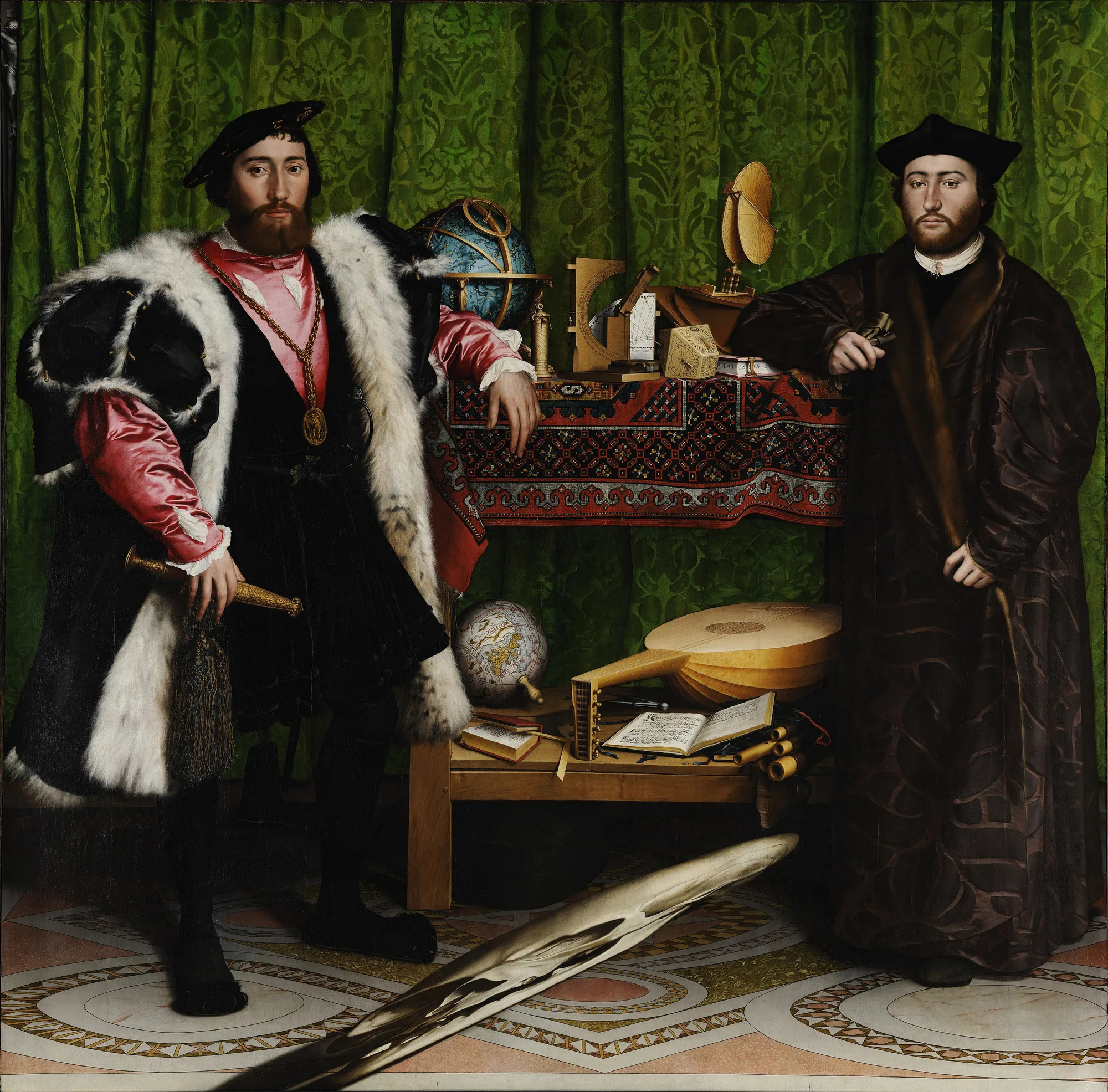
床のなぞの物体、ななめから見るとドクロに変身!The strange shape on the floor turns into a skull from the side!
この作品のお話
Story1533年、ロンドンにいたフランスの2人の若いエリートの肖像です。左は大使ジャン・ド・ダントヴィル、右は友人の司教ジョルジュ・ド・セルヴ。絵の中の文字は、2人の年齢を29と25と記しています。2人のあいだの棚には、天球儀や日時計などの天文の道具、地球儀、リュート、楽譜、算数の本が並び、当時の最先端の学問を表しています。
This portrait shows two young French men in London in 1533. On the left is the ambassador Jean de Dinteville, and on the right is his friend, Bishop Georges de Selve. Inscriptions in the painting give their ages as 29 and 25. Between them, the shelves hold a celestial globe, sundials, a globe of the Earth, a lute, a songbook and a math book. These show the latest knowledge of the time.
いちばんのなぞは、手前の床にななめにのびる、細長いふしぎな形です。じつはこれは、極端に引きのばして描かれたドクロ。絵の右はしに近づいて斜めに見ると、ちゃんとした形にもどります。「アナモルフォーシス(ゆがみ絵)」という技法で、「人は必ず死ぬ」ことを思い出させる仕かけと考えられています。
The biggest mystery is the long, strange shape on the floor. It is actually a skull, stretched out very far. If you stand near the right side and look at it from an angle, it becomes a normal skull. This trick is called anamorphosis. It probably reminds us that everyone will die one day.
このころイギリスでは、ヘンリー8世が離婚問題でローマ教会と対立し、ヨーロッパは宗教の争いでゆれていました。棚の小物にも、その不安が隠されているといわれます。絵は1890年にロンドン・ナショナル・ギャラリーが買い取り、今も人気の作品です。ほぼ等身大の2人の姿は、前に立つ人を圧倒します。
At this time, Henry VIII was fighting with the Church in Rome over his divorce, and Europe was divided by religious conflicts. Some small objects on the shelves may hide these worries. The National Gallery in London bought the painting in 1890, and it is still one of its most popular works. The almost life-size figures are very impressive when you stand in front of them.
2人のフランス人の男性が棚の横に立っています。棚には地球儀や本、リュートがあります。床を見てください。細長いふしぎな形があります。右側に立って、もう一度見てください。ドクロです!
Two French men stand next to some shelves. On the shelves, there are globes, books and a lute. Look at the floor. There is a long, strange shape. Stand on the right side and look again. It is a skull!
英語のレベルは上の「やさしい/ふつう」で切りかえられます。
えっ!?な裏ネタ
Secrets棚の下段のリュートをよく見ると、弦が1本切れています。調和の取れない音、つまり当時のキリスト教世界の分裂を表しているという説があります。すぐそばには、ルターの言葉による賛美歌の本が開かれています。
Look closely at the lute on the lower shelf. One string is broken. Some think it stands for disharmony, the split in the Christian world at the time. Nearby, a hymnbook lies open with hymns in Martin Luther's words.
緑のカーテンの左上のすみに、小さな十字架のキリスト像が半分だけのぞいています。気づかない人がほとんどですが、死を表すドクロと、救いを表す十字架が、絵の中で向き合っているとも読めます。
In the top-left corner, a small crucifix peeks out from behind the green curtain. Most people miss it. Some see the skull of death and the cross of hope facing each other in the painting.
棚の上の筒形の日時計の目盛りから、この場面は1533年4月11日、キリストが十字架にかけられた聖金曜日を示している、という説があります。ただし同じ目盛りは8月の日付とも読め、ほかの道具とも合わないため、確かな証拠とは言えないと考えられています。
Some scholars read the cylinder sundial on the top shelf as showing 11 April 1533, Good Friday, the day Christ died. But the same setting could also mean a day in August, and the other instruments do not agree. So the painting does not give us a sure date.
下段の地球儀には、ダントヴィルの領地だったフランスの小さな村ポリジーの名前が書きこまれています。大使が、遠くロンドンから故郷を思っていたのかもしれません。小さな文字まで読めるほどの、ホルバインの筆の細かさにもおどろかされます。
On the globe on the lower shelf, you can find the name Polisy, a small French village where Dinteville had his home. Perhaps he was thinking of home while he was far away in London. Holbein's tiny, readable letters are amazing too.
ここを見て!
Look Closer1ゆがんだドクロThe stretched skull
床にななめにのびる形。絵の右はしからのぞきこむと、ドクロに見えます。
This shape stretches across the floor. Look at it from the right edge, and it becomes a skull.
2弦の切れたリュートThe lute with a broken string
楽器のリュート。弦が1本切れています。
A lute. One of its strings is broken.
3天球儀と天文の道具Celestial globe and instruments
星座を描いた天球儀や日時計。天文学の最新の道具がそろっています。
A globe of the stars and sundials. These were the newest tools for studying the sky.
4かくれた十字架The hidden crucifix
カーテンのすきまから、小さな十字架がのぞいています。
A small crucifix peeks out from behind the curtain.
英語で名画を語ろう
Talk about Art in EnglishIf you look at it from a different angle, you can see a skull.
ちがう角度から見ると、ドクロが見えます。
💡 「見方を変える」の意味にも。think from a different angle
英語で説明すると… Describe it
2人の男が緑のカーテンの前に立っています。左の男はピンクの服を着て、毛皮の裏地がついた大きな黒いコートをはおっています。2人のあいだには、地球儀や本、リュートがのった棚があります。手前の床には、ふしぎな灰色の形があります。
Two men are standing in front of a green curtain. The man on the left wears pink clothes and a big black coat lined with fur. Between them, there are shelves with globes, books and a lute. In the foreground, there is a strange gray shape on the floor.
考えてみよう Think & Talk
- ホルバインはなぜドクロを普通に描かずに隠したのだと思いますか?Why do you think Holbein hid the skull instead of painting it normally?
- 自分を表す物をテーブルに並べるとしたら、何を選びますか?If you put objects that show who you are on a table, what would you choose?
この作品の英単語
WordsJean de Dinteville was the French ambassador in London.
ジャン・ド・ダントヴィルはロンドン駐在のフランス大使でした。
The strange shape on the floor is a skull.
床のふしぎな形はドクロです。
Holbein stretched the skull to hide it.
ホルバインはドクロを引きのばして隠しました。
One string of the lute is broken.
リュートの弦が1本切れています。
ミニクイズ
QuizQ. 床のふしぎな形を正しく見るには?How can you see the strange shape on the floor correctly?
右はしに近づいてななめにのぞくと、ドクロの形になります。
Stand near the right side and look at an angle. It becomes a skull.
ウソ?ホント? 左の男性の短剣のさやには、29という数字が書かれている。The number 29 is written on the case of the left man's dagger.
ダントヴィルの年齢を示す数字で、ラテン語の銘文の一部です。
It is part of a Latin inscription that gives Dinteville's age.
ウソ?ホント? 2人はイギリスの王子だ。The two men are English princes.
フランスの大使と司教です。
They are a French ambassador and a French bishop.
 画像の出典とライセンス / Image credit
- PDHans Holbein the Younger - The Ambassadors - Google Art Project.jpg(Wikimedia Commons)
ライセンス:Public domain(パブリックドメイン)/作者・撮影者の表記:Hans Holbein the Younger/提供元:Google Arts & Culture — bQEWbLB26MG1LA
この作品は、作者の死後長い年月がたち著作権の保護期間が終わった「パブリックドメイン」の作品です。画像は平面の作品を忠実に写したもので、新しい著作権は生じません(Wikimedia Commons の PD-Art の考え方)。 所蔵:ロンドン・ナショナル・ギャラリー(The National Gallery)。画像は表示のために縮小・WebP 形式に変換しています。