Genji monogatari
an eleventh-century court novel
源氏物語(げんじものがたり)
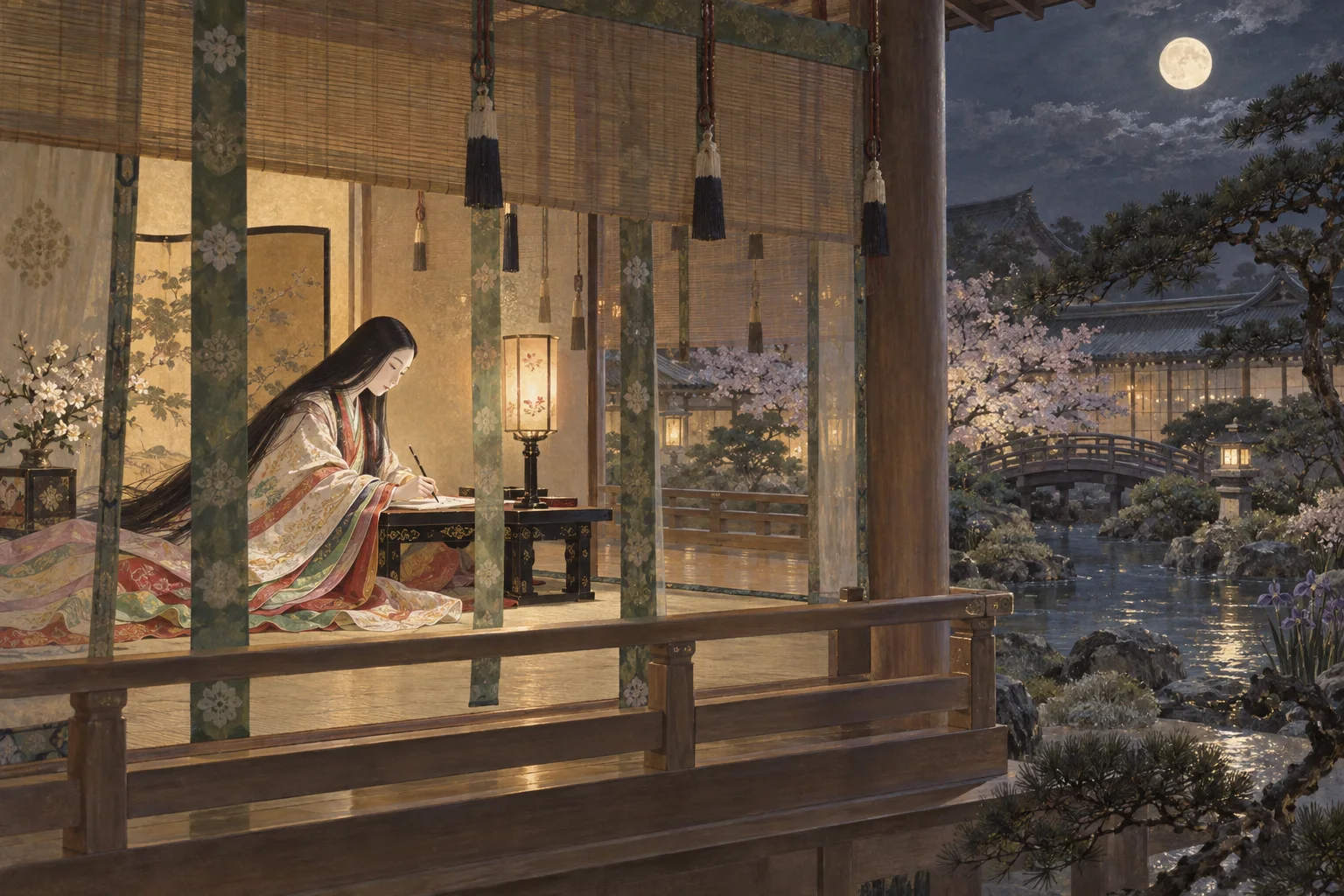
In one line
The shortest answer that works
Genji monogatari, or The Tale of Genji, is an eleventh-century novel written by a woman of the imperial court.
源氏物語とは、11世紀に宮廷に仕えた女性が書いた長編小説です。
In 30 seconds
The standard explanation
The Tale of Genji was written in the early eleventh century by Murasaki Shikibu, a woman serving at the imperial court. It follows Hikaru Genji, the son of an emperor, through his loves, his political rises and falls, and then continues with the next generation after his death. It runs to fifty-four chapters and is often called one of the world's earliest novels.
『源氏物語』は11世紀の初めごろ、宮廷に仕えた女性、紫式部によって書かれました。天皇の子である光源氏の恋と、政治的な栄達と失脚を描き、その死後は次の世代の物語へと続きます。全54帖からなり、世界で最も早い時期の長編小説のひとつと呼ばれることがよくあります。
As a short speech
A full paragraph you can read aloud
The Tale of Genji was written around the early eleventh century by Murasaki Shikibu, a woman who served an empress at the Heian court. It is long, fifty-four chapters, and it follows Hikaru Genji, the handsome son of an emperor by a low-ranking consort, through decades of love affairs, court politics, exile and return, and then keeps going after his death into the lives of the next generation.
What makes it remarkable is not the plot but the psychology: the characters have inner lives, they misread each other, and the narrator is aware of how unhappy the women in the story often are. People sometimes call it the world's first novel. It is fairer to say it is one of the earliest works anywhere that reads like a novel, and it is certainly one that almost every Japanese student meets at school.
『源氏物語』は11世紀の初めごろ、平安の宮廷で中宮に仕えた女性、紫式部によって書かれました。全54帖と長く、身分の低い更衣を母に持つ美しい皇子、光源氏の数十年にわたる恋と、宮廷の政治、流離と帰還を描き、その死後も次の世代の物語へと続きます。
優れているのは筋立てではなく心理です。登場人物には内面があり、互いを読み違え、語り手は物語の中の女性たちがしばしば不幸であることを知っています。
世界最初の小説と呼ばれることがありますが、小説のように読める最も早い作品のひとつ、と言うほうが公平でしょう。日本の生徒のほとんどが学校で出会う作品であることは確かです。
Questions people actually ask
And how to answer them.
Is it really the world's first novel?
That claim is popular but contested, since it depends on what counts as a novel and there are earlier long prose narratives elsewhere. What is safe to say is that it is one of the earliest surviving works of long psychological fiction anywhere.
その言い方はよく使われますが議論があります。何を小説と数えるかによりますし、他の地域にも先行する長い散文の物語があるからです。安全に言えるのは、心理を描いた長い虚構として、世界でも最も早い時期に残った作品のひとつだということです。
Can Japanese people read the original?
Not easily. The classical language is far from modern Japanese, so students read short annotated extracts in class, and most adults who read the whole thing read a modern translation. Several famous novelists have produced their own versions.
簡単には読めません。古典の言葉は現代日本語とかなり違うので、学校では注のついた短い抜粋を読み、全編を読む大人のほとんどは現代語訳で読みます。有名な作家が自分の訳を出した例もいくつもあります。
Phrases you can use
- It was written about a thousand years ago.千年ほど前に書かれました。
- The author was a woman at the imperial court.作者は宮廷に仕えた女性です。
- Most Japanese read it in a modern translation.日本人の多くは現代語訳で読みます。
- It has fifty-four chapters.全部で54帖あります。
Words you need
- court lady女房
- chapter帖
- classical Japanese古典日本語
- modern translation現代語訳
Watch
From YouTubeBackground (Japanese)
紫式部は本名が伝わっておらず、「紫」は作中の人物紫の上から、「式部」は父の官職から来た呼び名とされます。物語は当時、宮廷の女性たちの間で写して読まれ、続きを待たれていたと考えられています。原本は残っておらず、鎌倉時代の写本などをもとに読まれてきました。与謝野晶子、谷崎潤一郎、円地文子、瀬戸内寂聴ら多くの作家が現代語訳を手がけ、訳ごとに文体が大きく異なるのも特徴です。