shodo
Japanese calligraphy
書道(しょどう)
In one line
The shortest answer that works
Shodo is writing characters with a brush and ink as an art form, where a stroke cannot be corrected.
書道とは、筆と墨で文字を書く芸術で、一度引いた線は直せません。
In 30 seconds
The standard explanation
Calligraphy is taught in Japanese schools and practiced as an art. You grind an ink stick on a stone, load a brush, and write on absorbent paper where every stroke soaks in immediately. Nothing can be corrected or gone over. Speed, pressure and the order of strokes are all visible in the finished line, which is what is being judged.
書道は日本では学校で教えられ、芸術としても続けられています。硯で墨をすり、筆に含ませ、吸い込みの早い紙に書きます。一画ごとにすぐしみ込み、直すことも、なぞることもできません。速さ、筆圧、書き順のすべてが線に残り、それが評価されるものです。
As a short speech
A full paragraph you can read aloud
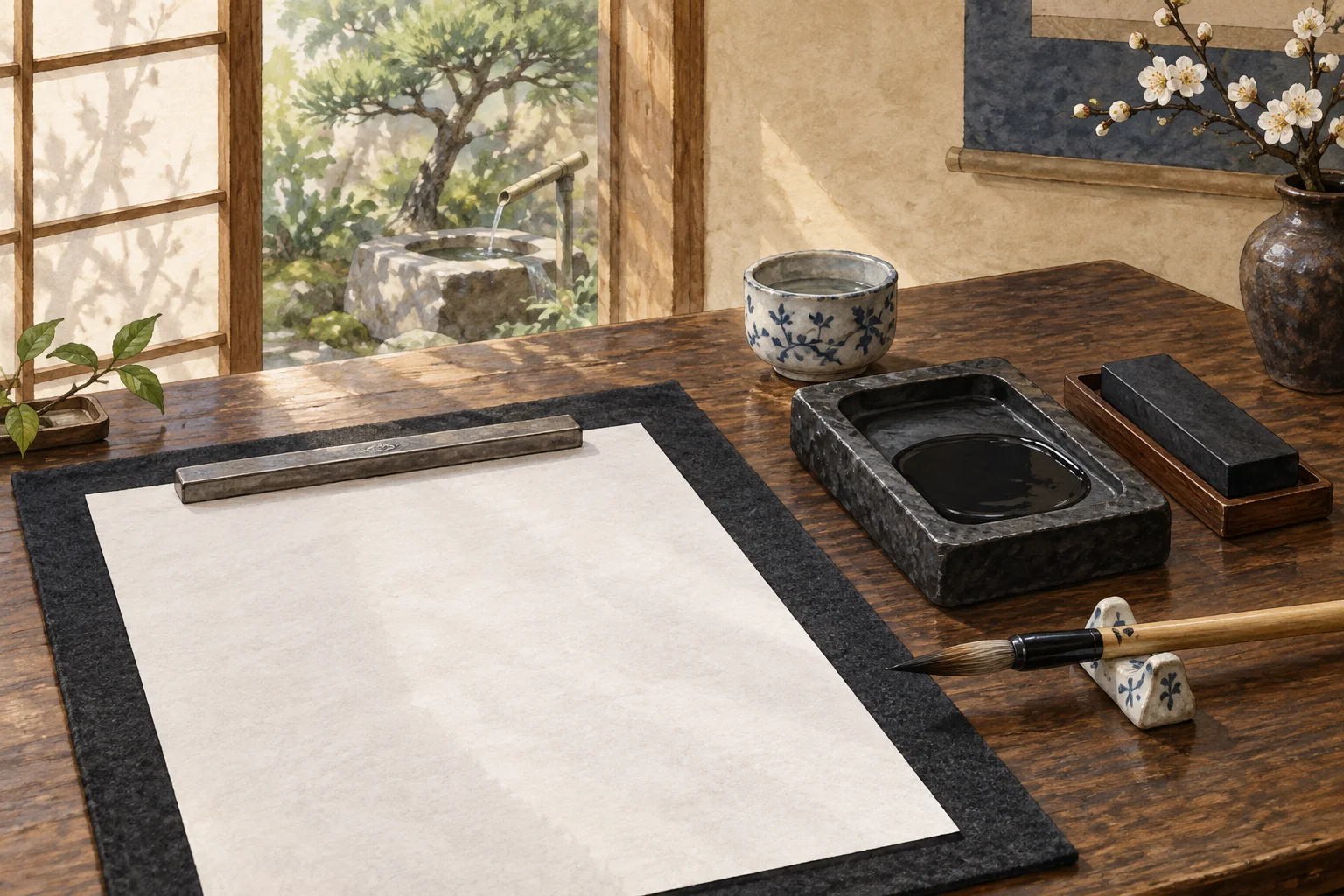
Shodo is calligraphy, and in Japan it is both part of the school curriculum and a lifelong art. Children learn it in primary school, at their desks with a felt mat, an ink stone, a brush and paper.
What makes it difficult is simple: the paper absorbs ink instantly, so a stroke cannot be corrected, thickened or gone over. Whatever your hand did is what stays. Speed, pressure, the angle of the brush and the order of the strokes are all readable in the finished character by anyone trained to see them.
There are different styles, from the formal block script where every stroke is separate, to the flowing cursive where a whole character becomes one line and even Japanese people often cannot read it. At New Year there is a custom called kakizome, the first writing of the year, done in early January, usually of a word you want to aim at.
書道は、日本では学校で習うものであり、一生続ける芸術でもあります。子どもは小学校で、机に下敷きを敷き、硯と筆と紙を並べて習います。難しさは単純です。
紙が墨をすぐ吸うため、線を直すことも、太くすることも、なぞることもできません。手が動いたとおりが、そのまま残ります。速さ、筆圧、筆の角度、書き順。そのすべてが仕上がった字に読み取れます。見る目のある人には分かります。
書体にも幅があり、一画ずつ離して書く楷書から、一字がひと続きの線になり、日本人でも読めないことのある草書まであります。正月には「書き初め」という習慣があり、1月のはじめにその年の目標にしたい言葉を書きます。
Questions people actually ask
And how to answer them.
Why does stroke order matter so much?
Because it shapes the line. A character written in the wrong order looks subtly wrong even to someone who cannot say why, and in cursive script the connections between strokes become impossible.
線の形が変わるからです。順序を違えて書いた字は、理由を言えない人にも微妙に違って見えますし、草書では画のつながり方が成立しなくなります。
Is it the same as Chinese calligraphy?
It comes from it and shares the kanji, but Japanese calligraphy also writes kana, the flowing syllabic script, which developed its own aesthetic and has no Chinese equivalent.
中国書法に由来し、漢字を共有しています。ただ日本の書道は、流れるような仮名も書きます。仮名は独自の美意識を発展させ、中国には対応するものがありません。
Can I try it as a visitor?
Easily. Short classes for visitors are common in Kyoto and Tokyo, and a beginner set costs very little in a stationery shop. Writing one character well is a satisfying afternoon.
簡単にできます。京都や東京には訪日客向けの短い教室が多くあり、初心者用の道具は文具店で安く買えます。一字をきちんと書くだけでも、良い午後になります。
Phrases you can use
- You can't correct a stroke once it's written.一度書いた線は直せません。
- You grind the ink yourself on a stone.墨は硯で自分ですります。
- Stroke order changes how the character looks.書き順で字の形が変わります。
- Every child learns it in primary school.小学校でみんなが習います。
- At New Year we write our goal for the year.正月には、その年の目標を書きます。
Words you need
- calligraphy書道
- brush筆
- ink stone硯
- stroke画、一筆
- absorbent吸い込みやすい
Watch
From YouTubeBackground (Japanese)
書道は日本の小学校の国語で「書写」として扱われ、毛筆は3年生から必修となっている(学習指導要領)。書体には楷書・行書・草書・隷書・篆書があり、日常的に読めるのは楷書と行書まで。仮名書道は平安時代に和歌を書くために発達し、連綿(文字を続けて書くこと)や散らし書きという独自の構成法を生んだ。文房四宝(筆・墨・硯・紙)は中国由来の呼び名。書き初めは1月2日に行うのが伝統とされ、書いたものは1月15日ごろのどんど焼きで燃やし、炎が高く上がると字が上達すると言われる。