tatami shokunin
the maker of tatami mats, a shrinking trade that still measures every room by hand
畳職人(たたみしょくにん)
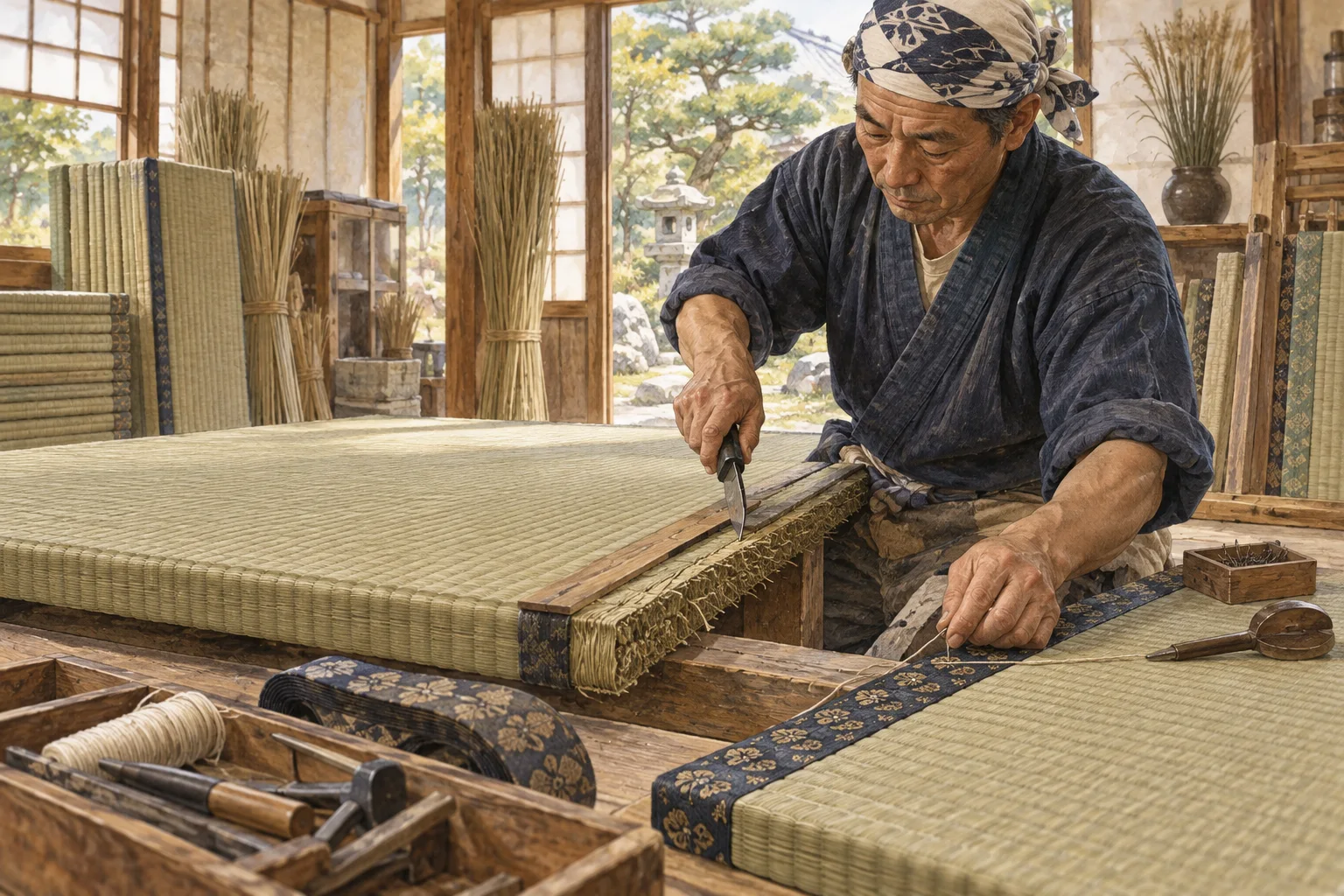
In one line
The shortest answer that works
A tatami craftsman custom-builds each mat to the exact, often slightly uneven dimensions of a single room, not a standard size.
畳職人は既製品ではなく、部屋ごとにわずかに違う寸法を測って、一枚一枚を仕立てます。
In 30 seconds
The standard explanation
Tatami mats look identical but are rarely interchangeable, because Japanese rooms are almost never perfectly square. A tatami craftsman measures each room by hand and builds every mat to its own slightly different size, then fits them together like a puzzle that only works in that one room. Nearly all the rush grass grown in Japan for the mat surface now comes from Kumamoto, though much of what is used is imported. The trade has shrunk for decades as houses switch to flooring, and full-time craftsmen are becoming harder to find.
畳は見た目こそ同じでも、たいてい使い回しがききません。日本の部屋はほぼ完全な四角にはならないからです。畳職人は部屋ごとに手で寸法を測り、一枚一枚わずかに違う大きさに仕立て、その部屋でしか組み合わない、いわばパズルとして敷き詰めます。畳表に使うい草は、国産のほぼすべてが熊本県産ですが、使われる量では輸入品も多くあります。フローリングへの転換で需要は何十年も縮み続け、専業の職人を見つけるのは難しくなっています。
As a short speech
A full paragraph you can read aloud
People assume tatami mats are a standard, interchangeable product, like tiles, but a tatami craftsman will tell you that is almost never true. Japanese rooms are rarely perfect rectangles; walls settle, pillars sit slightly off, and a room built decades ago has its own quiet distortions.
So a craftsman visits the house, measures the room by hand with each corner treated separately, and builds mats to that room's exact, often slightly irregular dimensions. Move a mat from one room to another and it usually will not sit flush.
The rush grass covering the surface, called igusa, comes almost entirely from Kumamoto when it is grown in Japan, though a lot of tatami now uses imported or synthetic surfaces to cut cost. As houses shift toward Western flooring, fewer new tatami rooms get built each year, and the number of full-time craftsmen who can still measure and weave by hand keeps shrinking.
畳は工業製品のように既製品で使い回せると思われがちですが、畳職人に言わせれば、それはほぼ当てはまりません。日本の部屋はきれいな長方形であることがまれで、壁は沈み、柱はわずかにゆがみ、何十年も前に建てられた部屋には、その部屋だけの静かなゆがみがあります。
だから職人は家を訪れ、角の一つひとつを別々に手で測り、その部屋にぴったり合う、時にわずかに不揃いな寸法で畳を仕立てます。畳を別の部屋に持っていくと、たいていぴったりとは収まりません。
表面を覆ういぐさは、国産ならほぼすべてが熊本県産ですが、費用を抑えるため輸入品や化学表を使う畳も多くなっています。住まいが洋室のフローリングへ移るにつれ、新しく畳の部屋を作る件数は年々減り、手で測って織れる専業の職人の数も減り続けています。
Questions people actually ask
And how to answer them.
Can I just buy tatami mats online and lay them myself?
You can buy small tatami units for a single corner of a room, but full custom mats for an entire room are normally measured and fitted by a craftsman, since a standard size rarely matches the actual room.
部屋の一角に敷く小さな畳ユニットなら買えますが、部屋全体の本格的な畳は、たいてい職人が測って仕立てます。既製の寸法が実際の部屋に合うことはまれだからです。
Why does tatami have that distinctive smell?
That is the scent of dried igusa rush grass, considered part of the appeal when new and fading as the mat ages; it is also why some people replace only the surface layer instead of the whole mat.
乾かしたいぐさの香りで、新しいうちは魅力の一つとされ、畳が古くなるにつれて薄れます。表だけを替えて畳全体は替えない人がいるのも、このためです。
Are tatami rooms disappearing from Japanese homes?
They are becoming less common in new construction as flooring takes over, but many homes still keep one tatami room, often for guests or for laying out futon.
新築ではフローリングに押されて減りつつありますが、客間や布団を敷く部屋として和室を一室残す家は今も多くあります。
Phrases you can use
- This mat was custom-made for this exact room.この畳はこの部屋専用に仕立てられています。
- The room isn't perfectly square, so we measured by hand.この部屋は正確な四角ではないので、手で測りました。
- That smell is fresh igusa rush.そのにおいは新しいいぐさです。
- We're replacing just the surface, not the whole mat.畳全体ではなく、表だけを替えます。
- Full-time tatami craftsmen are getting harder to find.専業の畳職人は見つけにくくなっています。
Words you need
- tatami craftsman畳職人
- rush grass (mat surface)い草・畳表
- to measure by hand手で測る
- Japanese-style room和室
- custom-made特注の・仕立ての
Watch
From YouTubeBackground (Japanese)
畳の表に使ういぐさは、熊本県八代市を中心とする産地が国内生産の9割以上を占める。ただし畳表全体では中国などからの輸入品も多い。畳職人は部屋ごとに寸法を手作業で測り、わずかに不揃いな日本家屋の柱や壁に合わせて一枚ずつ仕立てるため、既製品のように別の部屋へ使い回すことは通常できない。フローリングの普及で和室そのものが減り、畳の張り替え需要も縮小が続いており、手縫いで畳床を仕立てられる専業の職人は各地で減少している。