fusuma and shoji
the sliding paper doors of a Japanese house
襖と障子(ふすまとしょうじ)
In one line
The shortest answer that works
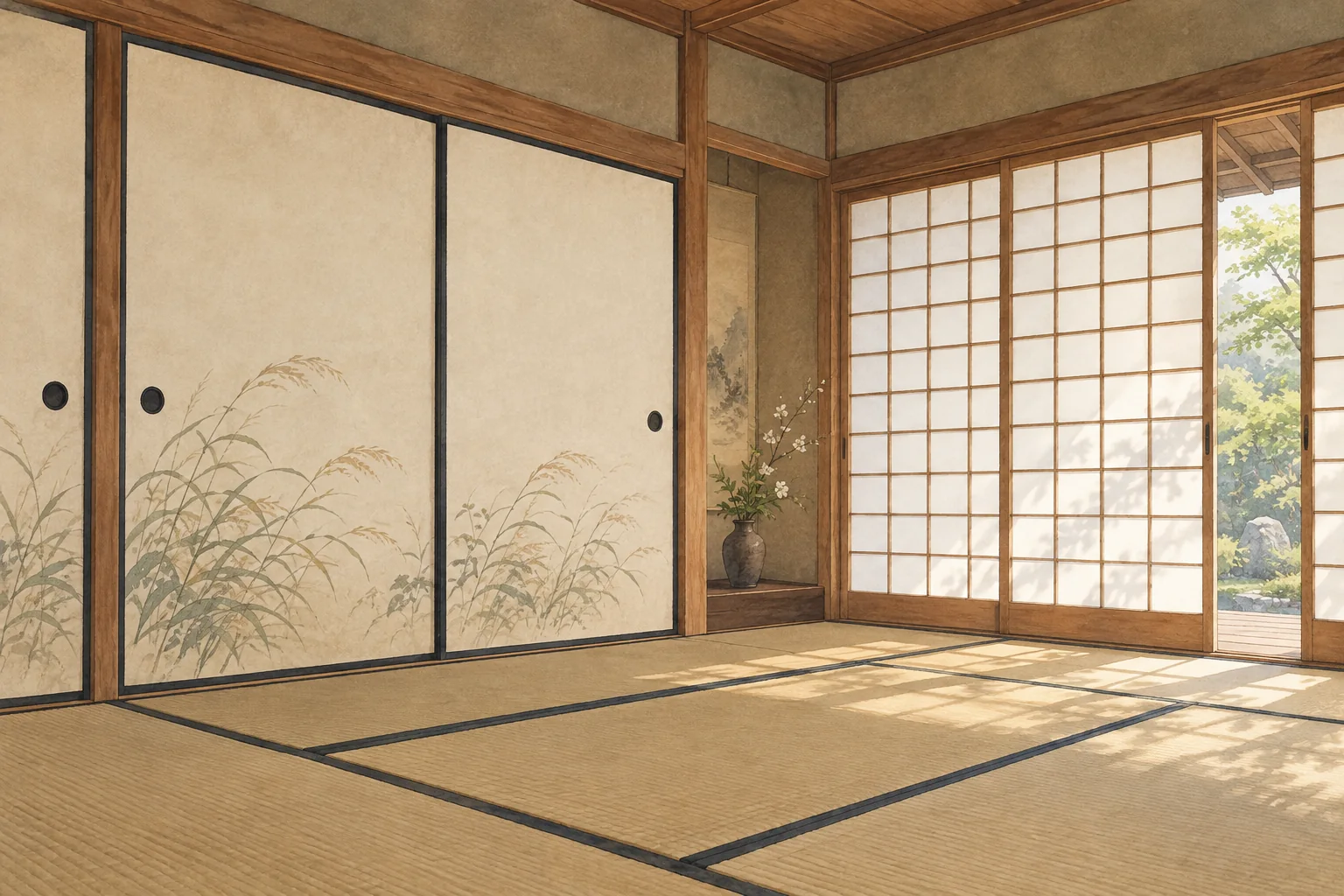
Fusuma and shoji are sliding paper doors that let a Japanese house change its rooms.
襖と障子は紙を張った引き戸で、日本の家は部屋の区切り自体を変えられます。
In 30 seconds
The standard explanation
Traditional Japanese rooms are divided by sliding panels rather than fixed walls. Fusuma are opaque, papered on both sides, and separate rooms. Shoji are translucent, a wooden lattice covered with thin white paper, and face the outside to let light through. Both slide in grooves and can be lifted out, so two rooms can become one.
伝統的な日本の部屋は、固定された壁ではなく引き戸で仕切られます。襖は両面に紙を張った不透明な戸で、部屋と部屋を分けます。障子は木の格子に薄い白紙を張った半透明の戸で、外側に面して光を通します。どちらも溝を滑り、外して持ち上げられるので、二部屋を一部屋にできます。
As a short speech
A full paragraph you can read aloud
In a traditional Japanese house, the walls move. Rooms are divided by sliding panels that run in grooves in the floor and ceiling. There are two kinds. Fusuma are opaque, papered on both sides, often painted, and they separate one room from another.
Shoji are translucent: a fine wooden lattice covered with thin white paper, used where a wall meets the outside, so daylight comes through as a soft, even light without anyone being able to see in.
Both can be slid fully open or lifted out of their grooves altogether, which means two small rooms can become one large one for a gathering and go back to being two afterwards. It is a flexible way to use limited space. The trade-off is obvious: paper is not soundproof and not warm. Anyone who has stayed in an old Japanese house in winter knows exactly what I mean.
伝統的な日本の家では、壁が動きます。部屋は、床と天井の溝を滑る引き戸で仕切られています。二種類あります。襖は両面に紙を張った不透明な戸で、絵が描かれていることも多く、部屋と部屋を分けます。
障子は半透明で、細い木の格子に薄い白紙を張ったもの。壁が外に面する場所に使われ、外から中を見られないまま、やわらかく均一な光を通します。どちらも全部開けられますし、溝から外してしまうこともできます。
つまり小さな二部屋を、集まりのときは一つの大きな部屋にして、あとでまた二つに戻せるのです。限られた広さを柔軟に使うやり方です。代償ははっきりしています。紙は防音もしませんし、暖かくもありません。冬に古い日本家屋に泊まったことがある人なら、よく分かるはずです。
Questions people actually ask
And how to answer them.
What's the quick way to tell them apart?
Light. If you can see a glow through it, it is shoji. If it is solid and you cannot, it is fusuma. Shoji face the outside; fusuma sit between rooms.
光です。透けて明るければ障子、透けなければ襖。障子は外に面し、襖は部屋と部屋の間にあります。
Doesn't the paper tear?
Constantly, especially with children and cats. Re-papering shoji is a normal household job, traditionally done before New Year, and repair patches shaped like flowers are sold for small holes.
よく破れます。とくに子どもと猫がいる家では。障子の張り替えは家の仕事のひとつで、年末に行う習慣があります。小さな穴用に、花の形をした補修シールも売られています。
How do you open them properly?
In a formal setting you kneel, slide it partway with one hand, then the rest with the other, and close it the same way. This is part of tea ceremony training, and most people do not do it at home.
正式な場では、座って片手で少し開け、もう片方の手で残りを開け、閉めるときも同様にします。茶道の稽古に含まれる作法で、家で実践している人はほとんどいません。
Phrases you can use
- Shoji let the light through; fusuma don't.障子は光を通し、襖は通しません。
- You can take them out and make it one big room.外せば、大きな一部屋にできます。
- The paper gets replaced before New Year.紙は年末に張り替えます。
- They slide, so there's no space needed to swing a door.引き戸なので、開くための空間が要りません。
- Paper isn't very soundproof, as you'd imagine.ご想像のとおり、紙はあまり音を遮りません。
Words you need
- sliding door引き戸
- translucent半透明の
- lattice格子
- partition仕切り
- soundproof防音の
Watch
From YouTubeBackground (Japanese)
襖も障子も平安時代の寝殿造りにさかのぼり、当初は「障子」が仕切り全般を指す語だった。現在の透ける障子は「明かり障子」と呼ばれて区別された。襖に描かれた絵は「障壁画」と呼ばれ、狩野派による城や寺の襖絵は美術史上の重要作品である。引き戸は開閉に前後の空間が不要で、狭い住宅に適している。障子紙は和紙で、光を拡散させながら通すため、室内が均一に明るくなる。近年は破れにくい樹脂加工の障子紙や、断熱性を高めた二重構造の製品も普及している。なお敷居を踏まないのは、建具の動きを損ねるためと、家の格を示す部分であるためとされる。