Sanjusangendo
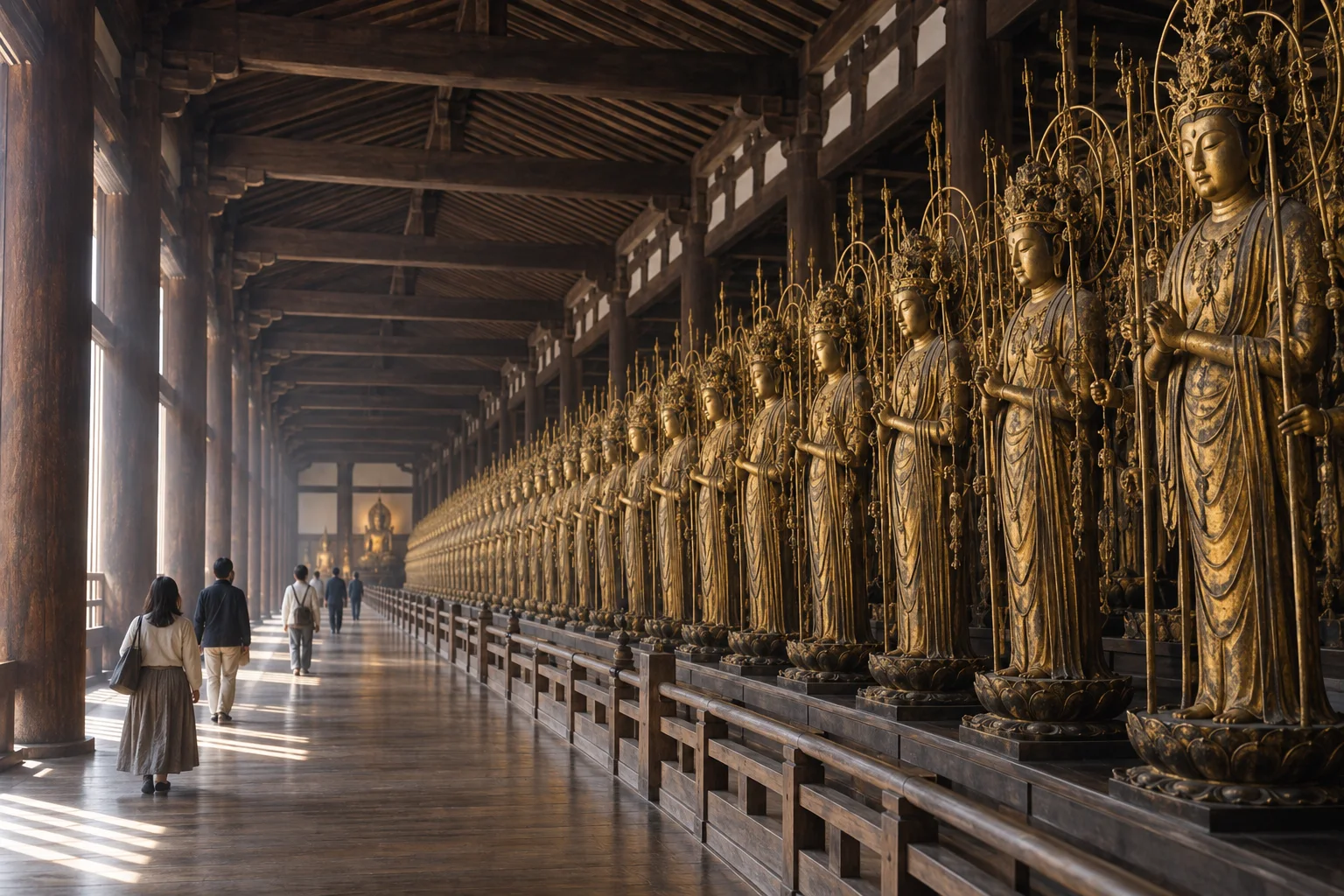
the 120-meter hall in Kyoto holding 1,001 statues of Kannon
三十三間堂(さんじゅうさんげんどう)
In one line
The shortest answer that works
Sanjusangendo is a 120-meter wooden hall in Kyoto holding 1,001 standing statues of Kannon.
三十三間堂は京都にある長さ120メートルの木造のお堂で、千手観音立像が1001体並んでいます。
In 30 seconds
The standard explanation
Sanjusangendo is a single wooden hall in eastern Kyoto, about 120 meters long. Inside, 1,000 gilded statues of the thousand-armed Kannon stand in ten rows, with one large seated Kannon at the center, making 1,001. The hall was founded in 1164 and rebuilt in 1266 after a fire. The name means hall of thirty-three bays, counting the spaces between the pillars inside.
三十三間堂は京都の東にある一棟のお堂で、長さはおよそ120メートルあります。中には金色の千手観音立像が十列に千体並び、中央に大きな坐像が一体あって、あわせて1001体になります。創建は1164年、火災のあと1266年に再建されました。名前は、内陣の柱の間が33あることから来ています。
As a short speech
A full paragraph you can read aloud
Sanjusangendo is one long wooden hall in eastern Kyoto, about a hundred and twenty meters from end to end, and what is inside is difficult to prepare people for. A thousand life-sized gilded statues of Kannon, the bodhisattva of compassion, stand in ten tiered rows, with one larger seated figure in the middle.
Each statue has forty main arms, and each arm was understood to save twenty-five worlds, which is how a thousand arms are counted. They were carved by teams of sculptors in the twelfth and thirteenth centuries, and the faces are not identical.
There is an old saying that you will find the face of someone you have lost among them. The hall was founded in 1164 and rebuilt in 1266 after fire. Photography is not allowed inside, which I think is right. It is a room you look at rather than record.
三十三間堂は京都の東にある一棟の長いお堂で、端から端までおよそ120メートルあります。中にあるものは、前もって説明しにくいものです。等身大の金色の千手観音が十段の列に千体並び、中央に一回り大きな坐像が一体います。
一体につき主要な手が40本あり、一本が25の世界を救うと考えられたので、40×25で千手と数えます。12世紀から13世紀にかけて、仏師の集団によって彫られました。顔は同じではありません。
会いたい人の顔がこの中にある、という言い伝えがあります。創建は1164年、火災のあと1266年に再建されました。堂内は撮影できませんが、それでよいと思います。記録するより、見る部屋です。
Questions people actually ask
And how to answer them.
Are all thousand statues really different?
They are individually carved, not cast from one mold, so the faces do differ. Whether every single one is distinct is hard to verify, but the traditional claim is that no two are the same.
一体ずつ彫られていて、型で作ったものではないので、顔は実際に違います。全部が違うと確かめるのは難しいのですが、同じ顔は一つもないと言い伝えられています。
Why a thousand arms?
The statues actually have forty main arms besides the two joined in front. Each was understood to save twenty-five worlds, so forty times twenty-five equals a thousand. It is a number meaning boundless, not a literal count.
実際は合掌する二手のほかに主要な手が40本あります。一本が25の世界を救うとされ、40かける25で千になります。数えた数ではなく、限りがないことを表す数です。
What is the archery event here?
Since the Edo period, archers have shot arrows down the length of the west veranda. Today it survives as a New Year event where young people in kimono shoot at a target sixty meters away.
江戸時代から、西側の縁の端から端へ矢を射る通し矢が行われてきました。いまは正月の行事として残り、晴れ着の若者が60メートル先の的を射ます。
A common misunderstanding
MYTHThe statues each have a thousand physical arms.
FACTEach has forty main arms plus two joined in prayer. Forty arms times the twenty-five worlds each was said to save gives a thousand.
Phrases you can use
- There are 1,001 statues of Kannon in one hall.一つのお堂に観音像が1001体あります。
- The name means thirty-three bays between the pillars.名前は、柱の間が33あることから来ています。
- They say no two faces are the same.同じ顔は一つもないと言われています。
- Photography isn't allowed inside.堂内は撮影できません。
- In January there's an archery event along the veranda.1月には縁に沿って矢を射る行事があります。
Words you need
- bodhisattva of compassion観音(慈悲の菩薩)
- gilded金箔を押した
- veranda縁(えん)
- bay (between pillars)柱間(はしらま)
- sculptor of Buddhist images仏師
Watch
From YouTubeBackground (Japanese)
正式には蓮華王院本堂という。長寛2年(1164年)に後白河上皇の命で平清盛が造営し、建長元年(1249年)の火災で焼けたあと、文永3年(1266年)に再建された。中央の千手観音坐像は再建時に湛慶が82歳で完成させたものとされる。江戸時代の通し矢では、堂の南端から北端まで約120メートルを昼夜射続け、記録は一昼夜で8000本以上が的に届いたとされる。軒が低いため、矢はほぼ水平に飛ばさなければならなかった。