nihonto
the Japanese sword
日本刀(にほんとう)
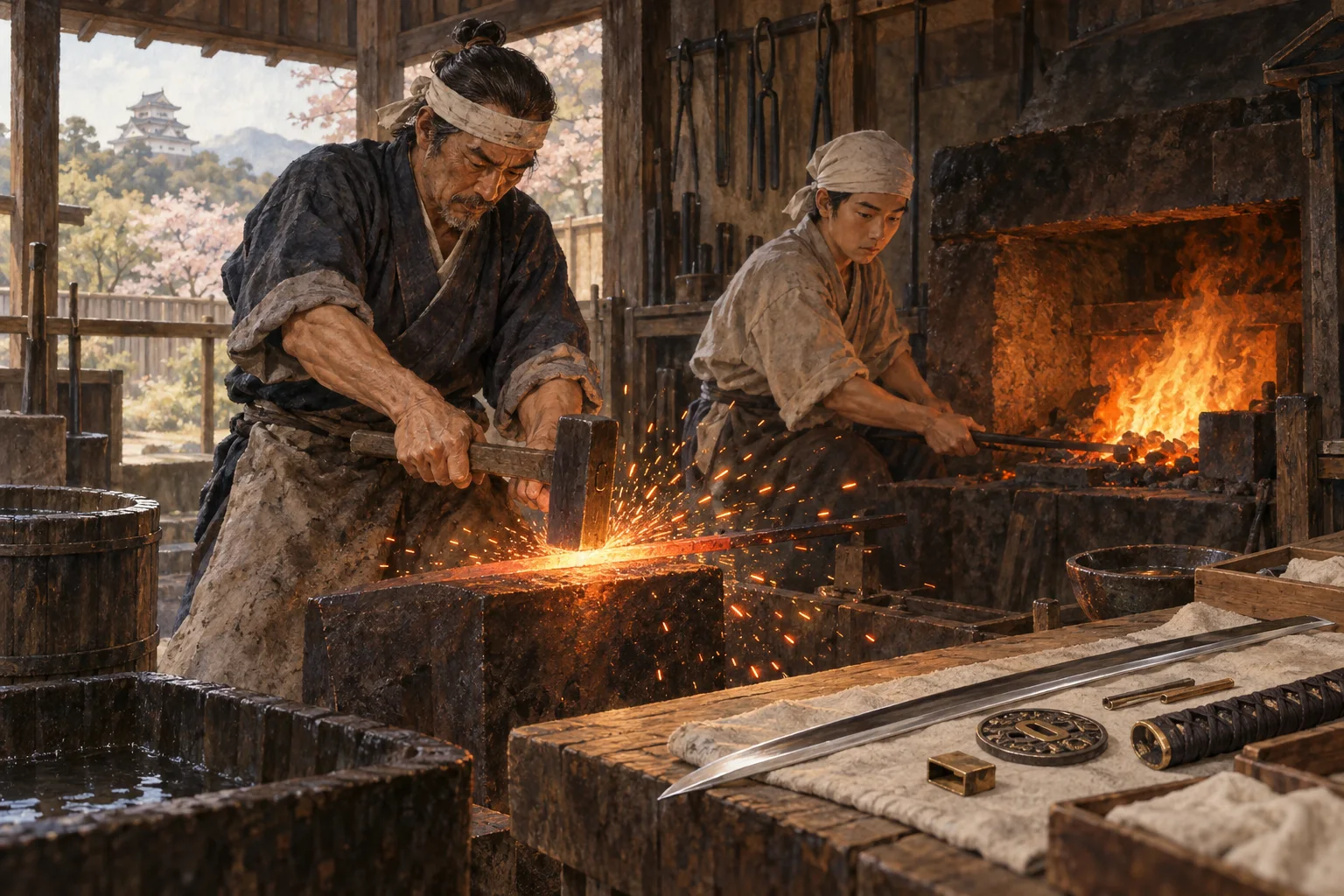
In one line
The shortest answer that works
A nihonto is a Japanese sword, made by combining hard and soft steel so it can be both sharp and resilient.
日本刀は、硬い鋼と軟らかい鋼を組み合わせることで、鋭さと粘りを両立させた刀です。
In 30 seconds
The standard explanation
A Japanese sword is made from tamahagane steel, folded repeatedly during forging and then built from layers of different hardness: a hard edge that holds sharpness and a softer core that absorbs shock. The curve and the wavy temper line come from differential quenching. Swords are legally registered art objects in Japan today.
日本刀は玉鋼から作られ、鍛えるあいだに何度も折り返し、硬さの違う鋼を組み合わせて構成されます。刃は硬く鋭さを保ち、芯は軟らかく衝撃を吸収します。反りと波打つ刃文は、焼き入れの際の冷却の差から生まれます。現在の日本では、刀剣は登録を受けた美術品として扱われます。
As a short speech
A full paragraph you can read aloud
The Japanese sword is admired worldwide, and the most repeated fact about it is also the most misunderstood. People say the steel is folded thousands of times to make it strong. The folding is real, but its main purpose is to even out the carbon content and work out impurities in the raw steel, which was made in a traditional clay furnace and is not uniform.
The real engineering is in combining steels of different hardness: a hard outer layer that takes and holds an edge, and a softer core that absorbs impact so the blade does not shatter. The famous curve is not carved in.
It appears during quenching, when clay of different thickness is painted onto the blade, so the edge cools faster than the spine and the blade bends itself. That same process creates the wavy line along the edge. Today swordsmiths are licensed and limited in how many blades they may make, and every sword must be registered.
日本刀は世界的に評価されていますが、最もよく語られる事実が、同時に最も誤解されています。何千回も折り返して鍛えるから強い、と言われます。折り返しは事実ですが、その主な目的は炭素の量を均一にし、原料の鋼に含まれる不純物を除くことです。
伝統的な炉で作られる玉鋼は均質ではないからです。本当の工夫は、硬さの違う鋼を組み合わせることにあります。刃を取り、保つ硬い外側と、衝撃を吸収して折れを防ぐ軟らかい芯。有名な反りも、削って作るのではありません。
焼き入れのときに現れます。刃と棟で土の厚みを変えて塗るため、刃のほうが速く冷え、刀は自ら曲がるのです。同じ工程が、刃に沿った波形の刃文も生みます。現在、刀鍛冶は免許制で作れる本数にも制限があり、すべての刀に登録が必要です。
Questions people actually ask
And how to answer them.
So why fold the steel at all?
To homogenize it. Traditional tamahagane has uneven carbon and slag, and repeated folding distributes the carbon and drives out impurities. It is refining, not magic.
均質にするためです。伝統的な玉鋼は炭素量が不均一で不純物も含むため、折り返して炭素を行き渡らせ、不純物を追い出します。魔法ではなく、精錬です。
Can I take one home as a souvenir?
A genuine sword requires a registration certificate and an export permit, and the process is strict. Most visitors buy a reproduction instead, which is legal and clearly marked as such.
本物の刀には登録証と輸出許可が必要で、手続きは厳格です。多くの旅行者は模造刀を買います。合法で、模造品であることが明示されています。
Are swords still made today?
Yes, by licensed smiths, as art objects. Each individual blade has to be approved before it is made, and there is a minimum number of forging days, so in practice a smith makes around two dozen a year.
作られています。免許を持つ刀鍛冶が美術品として作ります。一振りごとに事前の承認が必要で、鍛錬日数の基準もあるため、実際に作れるのは年に24振り程度です。
A common misunderstanding
MYTHFolding the steel thousands of times is what makes a katana superior.
FACTFolding refines uneven traditional steel. The performance comes mainly from combining hard and soft steels and from differential quenching.
Phrases you can use
- The folding evens out the steel, rather than adding strength.折り返しは強くするというより、鋼を均一にする工程です。
- A hard edge over a softer core.硬い刃と、軟らかい芯の組み合わせです。
- The curve appears during quenching.反りは焼き入れのときに生まれます。
- That wavy line is the temper line.あの波形の線が刃文です。
- Every sword in Japan has to be registered.日本ではすべての刀に登録が必要です。
Words you need
- blade刀身、刃
- forge (verb)鍛える
- quench焼き入れする
- temper line刃文
- swordsmith刀鍛冶
Watch
From YouTubeBackground (Japanese)
日本刀の原料である玉鋼は、砂鉄と木炭を用いる「たたら製鉄」で作られる。島根県の日刀保たたらが現在も操業し、作刀用の玉鋼を供給している。反りが生まれるのは焼き入れ時で、刃側に薄く棟側に厚く土を置くことで冷却速度に差をつけ、刃側の組織が膨張して刀身が反る。刃文はこの土置きの形によって決まる。銃砲刀剣類所持等取締法により、日本刀は都道府県教育委員会の登録を受けたものだけが所持でき、登録証は刀とともに移動する。作刀も同じ法律により、一振りごとに都道府県教育委員会の承認を受ける必要がある。太刀・刀は15日以上、脇差・短刀は10日以上の鍛錬を経ることが基準とされており、この手続きと日数の縛りによって、実質的に年24振(月2振り)程度が上限になっている。